2 Samuel 1
Berean Standard Bible · Tap a verse to see its cross-references.
About this book
About 2 Samuel
- Easton's Bible Dictionary (1897) says the books of Samuel were probably written by Samuel, Gad, and Nathan. According to that entry, Samuel penned the first twenty-four chapters of the first book; Gad, David's companion, continued the history, and Nathan completed it, probably arranging the whole. The entry gives no date of writing, but says Second Samuel covers perhaps fifty years, the reign of David.Sources: Easton: Samuel, Books of
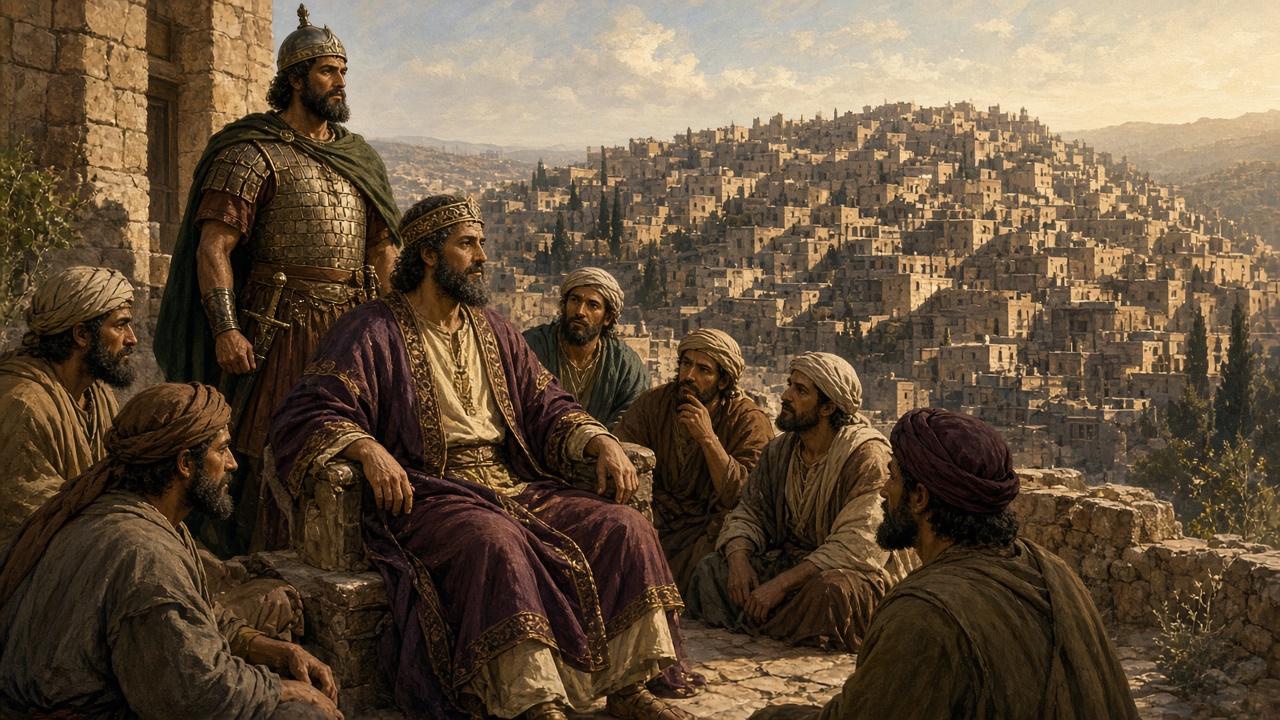
- After Saul's death, David was made king over Judah and reigned in Hebron, while Abner, commander of Saul's army, had Ish-bosheth proclaimed king. Ish-bosheth reigned at Mahanaim, beyond the Jordan, and a state of war existed between the two kings. Joab, captain of the host throughout David's reign, led the assault on the fortress on Mount Zion in Jerusalem and for that service was raised to the rank of prince of the king's army.Sources: Abner · Mahanaim · Joab · Jerusalem
- Easton describes 2 Samuel as a history of David's reign, mainly in its political aspects: over Judah in chapters 1-4, and over all Israel in chapters 5-24. The last four chapters are treated as a sort of appendix, recording various events but not in chronological order. The books are not complete histories; frequent gaps appear because, in Easton's view, their aim is the gradual development of the kingdom of God rather than a full account of each reign.Sources: Easton: Samuel, Books of
- The Septuagint translators regarded the books of Samuel and of Kings as one continuous history, which they divided into four books called the Books of the Kingdom. The Vulgate followed this division but named them the Books of the Kings, so the books called First and Second Samuel in modern Protestant versions were the First and Second Books of Kings. Easton also notes that the account of David's sin in the matter of Bathsheba, in 2 Samuel 11:2-12:29, is omitted from the corresponding passage in 1 Chronicles 20.Sources: Easton: Samuel, Books of
Notes written with AI assistance from open sources (Theographic Bible Metadata, CC BY-SA 4.0; Easton’s Bible Dictionary, public domain) and reviewed before publishing.
Saul’s Death Reported to David
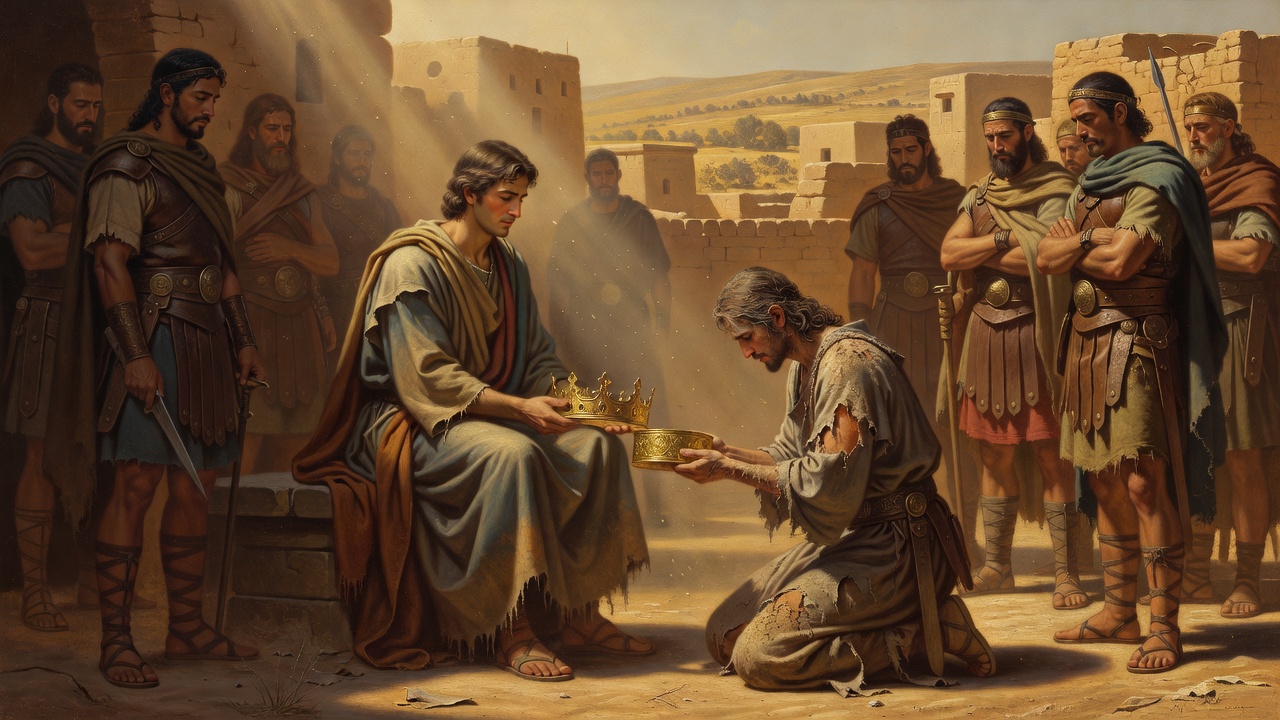
1After the death of Saul, David returned from the slaughter of the Amalekites and stayed in Ziklag two days. 2On the third day a man with torn clothes and dust on his head arrived from Saul’s camp. When he came to David, he fell to the ground to pay him homage.
3“Where have you come from?” David asked.
“I have escaped from the Israelite camp,” he replied.
4“What was the outcome?” David asked. “Please tell me.”
“The troops fled from the battle,” he replied. “Many of them fell and died. And Saul and his son Jonathan are also dead.”
5Then David asked the young man who had brought him the report, “How do you know that Saul and his son Jonathan are dead?”
6“I happened to be on Mount Gilboa,” he replied, “and there was Saul, leaning on his spear, with the chariots and the cavalry closing in on him. 7When he turned around and saw me, he called out and I answered, ‘Here I am!’
8‘Who are you?’ he asked.
So I told him, ‘I am an Amalekite.’
9Then he begged me, ‘Stand over me and kill me, for agony has seized me, but my life still lingers.’
10So I stood over him and killed him, because I knew that after he had fallen he could not survive. And I took the crown that was on his head and the band that was on his arm, and I have brought them here to my lord.”
11Then David took hold of his own clothes and tore them, and all the men who were with him did the same. 12They mourned and wept and fasted until evening for Saul and his son Jonathan, and for the people of the LORD and the house of Israel, because they had fallen by the sword.
13And David inquired of the young man who had brought him the report, “Where are you from?”
“I am the son of a foreigner,” he answered. “I am an Amalekite.”
14So David asked him, “Why were you not afraid to lift your hand to destroy the LORD’s anointed?” 15Then David summoned one of the young men and said, “Go, execute him!” So the young man struck him down, and he died. 16For David had said to the Amalekite, “Your blood be on your own head because your own mouth has testified against you, saying, ‘I killed the LORD’s anointed.’”
David’s Song for Saul and Jonathan
17Then David took up this lament for Saul and his son Jonathan, 18and he ordered that the sons of Judah be taught the Song of the Bow. It is written in the Book of Jashar:
19“Your glory, O Israel, lies slain on your heights.
How the mighty have fallen!
20Tell it not in Gath;
proclaim it not in the streets of Ashkelon,
lest the daughters of the Philistines rejoice,
and the daughters of the uncircumcised exult.
21O mountains of Gilboa,
may you have no dew or rain,
no fields yielding offerings of grain.
For there the shield of the mighty was defiled,
the shield of Saul, no longer anointed with oil.
22From the blood of the slain,
from the fat of the mighty,
the bow of Jonathan did not retreat,
and the sword of Saul did not return empty.
23Saul and Jonathan, beloved and delightful in life,
were not divided in death.
They were swifter than eagles,
they were stronger than lions.
24O daughters of Israel,
weep for Saul,
who clothed you in scarlet and luxury,
who decked your garments with ornaments of gold.
25How the mighty have fallen in the thick of battle!
Jonathan lies slain on your heights.
26I grieve for you, Jonathan, my brother.
You were delightful to me;
your love to me was extraordinary,
surpassing the love of women.
27How the mighty have fallen
and the weapons of war have perished!”
Did you know?
David Laments Saul and Jonathan
- David ordered that the people of Judah be taught his lament for Saul and Jonathan, referred to as the Song of the Bow. This poetic dirge was recorded in the Book of Jashar, an ancient collection of songs celebrating notable Israelite leaders and events.Sources: Jasher · the Bible text itself
- In his lament, David pleaded that the disaster not be proclaimed in Gath or in the streets of Ashkelon, two prominent Philistine cities. He mourned that news of the defeat on Mount Gilboa would cause the daughters of the Philistines to celebrate over Israel's fallen leaders.Sources: Gath · Ashkelon · the Bible text itself
- David received the report of Saul's death while residing at Ziklag, a town in the Negeb that had been given to him by the Philistine king of Gath. The messenger brought Saul's royal crown and armlet directly to David after the battle on Mount Gilboa.Sources: Ziklag · the Bible text itself
Notes written with AI assistance from open sources (Theographic Bible Metadata, CC BY-SA 4.0; Easton’s Bible Dictionary, public domain) and reviewed before publishing.
Places in this chapter
- Mount Gilboa · 32.434, 35.414 · verses 6, 21
- Ashkelon · Today: Tel Ashkelon · 31.664, 34.546 · verse 20
Only places identified with high confidence are shown (90% or more according to the scholarly sources compiled by OpenBible). Period map: DARE (Digital Atlas of the Roman Empire), CC BY 4.0; modern map: © OpenStreetMap contributors; places: OpenBible.info (CC BY 4.0).
Credits and license for this translation
Berean Standard Bible
The Holy Bible in English: Berean Standard Bible
Public Domain
Language: English
Contributor: BSB Publishing, LLC
2026-10-02
Source: http://ebible.org/engbsb/ · eBible.org