Exodus 7
Wycliffe Bible · Tap a verse to see its cross-references.
God Commands Moses and Aaron
1And the Lord seide to Moises, Lo! Y haue maad thee the god of Farao; and Aaron, thi brother, schal be thi prophete. 2Thou schalt speke to Aaron alle thingis whiche Y comaunde to thee, and he schal speke to Farao, that he delyuere the sones of Israel fro his hond. 3But Y schal make hard his herte, and Y schal multiplie my signes and merueils in the lond of Egipt, and he schal not here you; 4and Y schal sende myn hond on Egipt, and Y schal lede out myn oost, and my puple, the sones of Israel, fro the lond of Egipt bi mooste domes; 5and Egipcians schulen wite, that Y am the Lord, which haue holde forth myn hond on Egipt, and haue led out of the myddis of hem the sones of Israel. 6And so Moises dide and Aaron; as the Lord comaundide, so thei diden. 7Forsothe Moyses was of fourescoor yeer, and Aaron was of fourescoor yeer and thre, whanne thei spaken to Farao.
Aaron’s Staff
8And the Lord seide to Moises and to Aaron, 9Whanne Farao schal seie to you, Schewe ye signes to vs, thou schalt seie to Aaron, Take thi yerde, and caste forth it before Farao, and be it turned into a serpent. 10And so Moises and Aaron entriden to Farao, and diden as the Lord comaundide; and Aaron took the yeerde, and castide forth bifore Farao and hise seruauntis, which yerde was turned in to a serpent. 11Forsothe Farao clepide wise men, and witchis, and thei also diden bi enchauntementis of Egipt, and bi summe priuy thingis in lijk maner; 12and alle castiden forth her yerdis, whiche weren turned in to dragouns; but the yerde of Aaron deuouride `the yerdis of hem. 13And the herte of Farao was maad hard, and he herde not hem, as the Lord comaundide.
The First Plague: Blood
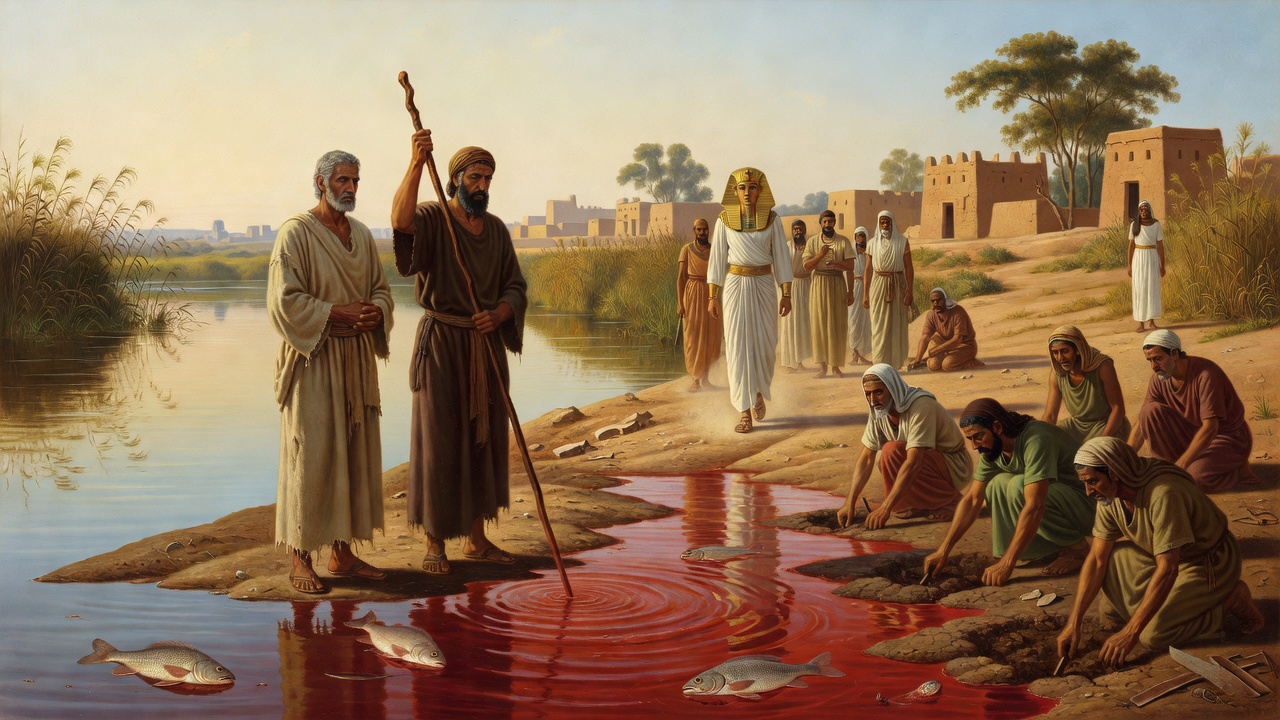
14Forsothe the Lord seide to Moyses, The herte of Farao is maad greuouse, he nyle delyuere the puple; 15go thou to hym eerli; lo! he schal go out to the watris, and thou schalt stonde in the comyng of hym on the brynke of the flood; and thou schalt take in thin honde the yerde, that was turned into a dragoun, 16and thou schalt seie to hym, The Lord God of Ebrews sente me to thee, and seide, Delyuere thou my puple, that it make sacrifice to me in desert; til to present time thou noldist here. 17Therfor the Lord seith these thingis, In this thou schalt wite, that Y am the Lord; lo! Y schal smyte with the yerde, which is in myn hond, the watir of the flood, and it schal be turned in to blood; 18and the fischis that ben in the flood schulen die; and the watris schulen wexe rotun, and Egipcians drynkynge the watir of the flood schulen be turmentid. 19Also the Lord seide to Moises, Seie thou to Aaron, Take thi yerde, and holde forth thin hond on the watris of Egipt, and on the flodis of hem, and on the stremys `of hem, and on the mareis, and alle lakis of watris, that tho be turned in to blood; and blood be in al the lond of Egipt, as wel in vessils of tree as of stoon. 20And Moises and Aaron diden so, as the Lord comaundide; and Aaron reiside the yerde, and smoot the watir of the flood bifore Farao and hise seruauntis, which watir was turned in to blood; 21and fischis, that weren in the flood, dieden; and the flood was rotun, and Egipcians myyten not drynke the water of the flood; and blood was in al the lond of Egipt. 22And the witchis of Egipcians diden in lijk maner by her enchauntementis; and the herte of Farao was maad hard, and he herde not hem, as the Lord comaundide. 23And he turnede awei hym silf, and entride in to his hows, nethir he took it to herte, yhe, in this tyme. 24Forsothe alle Egipcians diggiden watir `bi the cumpas of the flood, to drinke; for thei myyten not drynke of the `watir of the flood. 25And seuene daies weren fillid, aftir that the Lord smoot the flood.
Did you know?
Moses and Aaron before Pharaoh
- Moses was eighty years old and Aaron eighty-three when they spoke to Pharaoh. Easton's Bible Dictionary (1897) notes that Aaron, the eldest son of Amram and Jochebed, was born in Egypt three years before his brother Moses. In this chapter the LORD says he has made Moses "like God to Pharaoh," with Aaron as his prophet: Moses is to speak all that he is commanded, and Aaron is to tell Pharaoh to let the Israelites leave his land.Sources: the Bible text itself · Aaron
- Easton's Bible Dictionary (1897) notes that the name Nile is not found in Scripture; the Old Testament calls that river Sihor, "the black stream," or simply "the river," and also "the flood of Egypt." The Nile is formed by the White Nile and the Blue Nile, which meet at Khartoum, and it is the water Aaron strikes in this chapter. The fish died, the river stank, the Egyptians could not drink it and dug around the Nile for water, and seven full days passed.Sources: Nile · the Bible text itself
- Easton's Bible Dictionary (1897) says the Pharaoh of the Exodus was probably Menephtah I, the fourteenth and eldest surviving son of Rameses II, and that he resided at Zoan, where he had the interviews with Moses and Aaron recorded in Exodus. The same entry leaves the identification open: it is still a question whether Seti II or his father Menephtah was that Pharaoh, and some think the evidence favors Seti II.Sources: Pharaoh (of the Exodus) · the Bible text itself
Notes written with AI assistance from open sources (Theographic Bible Metadata, CC BY-SA 4.0; Easton’s Bible Dictionary, public domain) and reviewed before publishing.
Places in this chapter
- Egypt · 30.129, 31.308 · verses 3, 4, 5, 11, 19, 21, 22
- Nile · Today: Nile River · 31.465, 30.367 · verses 15, 17, 18, 20, 21, 24, 25
Only places identified with high confidence are shown (90% or more according to the scholarly sources compiled by OpenBible). Period map: DARE (Digital Atlas of the Roman Empire), CC BY 4.0; modern map: © OpenStreetMap contributors; places: OpenBible.info (CC BY 4.0).
Credits and license for this translation
Wycliffe Bible
This is the Pentateuch and Gospels from The Holy Bible, containing the Old and New Testaments, with the apocryphal books, in the earliest English version made from the latin Vulgate by John Wycliffe and his followers. c.1395
Public Domain
Language: Middle English (English)
Dialect: Middle
Translation by: John Wycliffe
2016-11-08
Section headings adapted from the Berean Standard Bible (public domain); they are not part of this translation’s text.
Source: http://ebible.org/engWycliffe/ · eBible.org