Êxodo 7
Wycliffe Bible · Toque num versículo para ver as referências cruzadas.
God Commands Moses and Aaron
1And the Lord seide to Moises, Lo! Y haue maad thee the god of Farao; and Aaron, thi brother, schal be thi prophete. 2Thou schalt speke to Aaron alle thingis whiche Y comaunde to thee, and he schal speke to Farao, that he delyuere the sones of Israel fro his hond. 3But Y schal make hard his herte, and Y schal multiplie my signes and merueils in the lond of Egipt, and he schal not here you; 4and Y schal sende myn hond on Egipt, and Y schal lede out myn oost, and my puple, the sones of Israel, fro the lond of Egipt bi mooste domes; 5and Egipcians schulen wite, that Y am the Lord, which haue holde forth myn hond on Egipt, and haue led out of the myddis of hem the sones of Israel. 6And so Moises dide and Aaron; as the Lord comaundide, so thei diden. 7Forsothe Moyses was of fourescoor yeer, and Aaron was of fourescoor yeer and thre, whanne thei spaken to Farao.
Aaron’s Staff
8And the Lord seide to Moises and to Aaron, 9Whanne Farao schal seie to you, Schewe ye signes to vs, thou schalt seie to Aaron, Take thi yerde, and caste forth it before Farao, and be it turned into a serpent. 10And so Moises and Aaron entriden to Farao, and diden as the Lord comaundide; and Aaron took the yeerde, and castide forth bifore Farao and hise seruauntis, which yerde was turned in to a serpent. 11Forsothe Farao clepide wise men, and witchis, and thei also diden bi enchauntementis of Egipt, and bi summe priuy thingis in lijk maner; 12and alle castiden forth her yerdis, whiche weren turned in to dragouns; but the yerde of Aaron deuouride `the yerdis of hem. 13And the herte of Farao was maad hard, and he herde not hem, as the Lord comaundide.
The First Plague: Blood
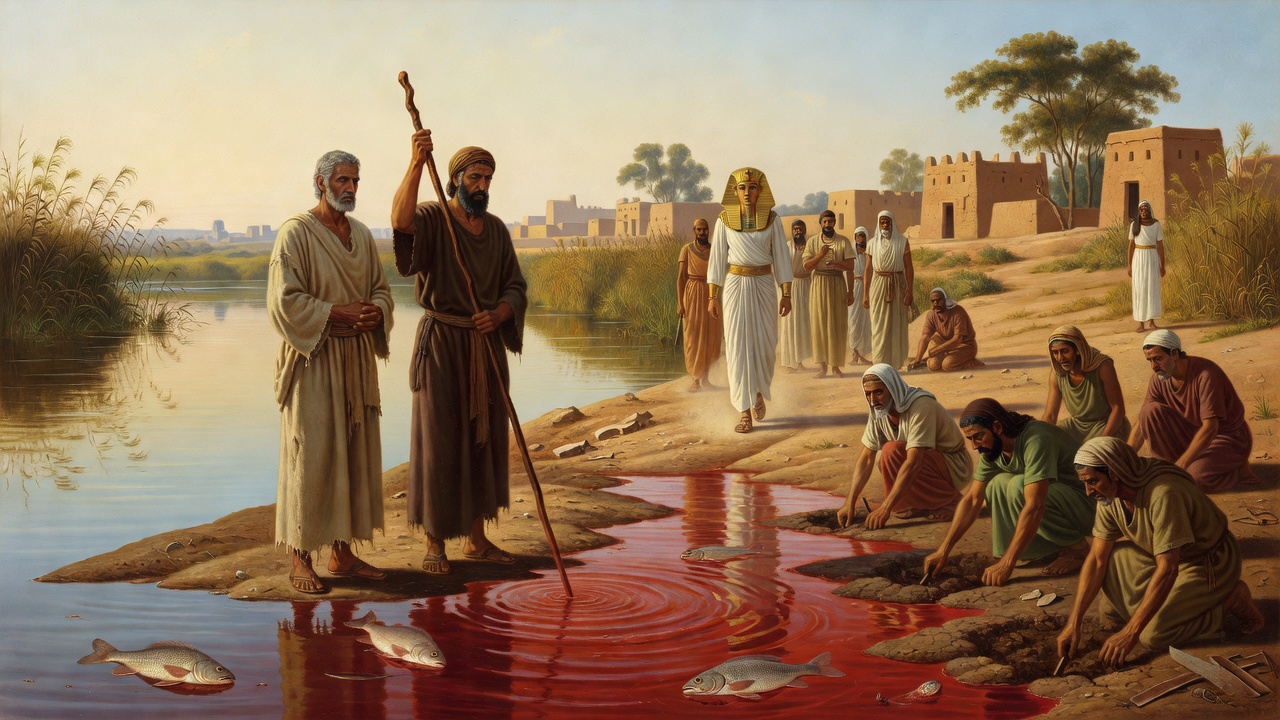
14Forsothe the Lord seide to Moyses, The herte of Farao is maad greuouse, he nyle delyuere the puple; 15go thou to hym eerli; lo! he schal go out to the watris, and thou schalt stonde in the comyng of hym on the brynke of the flood; and thou schalt take in thin honde the yerde, that was turned into a dragoun, 16and thou schalt seie to hym, The Lord God of Ebrews sente me to thee, and seide, Delyuere thou my puple, that it make sacrifice to me in desert; til to present time thou noldist here. 17Therfor the Lord seith these thingis, In this thou schalt wite, that Y am the Lord; lo! Y schal smyte with the yerde, which is in myn hond, the watir of the flood, and it schal be turned in to blood; 18and the fischis that ben in the flood schulen die; and the watris schulen wexe rotun, and Egipcians drynkynge the watir of the flood schulen be turmentid. 19Also the Lord seide to Moises, Seie thou to Aaron, Take thi yerde, and holde forth thin hond on the watris of Egipt, and on the flodis of hem, and on the stremys `of hem, and on the mareis, and alle lakis of watris, that tho be turned in to blood; and blood be in al the lond of Egipt, as wel in vessils of tree as of stoon. 20And Moises and Aaron diden so, as the Lord comaundide; and Aaron reiside the yerde, and smoot the watir of the flood bifore Farao and hise seruauntis, which watir was turned in to blood; 21and fischis, that weren in the flood, dieden; and the flood was rotun, and Egipcians myyten not drynke the water of the flood; and blood was in al the lond of Egipt. 22And the witchis of Egipcians diden in lijk maner by her enchauntementis; and the herte of Farao was maad hard, and he herde not hem, as the Lord comaundide. 23And he turnede awei hym silf, and entride in to his hows, nethir he took it to herte, yhe, in this tyme. 24Forsothe alle Egipcians diggiden watir `bi the cumpas of the flood, to drinke; for thei myyten not drynke of the `watir of the flood. 25And seuene daies weren fillid, aftir that the Lord smoot the flood.
Você sabia?
Moisés e Arão diante do faraó
- Moisés tinha oitenta anos e Arão oitenta e três quando falaram ao faraó. O Easton's Bible Dictionary (1897) observa que Arão, o filho mais velho de Anrão e Joquebede, nasceu no Egito três anos antes de seu irmão Moisés. Neste capítulo, o SENHOR diz que fez Moisés "como Deus para o faraó", e que Arão será seu profeta: Moisés deve falar tudo o que lhe for ordenado, e Arão deve dizer ao faraó que deixe os israelitas sair de sua terra.Fontes: o próprio texto bíblico · Aaron
- O Easton's Bible Dictionary (1897) observa que o nome Nilo não se encontra nas Escrituras; o Antigo Testamento chama esse rio de Sihor, "a corrente negra", ou simplesmente "o rio", e também "a inundação do Egito". O Nilo é formado pelo Nilo Branco e pelo Nilo Azul, que se encontram em Cartum, e é essa a água que Arão fere neste capítulo. Os peixes morreram, o rio cheirou mal, os egípcios não puderam bebê-la e cavaram ao redor do Nilo em busca de água, e passaram-se sete dias completos.Fontes: Nile · o próprio texto bíblico
- O Easton's Bible Dictionary (1897) diz que o faraó do Êxodo foi provavelmente Menephtah I, o décimo quarto e mais velho filho sobrevivente de Rameses II, e que ele residia em Zoan, onde teve as entrevistas com Moisés e Arão registradas em Êxodo. O mesmo verbete deixa a identificação em aberto: ainda é uma questão se Seti II ou seu pai Menephtah foi esse faraó, e alguns acham que as evidências favorecem Seti II.Fontes: Pharaoh (of the Exodus) · o próprio texto bíblico
Notas escritas com auxílio de IA a partir de fontes abertas (Theographic Bible Metadata, CC BY-SA 4.0; Easton’s Bible Dictionary, domínio público) e revisadas antes de publicar.
Lugares deste capítulo
- Egypt · 30.129, 31.308 · versículos 3, 4, 5, 11, 19, 21, 22
- Nile · Hoje: Nile River · 31.465, 30.367 · versículos 15, 17, 18, 20, 21, 24, 25
Só aparecem lugares com identificação de alta confiança (90% ou mais segundo as fontes acadêmicas reunidas pelo OpenBible). Mapa da época: DARE (Digital Atlas of the Roman Empire), CC BY 4.0; mapa atual: © colaboradores do OpenStreetMap; lugares: OpenBible.info (CC BY 4.0).
Créditos e licença desta tradução
Wycliffe Bible
This is the Pentateuch and Gospels from The Holy Bible, containing the Old and New Testaments, with the apocryphal books, in the earliest English version made from the latin Vulgate by John Wycliffe and his followers. c.1395
Public Domain
Language: Middle English (English)
Dialect: Middle
Translation by: John Wycliffe
2016-11-08
Títulos de seção adaptados da Berean Standard Bible (domínio público); não fazem parte do texto bíblico desta tradução.
Fonte: http://ebible.org/engWycliffe/ · eBible.org