Exodus 8
Wycliffe Bible · Tap a verse to see its cross-references.
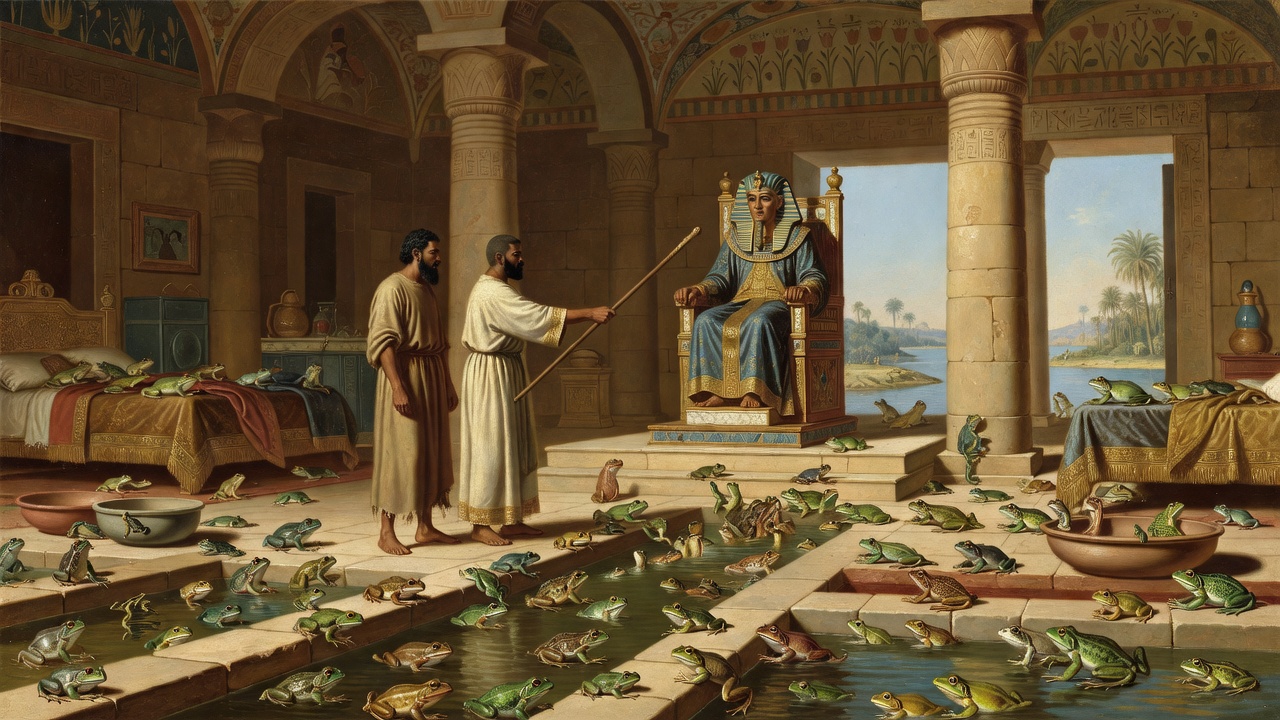
The Second Plague: Frogs
1Also the Lord seide to Moises, Entre thou to Farao, and thou schalt seie to hym, The Lord seith these thingis, Delyuere thou my puple, that it make sacrifice to me; sotheli if thou nylt delyuere, lo! 2Y schal smyte alle thi termys with paddoks; 3and the flood schal buyle out paddokis, that schulen stie, and schulen entre in to thin hows, and in to the closet of thi bed, and on thi bed, and in to `the hous of thi seruauntis, and in to thi puple, and in to thin ouenes, and in to the relyues of thi metis; 4and the paddoks schulen entre to thee, and to thi puple, and to alle thi seruauntis. 5And the Lord seide to Moises, Seie thou to Aaron, Hold forth thin hond on the floodis, and on the streemes, and mareis; and bryng out paddoks on the lond of Egipt. 6And Aaron helde forth the hond on the watris of Egipt; and paddoks stieden, and hileden the lond of Egipt. 7Forsothe and the witchis diden in lijk maner bi her enchauntementis; and thei brouyten forth paddoks on the lond of Egipt. 8Forsothe Farao clepide Moises and Aaron, and seide to hem, Preie ye the Lord, that he do a wei the paddoks fro me, and fro my puple; and Y schal delyuere the puple, that it make sacrifice to the Lord. 9And Moises seide to Farao, Ordeyne thou a tyme to me, whanne Y schal preie for thee, and for thi seruauntis, and for thi puple, that the paddokis be dryuun awei fro thee, and fro thin hows, and fro thi seruauntis, and fro thi puple; and dwelle oneli in the flood. 10And he answeride, To morewe. And Moises seide, Y schal do bi thi word, that thou wite, that noon is as oure Lord God; and the paddoks schulen go awei fro thee, 11and fro thin hous, and fro thi children, and fro thi seruauntis, and fro thi puple; and tho schulen dwelle oneli in the flood. 12And Moises and Aaron yeden out fro Farao. And Moises criede to the Lord, for the biheest of paddoks, which he hadde seid to Farao. 13And the Lord dide bi the word of Moises; and the paddoks weren deed fro housis, and fro townes, and fro feeldis; 14and thei gaderiden tho in to grete heepis, and the lond was rotun. 15Sotheli Farao seiy that reste was youun, and he made greuous his herte, and herde not hem, as the Lord comaundide.
The Third Plague: Gnats
16And the Lord seide to Moises, Spek thou to Aaron, Holde forth thi yerde, and smyte the dust of erthe, and litle flies, ether gnattis, be in al the lond of Egipt. 17And thei diden so; and Aaron helde forth the hond, and helde the yerde, and smoot the duste of erthe; and gnattis weren maad in men, and in werk beestis; al the dust of erthe was turned in to gnattis bi al the lond of Egipt. 18And witchis diden in lijk maner bi her enchauntementis, that thei schulden brynge forth gnattis, and thei miyten not; and gnattis weren as wel in men as in werk beestis. 19And the witchis seiden to Farao, This is the fyngur of God. And the herte of Farao was maad hard, and he herde not hem, as the Lord comaundide.
The Fourth Plague: Flies
20And the Lord seide to Moises, Rise thou eerli, and stonde bifore Farao, for he schal go out to the watris; and thou schalt seie to hym, The Lord seith these thingis, Delyuere thou my puple, that it make sacrifice to me; 21that if thou schalt not delyuere the puple, lo! Y schal sende in to thee, and in to thi seruauntis, and in to thi puple, and in to thin housis, al the kynde of flies ; and the housis of Egipcians schulen be fillid with flies of dyuerse kyndis, and al the lond in which thei schulen be. 22And in that dai Y schal make wondurful the lond of Gessen, in which my puple is, that flies be not there; and that thou wite that Y am the Lord in the myddis of erthe; 23and Y schal sette departyng bitwixe my puple and thi puple; this signe schal be to morewe. 24And the Lord dide so. And a moost greuouse flie cam in to the hows of Farao, and of hise seruauntis, and in to al the lond of Egipt; and the lond was corrupt of siche flies. 25And Farao clepide Moises and Aaron, and seide to hem, Go ye, make ye sacrifice to `youre Lord God in this lond. 26And Moises seide, It may not be so, for `we schulen offre to oure God the abhomynaciouns of Egipcians; that if we schulen sle bifore Egipcians tho thingis whiche thei worschipen, thei schulen `ouerleie vs with stoonus. 27We schulen go the weie of thre daies in to wildirnesse, and we schulen make sacrifice to oure Lord God, as he comaundide vs. 28And Farao seide, Y schal delyuere you, that ye make sacrifice to `youre Lord God in deseert; netheles go ye not ferthere; preie ye for me. 29And Moises seide, Y schal go out fro thee, and Y schal preie the Lord; and the fli schal go awei fro Farao, and fro hise seruauntis, and puple to morewe; netheles nyle thou more disseyue me, that thou delyuere not the puple to make sacrifice to the Lord. 30And Moises yede out fro Farao, and preiede the Lord, whiche dide bi the word of Moyses, 31and took awei flies fro Farao, and fro hise seruauntis, and puple; noon lefte, `sotheli nether oon. 32And the herte of Farao was maad hard, so that he delyueride not the puple, sothli nethir in this tyme.
Did you know?
Three Plagues on Egypt
- The frogs of this chapter swarm up from the Nile, a name the Old Testament does not use. Easton's Bible Dictionary says the river appears as Sihor, “the black stream,” or simply “the river,” and that the White Nile and the Blue Nile unite at Khartoum, then run 1,800 miles and enter the Mediterranean through two branches. Aaron stretches his staff over the rivers, canals, and ponds, and the frogs cover the land of Egypt.Sources: Nile · the Bible text itself
- When flies fill the houses of the Egyptians and ruin the land, the chapter says none will be found in Goshen, where the Israelites live, as a distinction between the two peoples. Easton's Bible Dictionary describes Goshen as a district east of the Nile, apparently not far from the royal residence, also called the land of Rameses because Pithom and Rameses lay within its borders, and it also links the district with Zoan, or Tanis. The same entry calls it “the best of the land.”Sources: Goshen · the Bible text itself
- Moses and Aaron speak with Pharaoh in person. Easton's Bible Dictionary (1897) places the Pharaoh of the Exodus at Zoan, the setting of his interviews with them recorded in Exodus, but leaves his identity an open question between Menephtah, called there the fourteenth and eldest surviving son of Rameses II, and Seti II, adding that some think the evidence favors Seti II.Sources: Pharaoh (of the Exodus) · the Bible text itself
Notes written with AI assistance from open sources (Theographic Bible Metadata, CC BY-SA 4.0; Easton’s Bible Dictionary, public domain) and reviewed before publishing.
Places in this chapter
- Nile · Today: Nile River · 31.465, 30.367 · verses 3, 9, 11
- Egypt · 30.129, 31.308 · verses 5, 6, 7, 16, 17, 21, 24
- Goshen · Today: Goshen 1 · 30.799, 31.834 · verse 22
Only places identified with high confidence are shown (90% or more according to the scholarly sources compiled by OpenBible). Period map: DARE (Digital Atlas of the Roman Empire), CC BY 4.0; modern map: © OpenStreetMap contributors; places: OpenBible.info (CC BY 4.0).
Credits and license for this translation
Wycliffe Bible
This is the Pentateuch and Gospels from The Holy Bible, containing the Old and New Testaments, with the apocryphal books, in the earliest English version made from the latin Vulgate by John Wycliffe and his followers. c.1395
Public Domain
Language: Middle English (English)
Dialect: Middle
Translation by: John Wycliffe
2016-11-08
Section headings adapted from the Berean Standard Bible (public domain); they are not part of this translation’s text.
Source: http://ebible.org/engWycliffe/ · eBible.org