Genesis 3
Chiga Tevaen'Jema Atesuja 1, Aisheve Caña'cho · Tap a verse to see its cross-references.
A'i egae tson'fa'cho
1Nane canjansi tsu poi Na'su Chiga agattoen'cho tsampini canseqque'suma ti'tsse injama'pa'can. Canjansija jipa pushesuma iñajampaña:
—¿Ñoa'me ti Chigaja jombachoccu'su quini'cco nama añe se'pi?
2Iñajampañasi pushesuja su:
—Jombachoccu'su quini'cco namajan añe gi osha'fa. 3Tsa'ma tsa jombachoccumbe enttinge'su quini'cco nameñi tsu Chigaja añe se'pi. Ni pporaeñe'qque tsu se'pi. Nane tsa'caen tson'da gi pa'faya.
4Tsa'ma canjansija pushesuma su:
—Ñoa'me paya'bi qui. 5Nane Chiga tsu atesu que'ija tsama an'da qui ñotsse injiengepa Chiga'caen osha'cho majan ñotssia, majan egave atesu'faya.
6Pushesuja tsama pañamba quini'ccoma camba ñotssi tsu qquen in'jan. Toya'caen tsambe na ñotssia anqque'susi an'da ñotssiave toya'caen egave'qque atesuye qquen in'jamba nama pishopa an. Amba faesuma pishopa tise tsa'ndunga afe. Afesi tise'qque an. 7Amba, tso'fe fettayeqquia'caen, injama'choni tisupa chu'cco can'jen'choma in'jamba ansange'fa. Ansangepa higuera ccaquejema anchon setsaemba tise'pa ai'vonga tandamba picco'fa.
8Tsonsi sime tayo tumbiansi Na'su Chiga Quitsaja andenga andepa jombachoccu'ye tsui ja'je. Tsandie, pushesu tisema pañamba jombachoccu sheque'chombe enttingenga a'tu'fa, Na'su Chiga tise'pama attesa'ne. 9Tsa'ma Na'su Chiga Quitsaja tsandiema ttu'sepa su:
—¿Mani qui can'jen?
10Tsandieja su:
—Que jombachoccunga pasia'je'choma pañamba gi chu'cco can'jemba dyopa a'tu'fa.
11Tsonsi Chigaja su:
—¿Majan tsu que'inga conda chu'cco can'jen'chove? ¿An'fa ti qui ña se'pi'cho quini'cco'su tetachoma?
12A'ija pañamba su:
—Que ñanga afe'cho pushesu tsu tsa quini'cco'su nama ñanga afesi gi an.
13Tsonsi Na'su Chiga Quitsaja pushesuma iñajampaña:
—¿Jongoesie qui tsa'caen tson?
Pushesuja su:
—Canjansi ñama afopoensi gi an.
14Tsonsi Na'su Chigaja canjansima su:
—Queja tsa'caen egae tsincomba qui poiyi'cco aiña'cho vaura'can'ma, poiyi'cco tsampini canse'chondeccuma bove me'detsse vanaña. Nane tisu injamáccui'ccu qui mangú jacamba andema amba canseya. 15Toya'caen queja pushesui'ccu chi'gaccopa iyicco'fasi tsu que dushundeccu'qque tise dushundeccui'ccu chi'gaccopa iyicco'faya. Nane tsambe du'shu tsu que tsove'ye tsui sapiaña. Tsa'ma queja tise tsutuccu'choma sinttuya.
16Tsomba Chigaja pushesuma su:
—Ja'ño gi ti'tsse quema vanaeña cuintsu vanamba du'shuma isuye. Nane ti'tsse aiye'jepa qui dushundeccuma isuya. Tsa'ma que tsa'nduma ñotsse in'jamba qui tisema pañaña. Tise tsu quema mandaya.
17Tsomba Chigaja tsandie, Adánma su:
—Queja que pushema pañamba ña se'pi'cho quini'cco'su nama ansi gi quema'qque vanaeña. Nane andema egae tsonsi ñotsse sho'yombisi qui paya'ngae vanamba semamba que anqque'suma taipa aña. 18Ñoa'me tsu nopa'siyi atapaya. Tsa'cansi qui vanamba tta'ttapa aqquia sho'yo'cho tetachoma taipa an'faya. 19Poipa'sui'ccu quian'me semamba qui que cui'ccuma cu'i'faya. Nane papa queve ñoña'cho andeve ccase daya'ngae qui tsa'caen vana'jeña. Nane andema ñoña'chopa qui ccase andeve daya.
20Tsonsi tsandie, Adán, tise pushema inisian Evave. Nane tiseja poi a'imbe chaña'si tsa'caen inisian. 21Tsomba Na'su Chiga Quitsa tise'pama ondiqquian. Nane ttonoma ondiccu'jeve ñoñamba tsandie, tise pushema'qque ondiqquian. 22Ondiqquiamba asi'ttaemba su:
—Ja'ño tsu a'ija ingi'caeñi da. Nane pa'cco ñotssia, pa'cco egave tsu atesu. ¿Jongoesu tsu tisema se'piya tsa Cansiaña'cho Quini'cco'su nama'qque añe? Tsama an'choecan'da tsu tsangae canseye'can.
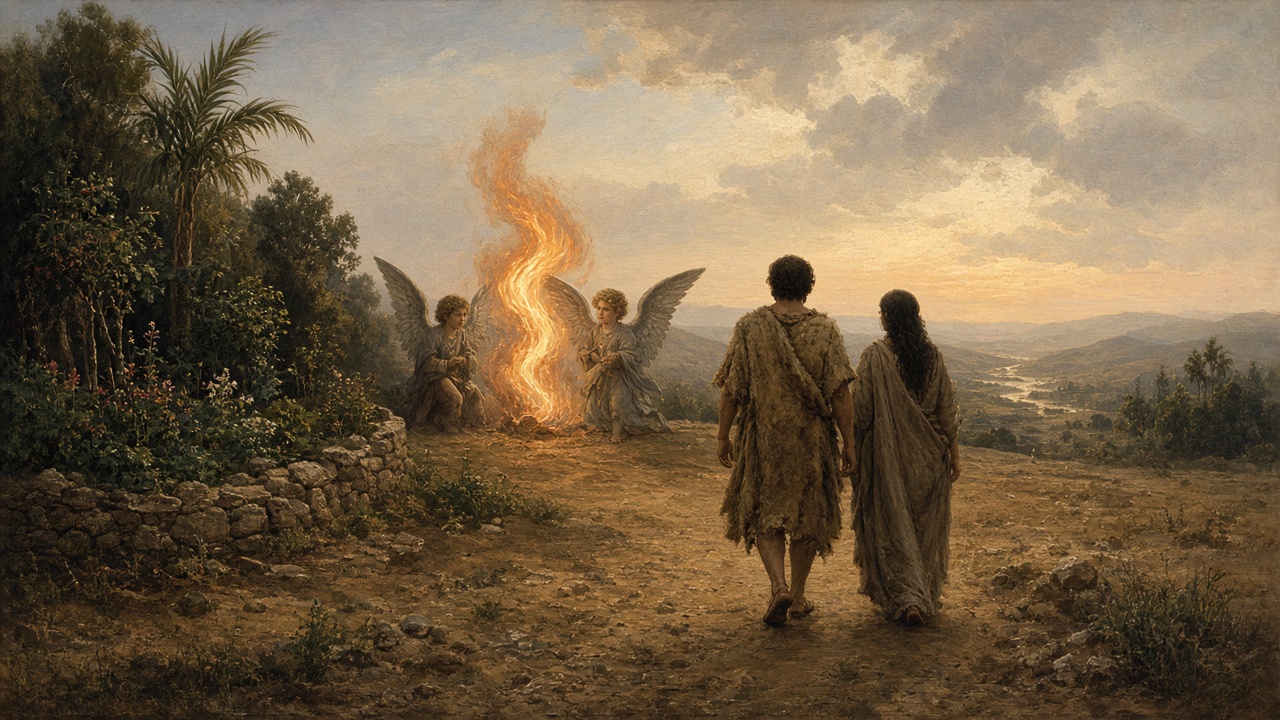
23Tsa'caen asi'ttaemba Na'su Chigaja a'ima Edéni'su jombachoqquie tteyamañamba manda tise've ñoñaqque'su andema semañe. 24Tsandiema tteyamañamba dos Chiga sefacconi'su sundarondeccuma ccutsian Edéni'su jombachoccu sombo'ttinga. Nane tseni Edénima chiga sombo'jefanga tise'pama ccutsiamba si'nge matichima'qque manda cuintsu ccafa ccafa ccafa jaye majan tsa Cansiaña'cho Quini'cconga já catsesa'ne.
Did you know?
The Fall and Exile from Eden
- A traditional reference explains Adam as “red,” a Babylonian word used as the generic name for man, with the same meaning in Hebrew and Assyrian, and links the name to his being formed from the dust of the earth. In this chapter that origin returns in the judgment: he will toil for his food until he returns to the ground, for he is dust and to dust he will return, and he is sent to work the soil from which he was taken.Sources: Adam · the Bible text itself
- In this chapter Adam gives his wife the name Eve, meaning “life” or “living,” because she would be the mother of all the living.Sources: Eve · the Bible text itself
- The site of the garden of Eden, from which the man is driven in this chapter, has been much discussed and placed in Armenia, west of the Caspian Sea, in Media, near Damascus, in Palestine, in southern Arabia, and in Babylonia. A traditional geographical note looks for it along the Tigris and the Euphrates, in the land of Shinar, or Babylonia.Sources: Eden · the Bible text itself
Notes written with AI assistance from open sources (Theographic Bible Metadata, CC BY-SA 4.0; Easton’s Bible Dictionary, public domain) and reviewed before publishing.
Credits and license for this translation
Chiga Tevaen'Jema Atesuja 1, Aisheve Caña'cho
New Testament and Genesis in Cofán (EC:con:Cofán)
copyright © 2012 Wycliffe Bible Translators, Inc.
Language: Cofán
Translation by: Wycliffe Bible Translators, Inc.
Cofán
con
Ecuador
Copyright Information
©Wycliffe Bible Translators, Inc. All rights reserved.
This translation text is made available to you under the
terms of the Creative Commons License: Attribution-Noncommercial-No Derivative Works.
( http://creativecommons.org/licenses/by-nc-nd/3.0/ )
In addition, you have permission to port the text to different file formats, as long as you
do not change any of the text or punctuation of the Bible.
You may share, copy, distribute, transmit, and extract portions
or quotations from this work, provided that you include the above copyright
information:
You must give Attribution to the work.
You do not sell this work for a profit.
You do not make any derivative works that change any of the actual words or punctuation of the Scriptures.
Permissions beyond the scope of this license may be
available if you contact
us with your request.
The New Testament
in Cofán
©Wycliffe Bible Translators, Inc. All rights reserved.
This translation is made available to you under the terms of the
Creative Commons Attribution-Noncommercial-No Derivatives license 4.0.
You may share and redistribute this Bible translation or extracts from it in any format, provided that:
You include the above copyright and source information.
You do not sell this work for a profit.
You do not change any of the words or punctuation of the Scriptures.
Pictures included with Scriptures and other documents on this site are licensed just for use with those Scriptures and documents.
For other uses, please contact the respective copyright owners.
2014-04-22
Source: http://ebible.org/conNTpo/ · eBible.org