Genesis 2
Chiga Tevaen'Jema Atesuja 1, Aisheve Caña'cho · Tap a verse to see its cross-references.
1Tsa'caen tsu Chigaja pa'cco sefacco andeve'qque agattoemba osha'cho tsani jincho'chove nanitsse agattoen. 2Nanimba septimo a'tave dasi tsequi a'ta pa'cco tise sema'bama nanimba ño'fa. 3Tsa'camba “Septimo a'taja ña ñotssi a'ta tsu” qquen supa Chigaja “Tsa a'taja sema'ma'quia a'ta tsu” qquen su. Nane tsequi a'ta Chigaja osha'cho agattoen'cho sema'bama nanimba ño'fapa tsa'caen su.
Edéni'su jombachoccu
4Qquen tsu Chiga agattoen'choja, ma'caen tiseja ande sefaccoma'qque agattoen:
Na'su Chiga tsa'caen ande, sefaccove'qque agattointeja 5toya tsu ande'su te'ta, ande'su shoshovi'qque sho'yombi. Nane Na'su Chiga toya unjima moembisi tsu toya sho'yombi. Toya'caen a'i'qque toya can'jembi andema semañe. 6Tsa'ma ccuttopa'si ande'ye sombopa ansundepa surunome dapa pa'cco andema tssipoen. 7Tsa'caen tssipoensi Na'su Chigaja andema mandyiccoemba a'ive ñoña. Ñoñamba tsofatunga tise qquendya'pama ufapa tisema qquendyaen. Tsa'caen qquendyaen a'imajan.
8Tsomba Na'su Chigaja coejechiga sombo'jeni Edén andenga osha'cho ñotssiama jombachoccunga jon. Jomba tseni tsu Tise agattoen'cho a'ima ccutsian. 9Tsomba ande'ye Chigaja osha'choma shoyo'yaen. Nane osha'cho ñotsse atteqque'su quini'cco majama ñotssia anqque'suma shoyo'yaen. Toya'caen jombachoccumbe enttingenga tsu tiseja Cansiaña'cho Quini'ccoma sho'yaen. Faesu quini'ccoma'qque tseni sho'yaen. Tsa quini'ccoma an'da majan ñotssia, majan egave atesuya'cho.
10Edén andene tsu na'enjan sombo jombachoccuma tssipoeñe. Sombopa tsu cuatro na'eme da. 11Fae'ccoma tsu Pisónme inisian. Tsaja pa'cco Havila andema shoquendí ja'je'cho. Cori tsu jin tsa andeni. 12Tsa corija ñotssi tsu. Toya'caen bedelio patu, ónice patu'qque tseni jin. 13Faesu na'emanda tsu Gihónme inisian. Tsaja pa'cco Cus andema shoquendí ja'je'cho. 14Faesu na'ema tsu Tigrisve inisian. Tsa na'en ja'je'choja Asiria joccani chiga sombo'jefa tsu. Toya'caen faesu na'ema tsu Eufratesve inisian.
15Tsonsi Na'su Chigaja a'ima Edéni'su jombachoccunga ccutsian cuintsu tsama semamba coiraye. 16Ccutsiamba a'ima su: “Poiyi'cco jombachoccu'su tetachoma qui añe osha. 17Tsa'ma tsa ñotssia, egama atesuya'cho quini'cco'su tetachomajan anjama. Nane maqui a'ta tsama an'da qui paya.”
18Tsomba Na'su Chigaja asi'ttaemba in'jan: “Ñotssimbi tsu tsandie tisuyi can'jeñe. Tisema fuite'suve gi ñoñaña tisia'can'me cuintsu tisei'ccu fae'ngae canseye.” 19Tsa'caen in'jamba Na'su Chigaja tayo andema osha'cho ande'ye jacanqque'su, sefa'ye chhajeqque'su chhiririave'qque ñoña'choma tsandienga i. Ipa tsandiema manda cuintsu osha'chove inisiañe. Tsa'cansi osha'cho tsu tsandie tise'pama inisianqquia'caen tsangae jincho. 20Nane tsandie tsu poiyi'cco aiña'cho vaura'can'ma sefani'su chhiririama, tsampini canseqque'suma'qque inisian. Tsa'ma ñoa'me tsandiei'ccu fae'ngae cansepa fuite'suve me'i'on. 21Tsa'cansi Na'su Chiga tisema anaesi tsandieja ana. Ana'jensi Chigaja tsandie utuccu'su tsu'ttama somboemba ttonoi'ccu changoma picco. 22Utuccu'su tsu'ttama Na'su Chigaja pushesuve ñoña. Ñoñamba tsandienga afe. 23Afesi tsandieja pushesuma attepa su: “¡Va tsu ñoa'me ña tsu'ttai'ccu, ña ttonoi'ccu ñama'caen ñoña'cho! Tisemanda gi inisiaña pushesuve. Nane Chigaja tsandie'suma tise've isusi ‘pushesu’ tsu.”
24Tsa'cansi tsu ja'ño tsandieja tise yaya, tise mamama catipa tise pushei'ccu can'jen'faya. Nane tsa dos tsu fae a'ia'caeñi da'faya.
25Toya'caen tsa'caen ñoñasi tsandie, pushesu'qque chu'cco can'jen'fa. Tsa'ma tsa'caen can'jen'ma ansangembe'yi can'jen'fa.
Did you know?
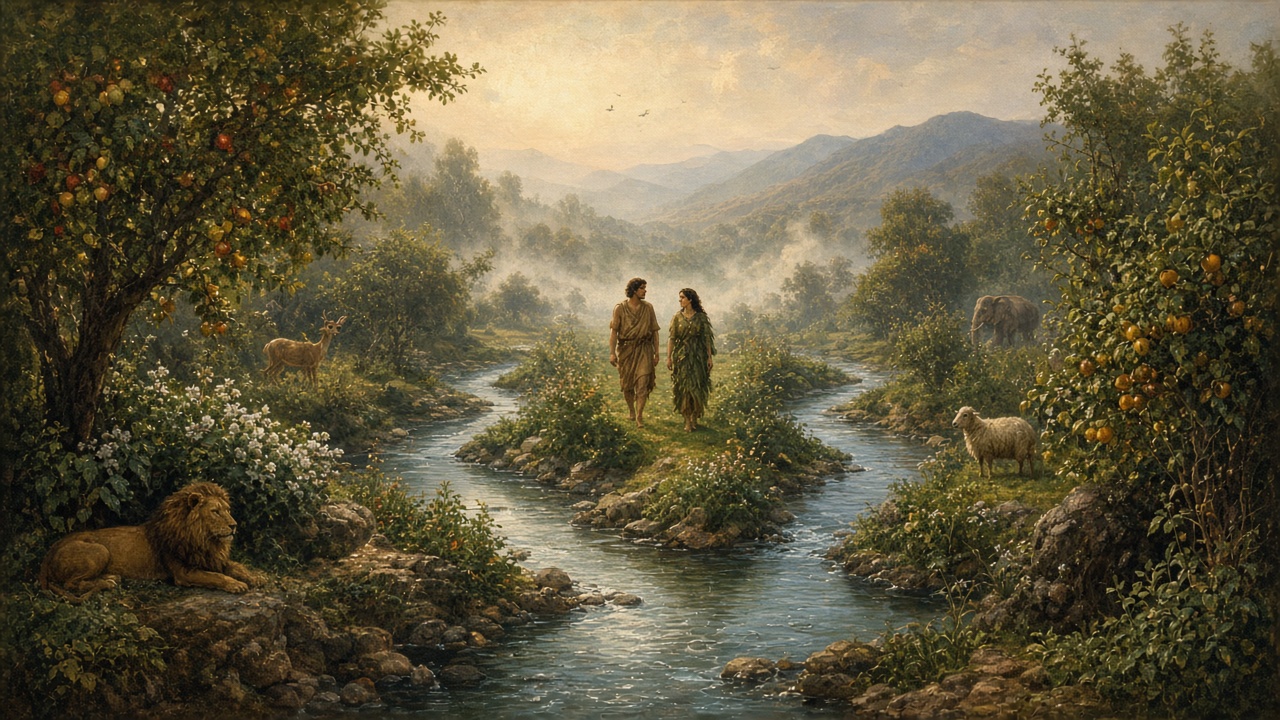
Adam, Eden, and the Four Rivers
- Adam, meaning “red,” is a Babylonian word and the ordinary name for a human being, with the same sense in Hebrew and in Assyrian. It was given to the first man. He was formed from the dust of the ground—hence the name—and God breathed into his nostrils the breath of life.Sources: Adam · the Bible text itself
- A river flowed out of Eden and divided into four headwaters: the Pishon, the Gihon, the Hiddekel, and the Euphrates. Some identify the Pishon with the Phasis or the Halys, others with the Indus, the Ganges, or still other rivers; the Gihon has been identified with the Nile, and others regard it as the Oxus, the Araxes, or the Ganges. The Hiddekel is the Tigris, called by the Accadians the river of Idikla; Gesenius understood the name as “the rapid Tigris.”Sources: the Bible text itself · Pison · Gihon · Hiddekel
- The site of Eden, the garden in which the first parents lived, has been discussed more than almost any other geographical question. It has been placed in Armenia, in the region west of the Caspian Sea, in Media, near Damascus, in Palestine, in southern Arabia, and in Babylonia. Easton's Bible Dictionary (1897) seeks it along the Tigris and the Euphrates of western Asia, in the land of Shinar, or Babylonia.Sources: Eden
Notes written with AI assistance from open sources (Theographic Bible Metadata, CC BY-SA 4.0; Easton’s Bible Dictionary, public domain) and reviewed before publishing.
Places in this chapter
- Assyria · 36.359, 43.153 · verse 14
- Euphrates · Today: Euphrates River · 31.004, 47.442 · verse 14
- Tigris · Today: Tigris River · 31.004, 47.442 · verse 14
Only places identified with high confidence are shown (90% or more according to the scholarly sources compiled by OpenBible). Period map: DARE (Digital Atlas of the Roman Empire), CC BY 4.0; modern map: © OpenStreetMap contributors; places: OpenBible.info (CC BY 4.0).
Credits and license for this translation
Chiga Tevaen'Jema Atesuja 1, Aisheve Caña'cho
New Testament and Genesis in Cofán (EC:con:Cofán)
copyright © 2012 Wycliffe Bible Translators, Inc.
Language: Cofán
Translation by: Wycliffe Bible Translators, Inc.
Cofán
con
Ecuador
Copyright Information
©Wycliffe Bible Translators, Inc. All rights reserved.
This translation text is made available to you under the
terms of the Creative Commons License: Attribution-Noncommercial-No Derivative Works.
( http://creativecommons.org/licenses/by-nc-nd/3.0/ )
In addition, you have permission to port the text to different file formats, as long as you
do not change any of the text or punctuation of the Bible.
You may share, copy, distribute, transmit, and extract portions
or quotations from this work, provided that you include the above copyright
information:
You must give Attribution to the work.
You do not sell this work for a profit.
You do not make any derivative works that change any of the actual words or punctuation of the Scriptures.
Permissions beyond the scope of this license may be
available if you contact
us with your request.
The New Testament
in Cofán
©Wycliffe Bible Translators, Inc. All rights reserved.
This translation is made available to you under the terms of the
Creative Commons Attribution-Noncommercial-No Derivatives license 4.0.
You may share and redistribute this Bible translation or extracts from it in any format, provided that:
You include the above copyright and source information.
You do not sell this work for a profit.
You do not change any of the words or punctuation of the Scriptures.
Pictures included with Scriptures and other documents on this site are licensed just for use with those Scriptures and documents.
For other uses, please contact the respective copyright owners.
2014-04-22
Source: http://ebible.org/conNTpo/ · eBible.org