Genesis 45
Cishingini Agwara Kambari [asg] · Tap a verse to see its cross-references.
Isufu u danai aza a̱ ni ko a̱yi ɗa ya
1Isufu u doku u fuɗa u ka̱na̱ asuvu a̱ ni ba, lo e kelime ka aza a̱ ni, ɗa u ɓosoi ka̱da̱wuri, ɗa u danai, <<Yaba dem u neke tsu uye.>> A ayin a na Isufu u danai aza a̱ ni ko a̱yi ɗa ya uma o yoku i lo ba. 2Ka̱da̱wuri ka na u ɓosoi va ka yaꞋan ta̱ kacaꞋa ka̱u ali ɗa aza a Masar a panai, ɗa a ɗikai kadanshi ka a kubana u mogono FiriꞋauna.
3Ɗa Isufu u danai aza a̱ ni, <<Mpa ɗa Isufu. Dada u buwa ta̱ ɗe n wuma?>> Ana aza a̱ ni a panai nannai aɗa a panasakai wovon ka̱u a fuɗa o doku a dansa ili ba.
4Ɗa Isufu u danai aza a̱ ni a, <<Yawai wo ɗevu nu mpa.>> Ana a yawai, ɗa u danai le, <<Mpa ɗa vangu vu ɗa̱ Isufu, vuza na i dengei. Ɗa a ɗikai a kubanka Masar. 5Ama gogo na ka̱ta̱ i pana wovon ba. Ka̱ta̱ kpamu i pana wupa u ka̱ci ka̱ ɗa̱ ba, adama a na i dengei mu ta̱. Adama a na kpamu mi isa wuma i ɗa i zuwai ɗa Ka̱shile ka̱ suki mu na kelime ka̱ ɗa̱. 6Gogo na a̱ya̱ e re a ɗa na a na kambulu ka uwai a iɗika. Gogo na a kubana a̱ya̱ a tawun a kambulu ki ta̱ lo, adama a na vicimba vi lo ba. 7Ama Ka̱shile ka̱ suku mu ta̱ adama a na n lapula uye adama a wuma u ɗa̱ kpamu, ali nu ntsukaya n ɗa̱ dem.
8<<A̱ɗa̱ ɗa i zuwai n ta̱wa̱i na ba, ama Ka̱shile. U zuwa mu ta̱ mo okpoi vuza na u kuneke FiriꞋauna odoki, n vuzagbayin vu kpaꞋa ku ni ra̱ka̱ n gomuna vi iɗika i Masar ra̱ka̱.
9<<Gogo na, yaꞋin gogoꞋo a kubana we esheku a̱ tsu. I dana yi, <Ili i na Isufu, maku ma ni ma danai i ɗa na: Ka̱shile ko bonoko mu ta̱ vuzagbayin a Masar. Ta̱wa̱i na gogo na ka̱ta̱ i la̱nga̱sa̱ ayin ba. 10Vi ta̱ kpamu o kuyongo a uɓon u Goshen a Masar i da̱sa̱ngi ɗevu nu mpa. Avu m muku n nu, nu ntsukaya n nu, nu nlala n ɗa̱ n ushiga dem n ili i na yi ni ɗa dem. 11Mi ta̱ kpamu e kuneke ɗa̱ ili dem. Adama a na a̱ya̱ a tawun a kambulu a buwa ta̱ lo a̱ kuta̱wa̱. Ta baci nannai ba, avu m muku n nu n ili i na i buwai dem, yi ta̱ o kokpo asuvayali.>
12<<Ɗa na ye ene ta̱ n a̱shi a̱ɗa̱, avu Bayami vangu vu va̱ ve ene ta̱ n ka̱ci ka̱ nu mpa ɗa Isufu va. 13Vu bana baci vu dana dada uteku u na mi punu n utsura a iɗika ya, dana yi kpamu i na ve enei. Dakakai i bana i ta̱wa̱ n a̱yi gogoꞋo.>>
14Ɗa u foɗo aminya a̱ ni ɗa u yikpa̱i ɗa u shika̱i, ɗa Bayami wo oɓongi ni ɗa u ka̱na̱i ma̱shi feu. 15Ɗa wo oɓongi aza a̱ ni dem ɗa u ɗoroi ma̱shi kpamu. Ana o kotsoi ɗa aza a̱ ni a̱ ka̱na̱i kadanshi n a̱yi. 16Ana arabali a yawai u mogono Isufu aza a̱ ni a̱ ta̱wa̱ ta̱, ɗa FiriꞋauna aza ulinga a ni a yaꞋin ma̱za̱nga̱ ka̱u. 17Ɗa u danai Isufu, <<Dana aza a̱ nu a ɗika ucanuku u le ni njaki n le a laza o kubono a iɗika i KanaꞋana. 18Ka̱sukpa̱ a bana a ɗika limata i le ya o kubono na Masar. Mi ta̱ e kuneke ubuta̱ u singai na a Masar i ta̱ kpamu a̱ kuciya̱ ili dem i na i kuyawa le. 19Dana le kpamu a ɗika ekeke a anaka punu a iɗika i Masar adama a na a ɗikaka muku n le n wawaꞋa n a̱ma̱ci e le, i ɗika kpamu esheku a̱ ɗa̱ a̱ kuta̱wa̱. 20Ka̱ta̱ o oꞋuso ka̱ci ke le kuɗika kuzuwa ku yoku ba, ama ili i singai yi iɗika i Masar yi ta̱ lo e kuneke le.>>
21Ta ta na muku mi Isaraila n yaꞋin nannai tsu na mogono ma ma danai le. A̱yi Isufu kpamu u nekei le keke va anaka tsu na mogono ma danai, n ilikulyaꞋa yi nwalu. 22Ra̱ka̱ vi le kpamu ɗa u nekei le ntogu n savu n singai, ama ɗa u nekei Bayami Azurufa amangatawun a tatsu n ntogu kpamu n tawun n tawun (500). 23Ɗa u suꞋuki n esheku ili i nampa, njaki kupa n na n ɗikai ucanuku u singai wa aza a Masar: n a̱na̱ku a njaki kupa a ɗikai ilikulyaꞋa m boroji n ili i na a kuwala n a lyaꞋi a uye. 24Ana wu tuka̱i le ɗa a lazai ɗa u danai le, <<Ka̱ta̱ i yaꞋan kanananai a uye ba.>>
25Ɗa a̱ ka̱sukpa̱i Masar ɗa a lazai a kubana we esheku e le a KanaꞋana. 26Ɗa a danai, <<Isufu u buwa ta̱ n wuma! A̱yi ɗa kpamu wi ɗe a kulyaꞋa tsugono a iɗika i Masar dem>> A̱yi Yakubu u fuɗa u dana ili ba, adam a na we ene ta̱ adanshi mayun ɗa ba. 27Ana a danai ni ili i na Isufu u danai le, ana kpamu we enei ekeke a anaka a na Isufu u suki adama a na a ɗika yi a kubana a Masar, ɗa u ta̱na̱i a mɓa̱la̱ n na wi ishi nu n ɗa. 28Ɗa u danai, <<Maku ma̱ va̱ Isufu u buwa ta̱ n wuma? Mi ta̱ a kubana adam a na me ene yi kafu n kuwa̱.>>
Did you know?
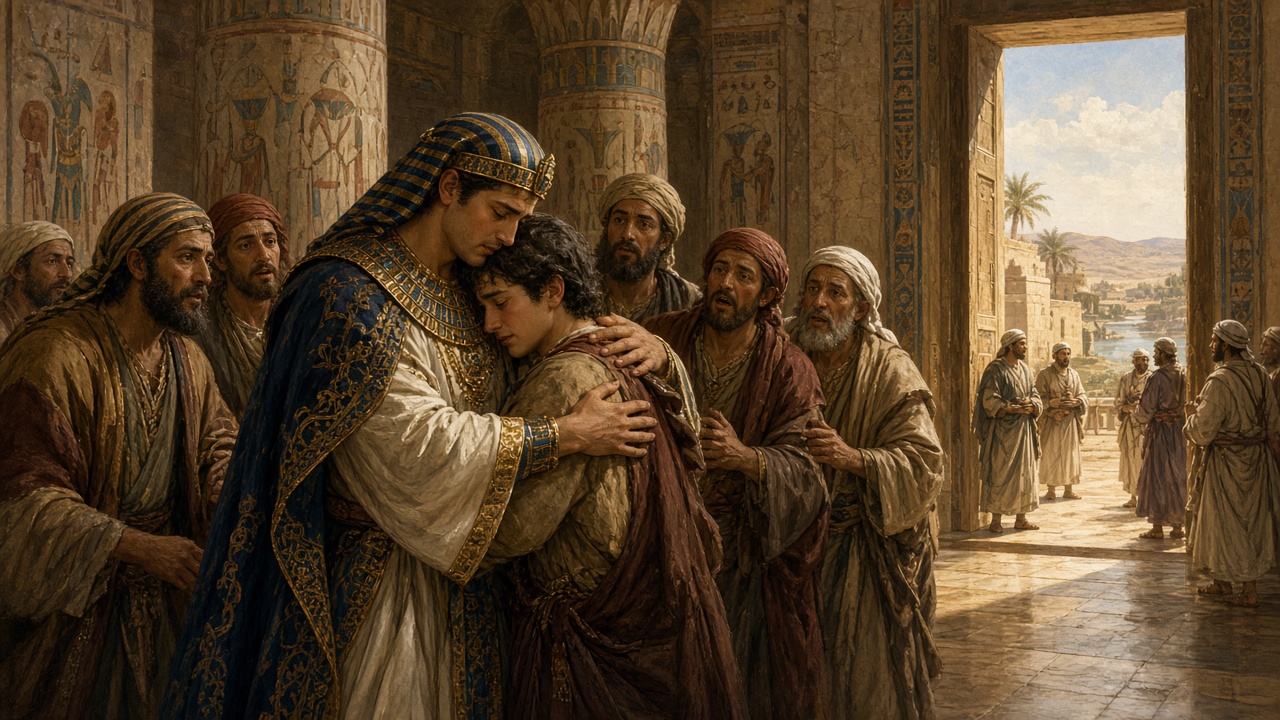
Joseph Reveals Himself to His Brothers
- Goshen, the district where Joseph tells his brothers to settle near him with their children, grandchildren, flocks, and herds, lay east of the Nile and apparently not far from the royal residence. Easton's Bible Dictionary (1897) notes that it is first mentioned in Joseph's message to his father, and that it was also called the land of Rameses, because the towns of Pithom and Rameses lay within its borders.Sources: Goshen · the Bible text itself
- Joseph weeps so loudly that the Egyptians hear him, and Pharaoh's household soon hears of it; Pharaoh and his servants are pleased when they learn the brothers have come, and he offers them the best of the land of Egypt. Easton's Bible Dictionary (1897) says the Pharaoh of Joseph's days was probably Apopi, or Apopis, the last of the Hyksos kings. It adds that Hyksos kings welcomed Asiatic shepherds, whereas older native Egyptians regarded shepherds as an abomination, though some argue that Joseph came to Egypt in the reign of Thothmes III, long after the Hyksos were expelled.Sources: Pharaoh (of Joseph) · the Bible text itself
- Benjamin was the younger son of Jacob by Rachel, and Joseph the elder of her two sons; their mother died giving birth to Benjamin at Ephrath and named him Ben-oni, meaning son of my pain, a name his father changed to Benjamin. At the reunion Joseph embraces Benjamin and weeps, giving him three hundred shekels of silver and five sets of clothes, while each of the other brothers receives a new garment.Sources: Benjamin (patriarch) · Joseph (son of Jacob) · the Bible text itself
Notes written with AI assistance from open sources (Theographic Bible Metadata, CC BY-SA 4.0; Easton’s Bible Dictionary, public domain) and reviewed before publishing.
Places in this chapter
- Egypt · 30.129, 31.308 · verses 4, 8, 9, 13, 18, 19, 20, 23, 25, 26
- Goshen · Today: Goshen 1 · 30.799, 31.834 · verse 10
- Canaan · 32.767, 35.333 · verses 17, 25
Only places identified with high confidence are shown (90% or more according to the scholarly sources compiled by OpenBible). Period map: DARE (Digital Atlas of the Roman Empire), CC BY 4.0; modern map: © OpenStreetMap contributors; places: OpenBible.info (CC BY 4.0).
Credits and license for this translation
Cishingini Agwara Kambari [asg]
Cishingini: Cishingini Agwara Kambari [asg] (Bible)
copyright © 2025 Language Development and Translation Initiative (LDTI)
Language: (Cishingini)
Contributor: The Seed Company
This translation is made available to you under the terms of the
Creative Commons Attribution Share-Alike license 4.0.
You have permission to share and redistribute this Bible translation in any format and to make reasonable revisions and adaptations of this translation, provided that:
You include the above copyright and source information.
If you make any changes to the text, you must indicate that you did so in a way that makes it clear that the original licensor is not necessarily endorsing your changes.
If you redistribute this text, you must distribute your contributions under the same license as the original.
Pictures included with Scriptures and other documents on this site are licensed just for use with those Scriptures and documents.
For other uses, please contact the respective copyright owners.
Note that in addition to the rules above, revising and adapting God's Word involves a great responsibility to be true to God's Word. See Revelation 22:18-19.
2025-07-09
Source: http://ebible.org/asg/ · eBible.org