Genesis 4
Cishingini Agwara Kambari [asg] · Tap a verse to see its cross-references.
Kayinu n Habila
1Ɗa A̱da̱mu u vaki n vuka vi ni Hawa, ɗa u yaꞋin ka̱tsuma̱, ɗa u matsai Kayinu. Ɗa u danai, <<Vuzavaguɗu u ɓa̱nka̱ mu ta̱, ɗa n ciya̱i kolobo.>> 2Ayin a na i lo, ɗa u matsakai ni vangu ɗa u neꞋi ni kula Habila.
Ana u gbonguroi ɗa wo okpoi maguɓi, a̱yi Kayinu tamkpamu wo okpoi kacimbi. 3A ayin a vukyaꞋa, ɗa Kayinu u bankai Vuzavaguɗu n kuneꞋe ki ili i kashina i ni. 4Ama a̱yi Habila u zagbai mokyon ma singai ma na a̱ gita̱i kumatsa. Ɗa u kiɗai, ɗa u bankai Vuzavaguɗu nu mɓurusa. Ɗa ta na Vuzavaguɗu wi isai alyuka a̱ ni. 5Ama u pana uyoꞋo u Kayinu n alyuka a̱ ni ba. Ɗa Kayinu u yaꞋin wupa, ka̱ɗu ka̱ ni ka̱ na̱mgba̱i.
6Ɗa Vuzavaguɗu we ecei ni, <<Yiɗa̱i i zuwai ɗa vi yaꞋin wupa? Yiɗa̱i i zuwai ɗa asuvu a̱ nu a̱ na̱mgba̱i? 7Ashe vi yaꞋan baci ili i singai a kisa i ɗa ba? Vu lapula baci ba, unushi u ɗa lo a̱ utsutsu a kuvana wu, adama a na u lyaꞋa utsura u nu. Ama u gaꞋan ta̱ vu laꞋa u ɗa.>>
8Ɗa Kayinu u danai vangu vi ni Habila, <<YaꞋan tsu bana a kakamba.>> Ele ɗe a kakamba, ɗa Kayinu u ga̱la̱i Habila.
9Ayin a na i lo, ɗa Vuzavaguɗu we ecei Kayinu, <<Te ɗai ambu wi?>>
Ɗa Kayinu wu ushuki, <<Mpa n yeve ba. Mpa ɗa kindi ka vangu va̱?>>
10Ɗa Vuzavaguɗu u danai, <<Yiɗa̱i i zuwai ɗa vi yaꞋin nannai? Adama a na mpasa n ambu mi ta̱ a malapa mu una̱ punu a iɗika a̱ kuta̱wa̱ wa̱ va̱. 11Gogo na iɗika i na i ɓa̱yuwa̱i adama a na yi isa mpasa n ambu e ekiye a̱ nu, i yaꞋanka wu ta̱ una̱. 12Ubuta̱ u na vu banai dem, ko vi yaꞋan ulinga nini, iɗika ya yo kudoku ya matsa ili ba. Uteku n anana vo okpo ta̱ vuza vu ka̱ka̱ra̱sa̱ punu a iɗika.>>
13Ɗa Kayinu u danai Vuzavaguɗu, <<Atakaci a̱ va̱ a laꞋa ta̱ utsura u va̱. 14Gogo na vu loko mu ta̱ a iɗika ya, mi ta̱ o kokpo usokongi a̱ ubuta̱ u nu, ka̱ta̱ mo okpo ka̱ka̱ra̱shi punu a aduniyan, vuza na we enei mu dem wi ta̱ a kuna mu.>>
15Ɗa Vuzavaguɗu wu ushuki u danai, <<Ta nannai ba! Vuza na baci dem wu unai Kayinu mi ta̱ feu a kutakacika yi ali kucindere.>> Ɗa Vuzavaguɗu u zuwakai ni urotu adama a na vuza na de dem u cinai ni ka̱ta̱ wu una yi ba. 16Ɗa Kayinu u ka̱sukpa̱i kelime ka Vuzavaguɗu ɗa u lazai u banai u da̱sa̱ngi a iɗika i Nodu a Kasana ka Adini.
Ntsukaya n Kayinu
17Ɗaɗa Kayinu u vaki n vuka vi ni ɗa u yaꞋin ka̱tsuma̱ u matsai maku ɗa u neꞋi ni kula Anuhu. Ayin a nanlo a̱yi a kumaꞋa likuci ɗa u nekei likuci ya n kula ku maku ma̱ ni Anuhu. 18Ɗa a matsakai Anuhu maku ɗa u nekei ni kula Iradu, ɗa Iradu u matsai Mehaluja ɗa Mehaluja u matsai Metusela esheku a Lameji.
19Lameji u zuwai a̱ma̱ci e re vuza te kula ku ni ku ɗa Ada kula ku vuza te Zila. 20Ɗa Ada u matsai Jabalu, a̱yi ɗa esheku a aza a na o kuyongo a̱ a̱pa̱m n a guɓai kuzuwa ku le. 21Vuza ni ɗa Jabalu vuza na wi esheku a awaꞋi a umolu n a̱liki a ishari. 22Ɗa Zila u matsai Tubula-kayinu vuza na u ci yima ila̱nga̱ n iyum. Taku vu Tubala-kayinu a̱yi ɗa Nama.
23Kanna ke te Lameji u danai a̱ma̱ci e re a̱ ni,
<<Ada n Zila, panakai mu,
a̱ɗa̱ a̱ma̱ci a Lameji,
n saꞋwa ta̱ kuna kolobo ko yoku
adama a na u uka mu ta̱ muna.
24I baci a kuna uma e cindere adama a vuza na wu unai Kayinu,
I ta̱ a kuna uma amangatatsunkupa n uma e cindere adama a vuza na baci wu unai Lameji.>>
25Ɗa A̱da̱mu u doku u vaki n vuka vi ni, ɗa u yaꞋin ka̱tsuma̱. Ɗa u matsai maku mo yoku, ɗa vuka vi neꞋi ni kula Shitu. U danai, <<Ka̱shile ke neke mu ta̱ maku mo yoku, adama a na Habila u buwa lo ba, Kayinu wu una yi ta̱.>> 26Shitu feu u matsai maku mo kolobo, ɗa u neꞋi ni kula Enos.
A ayin a nanlo a ɗa uma a̱ ka̱na̱i kuɗeke kula ku Vuzavaguɗu.
Did you know?
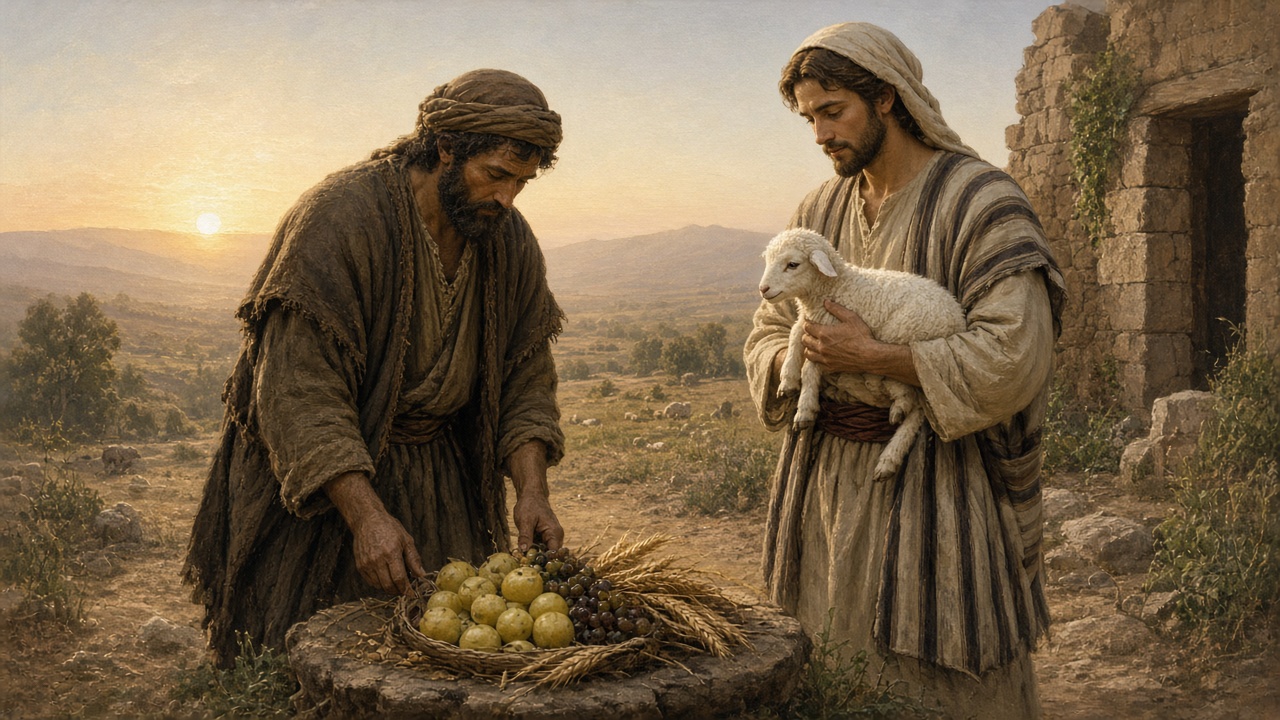
Cain, Abel, and Life East of Eden
- Abel’s Hebrew name means “breath” or “vanity.” He kept sheep, while his brother Cain tilled the soil: Abel brought the best portions of the firstborn of his flock, and Cain brought fruit of the ground. Easton's Bible Dictionary (1897) reads the phrase “in process of time” (margin, “at the end of days”) as probably referring to the Sabbath.Sources: Abel · Cain · the Bible text itself
- After Abel’s death, Cain settled in the land of Nod, east of Eden, a name meaning exile, wandering, or unrest. There he built a city and named it after his son Enoch. Easton's Bible Dictionary notes that this is the first city mentioned in Scripture.Sources: Nod · Enoch (son of Cain) · the Bible text itself
- Lamech, fifth in descent from Cain, married two women, Adah and Zillah. Easton's Bible Dictionary calls his address to them the only extant example of antediluvian poetry, sometimes known as “Lamech’s sword-song.” Their children are tied to early ways of life: Jabal with tents and livestock, Jubal with the harp and flute, and Tubal-cain with forging bronze and iron.Sources: Lamech (descendant of Cain) · Adah (wife of Lamech) · Zillah · the Bible text itself
Notes written with AI assistance from open sources (Theographic Bible Metadata, CC BY-SA 4.0; Easton’s Bible Dictionary, public domain) and reviewed before publishing.
Credits and license for this translation
Cishingini Agwara Kambari [asg]
Cishingini: Cishingini Agwara Kambari [asg] (Bible)
copyright © 2025 Language Development and Translation Initiative (LDTI)
Language: (Cishingini)
Contributor: The Seed Company
This translation is made available to you under the terms of the
Creative Commons Attribution Share-Alike license 4.0.
You have permission to share and redistribute this Bible translation in any format and to make reasonable revisions and adaptations of this translation, provided that:
You include the above copyright and source information.
If you make any changes to the text, you must indicate that you did so in a way that makes it clear that the original licensor is not necessarily endorsing your changes.
If you redistribute this text, you must distribute your contributions under the same license as the original.
Pictures included with Scriptures and other documents on this site are licensed just for use with those Scriptures and documents.
For other uses, please contact the respective copyright owners.
Note that in addition to the rules above, revising and adapting God's Word involves a great responsibility to be true to God's Word. See Revelation 22:18-19.
2025-07-09
Source: http://ebible.org/asg/ · eBible.org