Atos 20
Tupã Je'ẽha · Toque num versículo para ver as referências cruzadas.
Masendo ywy rupi Páu oho. Ngere ywy rupi a'e oho tĩ.
1Ngã mutyapuha upa putu'u rahã, Jesu kotyhar ta ke Páu mujy'ar. Ame'ẽ ta ke a'e muhury katu. A'erehe Jesu rehe ngã ipy'a katu te we rĩ. Pe, Páu pandu:
—Ihẽ aho ta — aja.
2Pe, Masendo ywy rupi oho. Ame'ẽ rupi wata oho. Jesu kotyhar ta ke a'e mu'e mu'e. Muhury katu tĩ. A'erehe Jesu rehe ngã ipy'a katu te we rĩ. Pe, Ngere ywy pe Páu uhyk oho. 3A'ep mahapyr jahy a'e mukanim. Pe, Si ywy pe a'e oho tate. Jarusu keruhũ pe oho tate. Arahã a'e ke jundéu awa ta jukwa ta aja Páu ukwa. A'erehe Masendo ywy rupi wata oho rahã, katu aja a'e ukwa. (Aja rahã, jukwa ym ta, aja ukwa katu.) 4Páu namõ Pi ra'yr oho tĩ. Her Sopato. Mberéi ok ta pe har a'e. Arita oho tĩ. Tesaron ok ta pe har a'e. Sekũ oho tĩ. Tesaron ok ta pe har a'e tĩ. Ngái oho tĩ. Nder ok ta pe har a'e. Tik oho tĩ. Asia ywy pe har a'e. Toro oho tĩ. Asia ywy pe har a'e tĩ. 5Timo oho tĩ. Ame'ẽ ta johu oho py. Toroa ok ta pe oho. A'ep Páu rehe a'eta harõ ixo. Pe, ihẽ rehe Páu uhyk uwyr. Ihẽ Ruk. 6Siri ok ta pe ihẽ axo. Jundéu awa ta mi'u matyriha weraha upa rahã, a'engi jande mokõi jaho. (Ame'ẽ wera rahã, mbeju ke mupururukiha nixói, ame'ẽ ke jundéu awa ta u'u.) Pe, Toroa ok ta pe jande jaho. Jarusu keruhũ pe jaho. Awa po wajar peteĩhar upa jaker rahã, pe, jahyk jaho. A'ep awa po wajar mokõi jande jaker.
Toroa ok ta pe har ta rehe Páu usak. A'ejõhar usak ngã rehe.
7Nomin pytun rahã, upa Jesu kotyhar ta jy'ar. Mbeju ke mopokiha rehe jy'ar. (Aja Jesu manõha rehe a'eta ukwa ukwa uĩ.) Ngã pe Páu pandu pandu hũ. Ame'ẽ ku'ẽ rahã, Páu oho ta, a'erehe pandu pandu we hũ. Pytun pyter rahã, ma'e pandu pandu we hũ rĩ. 8Jande jajy'ariha renda pe heta ma'e weraha ihĩ. Ywatehar henda ihĩ ame'ẽ pe jande jajy'ar jaĩ. 9Pe, awa ma'ãha rape 'ar pe ta'ynuhu wapyk uĩ. Her Euti. Páu pandu pandu u'am rahã, Euti pyhýi katu te hũ. Pe, ukwer katu. Pe, ywy pe u'ar ukwap. Pi! Mahapyr ywatehar henda ngi u'ar ukwap. Amõ ta oho piam rahã, pete'e manõ oup. 10Pe, Páu wyjy oho ehe. Ipynarãi pe wapyk oho ehe. Pyhyk, pe, amõ ta pe a'e pandu:
—Pejixi'u ym. Kwera katu apo — aja Páu pandu.
11Pe, ywatehar henda pe Páu jupir oho tĩ. Upa ma'e ke u'u rahã, pandu pandu we hũ ngã pe tĩ. Aja te'e xu'em oho. 12Pe, a'engi Páu oho. Pe, ta'ynuhu kwera katu ame'ẽ ke hok pe amõ ta mujywyr raho. Katu jywyr oho. Upa ngã hury katu.
Mire ok ta pe Páu uhyk oho
13Jande pe Páu pandu:
—Jarusu keruhũ pe peho. Aso ok ta pe peho. Ihẽ riki pe rupi ihẽ aho ta. A'ep pehẽ namõ jarusu keruhũ pe ihẽ apor ta aho tĩ — aja jande pe.
A'erehe jarusu keruhũ pe jande japor jaho. Ame'ẽ pe Aso ok ta pe jahyk py jaho. 14A'ep jande rehe Páu uhyk uwyr rahã, jarusu keruhũ pe a'e opor oho tĩ. A'engi ame'ẽ pe Mitire ok ta pe jahyk jaho. 15A'engi jande jaho tĩ. Ame'ẽ ku'ẽ rahã, Ki ypa'ũ rake rupi jasa jaho. 16Amõ ku'ẽ rahã, Sã ywy pe jahyk jaho. Amõ ku'ẽ rahã, Mire ok ta pe jande jaho. Asia ywy pe Páu pyta tar ym. A'erehe Ese ok ta rake rupi jasa jaho. Pahar Jerusarẽ ok ta pe Páu uhyk tar katu. A'ep jundéu awa ta mi'u matyriha wera rahã, uhyk tar katu. Uhyk rahã, katu ta ipe, aja Páu ukwa. Ngã mi'u matyriha weraha rer Penteko.
Ese ok ta pe har tamũi ta namõ Páu pandu pandu
17Mire ok ta pe Páu ixo rahã, Ese ok ta pe har ta tamũi ta pe myrandu a'e mondo. Jesu kotyhar ta rehe tamũi ta usak usak katu.
“Pahar ihẽ koty pejur” aja myrandu a'e mondo.
18Pe, tamũi ta uhyk uwyr ehe rahã, Páu pandu:
—Asia ywy pe ihẽ ahyk py ajur rahã, a'engi ihẽ rehe har pekwa katu. Myja pehẽ namõ ihẽ axo, ame'ẽ ke pekwa katu. 19Jesu jandema'e sawa'e te. Ima'e miasu aja ima'e parakyha ke ihẽ ama'ema'e hũ. Tupã je'ẽha ke ihẽ amu'e mu'e hũ axo. “Katu te ihẽ” aja ym akwa. Aja ihẽ axo rahã, ihẽ amu'e mu'e rĩ. Amõ ta jurujar ym ehe rahã, ihẽ ajixi'u tĩ. Ihẽ ke jundéu awa ta mahy tar katu rahã, ame'ẽ ngi ihẽ akyje ym. Tapijar te'e we amu'e mu'e rĩ. 20Heta pejy'ar rahã, pehẽ ke ihẽ amu'e hũ. Pehẽ rok pe ihẽ amu'e hũ pehẽ ke tĩ. Pehẽ pe ma'e katu ame'ẽ ke upa katu te ihẽ amu'e, aja pekwa katu tĩ. 21Kuja ihẽ apandu: “Ma'e peka'u te'eha pema'ema'eha ngi Tupã koty pehẽ py'a pemuruwak pemondo. Jesu rehe pejurujar katu. Jesu riki jandema'e sawa'e te” aja jundéu awa ta pe ihẽ apandu pandu hũ. Aja amõ awa ta pe ihẽ apandu pandu hũ tĩ. Jundéu awa aja ym ame'ẽ ta ke a'eta.
22—Apo Jerusarẽ ok ta pe ihẽ aho ta axo. Tupã'ã putar, a'erehe ihẽ aho axo. A'ep ma'e ihẽ rehe uhyk ta my? Ihẽ akwa ym. 23Kuja jõ ihẽ akwa katu. Ok ta pe pame katu te Tupã'ã mujekwa ihẽ pe. Kuja mujekwa. Ihẽ ke amõ ta mahy tar katu. Kyndaha pe ihẽ ke amõ ta kynda tar katu raho tĩ, aja ihẽ pe mujekwa. 24Pe, ihẽ ke amõ ta jukwa ta rahã, ngã ngi ihẽ akyje ym ta. Tupã je'ẽha ke ihẽ apandu we ta rĩ. Ngã ke Tupã muhã katu ta, ame'ẽ myrandu katu ke ihẽ apandu ta rĩ. Ame'ẽ rehe har ihẽ apandu, ame'ẽ ke ihẽma'e parakyha. Ame'ẽ ke ihẽ pe Jesu me'ẽ. Pe, ame'ẽ parakyha ke ihẽ amumba tar katu. Jesu riki jandema'e sawa'e te.
25—Upa pehẽ renda rupi ihẽ awata aho rahã, Tupã rehe har pehẽ pe ihẽ apandu pandu. Myja katu pexoha Tupã putar my, ame'ẽ rehe har ihẽ amu'e katu pehẽ ke. Apo ihẽ rehe pesak ym te ta tĩ. 26Apo jetehar te pehẽ pe ihẽ apandu katu tĩ. (Upa katu te Jesu rehe har pehẽ pe apandu pandu. Upa amu'e mu'e hũ.) A'erehe mupyraraha renda pe pehẽ ngi har amõ oho ta rahã, ihẽ rehe je'ẽha nixói. 27Ma'e Tupã putar, ame'ẽ rehe har upa katu te pehẽ pe ihẽ apandu. 28Pesak katu pehẽ juehe pexo. Aja rahã, Tupã ngi amõ koty pehẽ py'a pemuruwak ym ta pemondo. Upa Jesu kotyhar ta rehe pesak pesak katu pexo tĩ. Ame'ẽ parakyha ke pehẽ pe Tupã'ã me'ẽ. Jesu kotyhar tama'e kapitã ta ke pehẽ. A'erehe ame'ẽ ta rehe pesak katu pexo. Jesu rehe jurujar katu ame'ẽ ta Tupã kotyhar ta ke tĩ. Ta'yr manõha rupi a'e ipy'a jywyr ngã rehe.
29—Ihẽ raikwer rupi amõ ta uwyr ta. Ame'ẽ ta pehẽ rehe uhyk ta, aja akwa katu. Jesu kotyhar ta ke ame'ẽ ta muka'u ka'u te'e hũ ta. Jurujar katu ame'ẽ ta ukwa katuha ke amõ koty ame'ẽ ta muruwak ta mondo, aja ihẽ akwa katu. Katu ym aja. 30Jete. Pehẽ pyter ngi har amõ ta pu'am ta. Ame'ẽ ta te'e ma'e pandu ta. Amõ amõ ta jurujar katu ame'ẽ ta ke a'eta muka'u ka'u te'e ta. Aja ame'ẽ ta namõ jumu'e ixo ame'ẽ ta aja muruwak ta. 31A'erehe pesak katurahã! Aja rahã, peka'u ka'u te'e ym ta. Pekwa katurahã! Mahapyr warahy 'ar rahã, pehẽ ke ihẽ amu'e mu'e hũ. Wera rahã, ihẽ amu'e mu'e hũ. Pytun rahã, ihẽ amu'e mu'e hũ tĩ. Pehẽ ngi har amõ ta jurujar ym ame'ẽ ta rehe ihẽ ajixi'u hũ tĩ.
32—Apo pehẽ rehe har Tupã namõ apandu: “Mã peja Ese ok ta pe har ta rehe esak katu.” Jetehar te ke. A'e usak katu ta pehẽ rehe. Ame'ẽ myrandu ke pehẽ py'a rehe pemupyta katu. Aja rahã, ame'ẽ myrandu namõ pehẽ py'a ke a'e mãtã katu ta. Aja ehe har a'e mujekwa katu te we ta rĩ. Upa ixotyhar ta pe ma'e katu ame'ẽ ke a'e mupyta katu. Ame'ẽ ke me'ẽ me'ẽ ta. Aja pehẽ pe tĩ. Me'ẽ me'ẽ ta tĩ. 33Amõ tama'e tamatarer rehe ihẽ py'a ihẽ amoĩ ym. Amõ tama'e mundeha rehe ihẽ py'a ihẽ amoĩ ym tĩ. 34Ihẽ aparaky hũ. Aja tamatarer ihẽ apyhyk. Ame'ẽ pe ihẽma'e ke ihẽ ajo'ok. Ihẽ namõ ixo ame'ẽ ta pe ihẽ ame'ẽ tĩ. Ame'ẽ ke ihẽ riki ajo'ok tĩ. Ame'ẽ rehe har pekwa katu. 35Ihẽ aja peparaky katu rahã, katu tiki. Aja rahã, ima'e ym te ame'ẽ ta pe jande jame'ẽ me'ẽ katu. Jesu pandu ame'ẽ ke jande jakwa. Kuja a'e pandu:
“Amõ ngi ma'e ke amõ pyhyk rahã, hury we. Pe, amõ pe amõ me'ẽ rahã, hury katu te” aja Jesu pandu.
—(A'erehe ima'e ym te ame'ẽ ta pe jame'ẽ me'ẽ katu rahã, katu tiki) — aja tamũi ta pe Páu pandu.
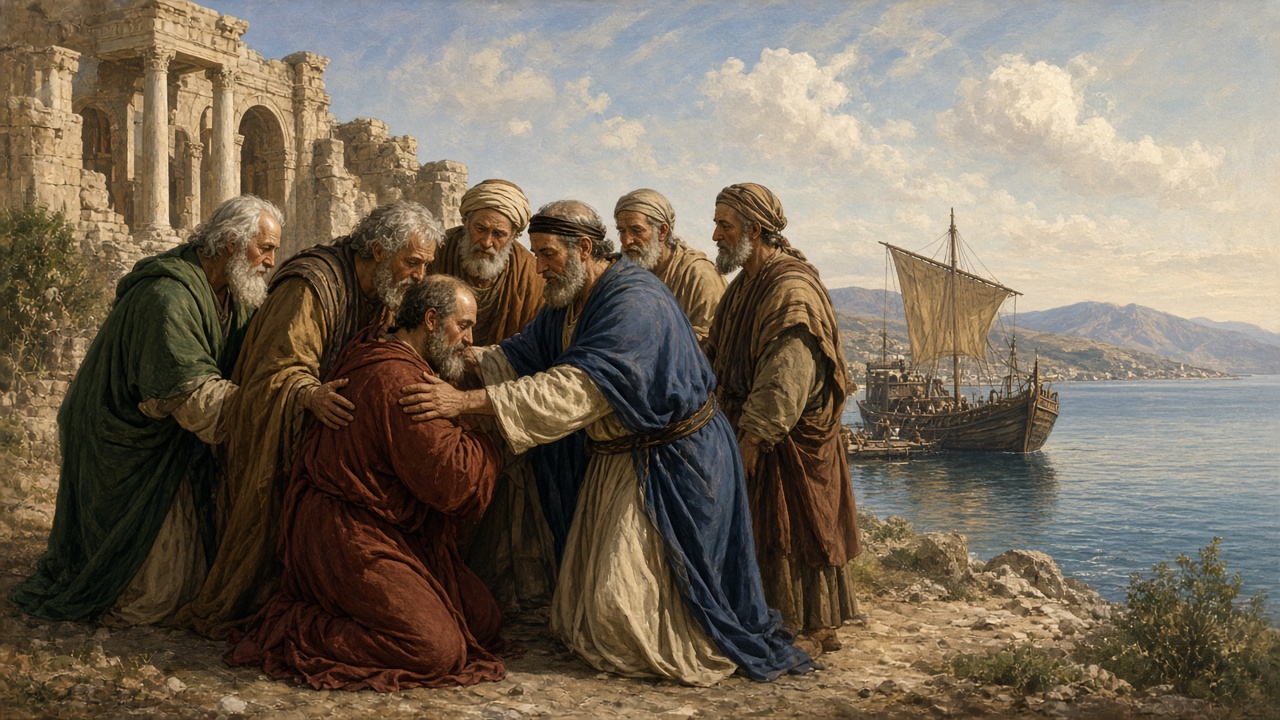
36Upa Páu pandu rahã, tamũi ta namõ ipynarãi pe wapyk. Pe, Tupã namõ a'eta pandu pandu. 37Pe, Páu ke Ese ok ta pe har tamũi ta jumã juman rahã, jixi'u hũ. Huwa ke a'eta pyter pyter tĩ. (Aja ipy'a katuha ke mujekwa.) 38“Ihẽ rehe pesak ym te ta tĩ” aja Páu pandu ramõ. Ame'ẽ je'ẽha rehe tamũi ta pyai te. Pe, jarusu keruhũ túi ame'ẽ pe Páu namõ a'eta oho.
Você sabia?
Despedida a caminho de Jerusalém
- Ao deixar Trôade, Paulo enviou os companheiros à frente no navio e foi a pé até Assos, pela estrada romana. Assos era um porto da Ásia proconsular, na Mísia, na margem norte do golfo de Adramítio; a caminhada tinha cerca de 20 milhas, o trajeto por mar cerca de 30, e a ilha de Lesbos ficava a cerca de 7 milhas da costa.Fontes: o próprio texto bíblico · Assos
- Paulo passou de navio ao largo de Éfeso para não perder tempo na província da Ásia — a província romana do oeste da Ásia Menor, cuja capital era Éfeso —, porque esperava, se possível, chegar a Jerusalém no dia de Pentecostes. Parou em Mileto, porto e antiga capital da Jônia, cerca de 36 milhas ao sul de Éfeso, e mandou chamar os anciãos da igreja de Éfeso.Fontes: o próprio texto bíblico · Asia · Miletus
- Sete homens viajavam com ele: Sópatro, de Bereia; Aristarco e Segundo, de Tessalônica; Gaio, de Derbe; Timóteo; e Tíquico e Trófimo, da Ásia. Aristarco, de Tessalônica, mais tarde compartilhou a prisão de Paulo em Roma, e Trófimo, efésio, acompanhou-o nessa parte da viagem e esteve com ele em Jerusalém.Fontes: o próprio texto bíblico · Aristarchus · Trophimus
Notas escritas com auxílio de IA a partir de fontes abertas (Theographic Bible Metadata, CC BY-SA 4.0; Easton’s Bible Dictionary, domínio público) e revisadas antes de publicar.
Lugares deste capítulo
- Macedonia · 41.600, 22.540 · versículos 1, 3, 6
- Greece · 37.972, 23.727 · versículo 2
- Syria · Hoje: Syria 2 · 33.511, 36.306 · versículo 3
- Asia · 38.400, 28.300 · versículos 4, 16, 18
- Berea · Hoje: Veria · 40.518, 22.200 · versículo 4
- Thessalonica · Hoje: Thessaloniki · 40.638, 22.946 · versículo 4
- Troas · Hoje: Alexandria Troas · 39.752, 26.159 · versículos 5, 6
- Philippi · 41.012, 24.285 · versículo 6
- Assos · 39.491, 26.337 · versículos 13, 14
- Mitylene · Hoje: ancient theater at Mitylene · 39.110, 26.547 · versículo 14
- Chios · 38.373, 26.137 · versículo 15
- Miletus · 37.531, 27.276 · versículos 15, 17
- Samos · 37.750, 26.833 · versículo 15
- Trogyllium · Hoje: Cape Mycale · 37.659, 27.003 · versículo 15
- Ephesus · 37.939, 27.341 · versículos 16, 17
- Jerusalem · 31.777, 35.234 · versículos 16, 22
Só aparecem lugares com identificação de alta confiança (90% ou mais segundo as fontes acadêmicas reunidas pelo OpenBible). Mapa da época: DARE (Digital Atlas of the Roman Empire), CC BY 4.0; mapa atual: © colaboradores do OpenStreetMap; lugares: OpenBible.info (CC BY 4.0).
Créditos e licença desta tradução
Tupã Je'ẽha
New Testament in Kaapor (BR:urb:Kaapor)
copyright © 2012 Wycliffe Bible Translators, Inc.
Language: Kaapor
Translation by: Wycliffe Bible Translators, Inc.
Copyright Information
© 2012, Wycliffe Bible Translators, Inc. All rights reserved.
This translation text is made available to you under the
terms of the Creative Commons License: Attribution-Noncommercial-No Derivative Works.
( http://creativecommons.org/licenses/by-nc-nd/3.0/ )
In addition, you have permission to port the text to different file formats, as long as you
do not change any of the text or punctuation of the Bible.
You may share, copy, distribute, transmit, and extract portions
or quotations from this work, provided that you include the above copyright
information:
You must give Attribution to the work.
You do not sell this work for a profit.
You do not make any derivative works that change any of the actual words or punctuation of the Scriptures.
Permissions beyond the scope of this license may be
available if you contact
us with your request.
The New Testament
in Kaapor
© 2012, Wycliffe Bible Translators, Inc. All rights reserved.
This translation is made available to you under the terms of the
Creative Commons Attribution-Noncommercial-No Derivatives license 4.0.
You may share and redistribute this Bible translation or extracts from it in any format, provided that:
You include the above copyright and source information.
You do not sell this work for a profit.
You do not change any of the words or punctuation of the Scriptures.
Pictures included with Scriptures and other documents on this site are licensed just for use with those Scriptures and documents.
For other uses, please contact the respective copyright owners.
2014-04-27
Fonte: http://ebible.org/urbNT/ · eBible.org