Atos 19
Tupã Je'ẽha · Toque num versículo para ver as referências cruzadas.
Ese ok ta pe Páu oho
1Korin ok ta pe Apor ixo rahã, ywy'ã rupi Páu wata oho. Amõ amõ ywy'ã 'ar rupi ok ta ihĩ. Ame'ẽ rupi wata oho. Pe, Ese ok ta pe uhyk oho. A'ep jumu'eha ta ke a'e mahem. (Ame'ẽ ta upa katu te Jesu rehe har ukwa ym.) Juã mujahukiha mu'e ame'ẽ ke jõ ame'ẽ ta ukwa katu. 2Páu pandu a'eta pe:
—Jesu rehe pejurujar katu rahã, pehẽ rehe Tupã'ã ihĩ katu my? — aja pandu.
A'eta pandu:
—Anĩ. Tupã'ã rehe har jande jakwa ym te — aja.
3Páu pandu tĩ:
—Aja rahã, myja pehẽ ke amõ mujahuk my? — aja.
A'eta pandu:
—Juã mujahukiha aja jande ke amõ mujahuk — aja ipe.
4Pe, Páu pandu:
—Juã mujahuk rahã, kuja ngã pe mujekwa. Ma'e ka'u te'eha ma'ema'eha ngi Tupã koty ipy'a ke amõ muruwak mondo, aja ngã pe mujekwa. Kuja jundéu awa ta pe Juã pandu: “Ihẽ raikwer rupi amõ sawa'e uwyr ta. Ame'ẽ rehe pejurujar katu” aja Juã pandu. Juã raikwer rupi uwyr ame'ẽ ke Jesu — aja Páu pandu.
5Ame'ẽ ke sawa'e ta hendu rahã, a'eta ke amõ mujahuk. Jesu je'ẽha rupi mujahuk. (Aja Jesu kotyhar ke a'eta apo 'y, aja ngã pe mujekwa.) 6Jesu riki jandema'e sawa'e te. Pe, ame'ẽ ta ãkã rehe ipo ke Páu mujar. Pe, ame'ẽ ta rehe Tupã'ã ihĩ katu tĩ. Pe, amõ amõ awa ta je'ẽha a'eta pandu pandu. (Aja rahã, Tupã'ã ihĩ katu a'eta rehe, aja mujekwa katu.) Tupã je'ẽha rehe har a'eta pandu pandu tĩ. 7Ame'ẽ ta awa py mokõi sawa'e ta hetaha.
8Mahapyr jahy rahã, ngã namõ Páu pandu pandu hũ. Pandu rahã, ngã ngi a'e kyje ym. Jundéu awa tama'e jy'ariha renda pe pandu pandu hũ. Jesu riki Tupã mu'am me'ẽ ke. Kapitã keruhũ aja Tupã mu'am. Jundéu awa ta harõ hũ ixo ame'ẽ ke a'e. Pe, Jesu rehe amõ jurujar katu rahã: “Ihẽ kotyhar ke nde apo 'y. Ihẽ namõ nde erexo ta” aja Tupã pandu. 9Anĩ. Ame'ẽ ke amõ ta putar ym. A'eta jurujar ym. Tupã ma'ema'e ame'ẽ rehe har katu ym a'eta pandu. Ngã hetaha ta pe a'eta pandu: “Pejurujar ym” aja pandu. A'erehe ame'ẽ ta ke Páu hijar oho. Jesu kotyhar ta ke a'e raho inamõ. Ame'ẽ ta ke jõ Páu mu'e mu'e. Wera rahã pame katu te amõ jumu'eha renda pe a'e mu'e. Jumu'eha renda riki amõ sawa'ema'e. 10Her Tira. Aja mokõi warahy 'ar rahã, Páu mu'e. A'erehe Tupã je'ẽha rehe heta Asia ywy pe har ta hendu. Heta jundéu awa ta hendu. Heta amõ awa ta hendu tĩ. Jundéu awa aja ym ame'ẽ ta ke a'eta.
Sewa ra'yr ta rehe har
11Tupãma'e pyrãtãha namõ Páu mukatu hũ. Ahy ixo ame'ẽ ta ke mukatu hũ. 12A'erehe pan kurer ta ke Páu rehe ngã mujar. Pan ra'yr ta ke mujar ehe tĩ. Ame'ẽ ta ke ahy ixo ame'ẽ ta pe ngã raho rahã, katu oho. Ãjã ta ke muhem mondo amõ ta ngi tĩ. 13Ko amõ jundéu awa ta ixo. Sewa ra'yr ta riki ixo. Kuja hetaha, awa po wajar mokõi. Ipái riki jundéu awa tama'e pa'i keruhũ. A'eta wata wata ixo. Amõ ta py'a ngi ãjã ta ke a'eta muhem mondo tĩ. Pe, Páu aja Jesu je'ẽha rupi a'eta ãjã ke muhem ta tipe manga. Jesu riki jandema'e sawa'e te. Ãjã pe a'eta pandu:
—Jesu rehe har Páu pandu pandu. Ame'ẽ je'ẽha rupi japandu: “Ehem eho” — aja ãjã pe Sewa ra'yr ta pandu.
15Pe, a'eta pe ãjã pandu:
—Jesu rehe har ihẽ akwa katu. Páu rehe har ihẽ akwa katu tĩ. Pehẽ anĩ. Awa pehẽ my? — aja ãjã pandu.
16Pe, Sewa ra'yr ta rehe sawa'e opor oho. Ãjã ipy'a rehe ihĩ ame'ẽ ke opor oho a'eta rehe. Pyrãtã opor oho a'eta rehe. Pe, ityk. Hok ngi sawa'e ta ke muhem mondo. Karãiha rape ke rãi muhem raho. Jawe te'e uhem oho tĩ. 17Ame'ẽ rehe har heta jundéu awa ta hendu. Heta amõ awa ta hendu tĩ. Jundéu awa aja ym ame'ẽ ta ke a'eta. Ese ok ta pe ixo ame'ẽ ta hendu. Hendu rahã, upa ngã jumukahem hũ ingi. “Ne jõ riki katu te me'ẽ ke” aja Jesu rehe har ngã pandu katu te. 18Jesu riki jandema'e sawa'e te. Pe, heta Jesu rehe jurujar katu ame'ẽ ta ma'e pandu uwyr. Amukwehe we pajema'e ukwaha ke a'eta ma'ema'e ixo rĩ. Ame'ẽ rehe har a'eta pandu uwyr. 19Ngã hetaha ta pyter pe pandu uwyr. Ngã hetaha ta pyter pe heta paper ke ame'ẽ ta werur tĩ. Pajema'e ukwaha ke paper rehe ihĩ. Ame'ẽ ke werur. Pe, hapy. Upa ukwái. Paper rehe muhepyha manga rahã, tamatarer heta te hũ tiki. Kuja, 50.000 wera rahã, paraky ame'ẽ muhepyha ke rehe uhyk. Ame'ẽ ke ngã hapy. Upa ukwái. (Aja pajema'e ukwaha ke hijar te, aja mujekwa katu.) 20Ukwái ha rehe ngã usak rahã, Tupã je'ẽha rehe heta ngã jurujar katu. Tupã je'ẽha riki pyrãtã te, ame'ẽja saka, a'erehe heta ngã jurujar katu ehe, Jesu rehe.
Ese ok ta pe ngã mutyapu hũ
21A'engi: “Masendo ywy rupi ihẽ aho ta. A'engi Ngere ywy rupi aho ta tĩ. A'engi Jerusarẽ ok ta pe ahyk ta aho” aja Páu pandu. Kuja a'e pandu tĩ:
—Upa Jerusarẽ ok ta pe har ta rehe ihẽ asak rahã, Hom ok ta pe ihẽ aho ta tĩ — aja Páu pandu.
22A'erehe Masendo ywy pe Timo ke a'e mondo py. Inamõ Era ke mondo tĩ. Páu namõ ma'ema'e katu ame'ẽ ta ke a'eta. Pe, Asia ywy pe Páu pyta we rĩ.
23Arahã Ese ok ta pe Tupã ma'ema'e ame'ẽ rehe har ngã je'ẽ je'ẽ hũ. Putar ym, a'erehe je'ẽ je'ẽ hũ. 24Neme riki ngã ke muparahy. Ita tuwyr rehe ma'eha a'e. A'ep Ndia rehe ngã jumu'eha renda ihĩ. Ndia riki imãi keruhũ. Tupã aja a'ep pe har ta ukwaha ngã jupe. Jumu'eha renda aja saka ok ra'yr ke Neme mujã mujã. Ita tuwyr ke te'e mujã mujã. Miasu ta heta tĩ. Ame'ẽ ma'eha rehe tamatarer a'eta pyhyk katu tĩ. 25Pe, miasu ta ke Neme mujy'ar. Neme aja ita tuwyr rehe heta ma'eha ta i'ãi tĩ. Ame'ẽ ta ke a'e mujy'ar tĩ. A'e pandu:
—Sa'e ta! Pehendu katurahã! Jande jama'eha namõ tamatarer japyhyk katu, aja pekwa katu. 26Apo Páu rehe har pekwa. A'e je'ẽha rehe pehendu tĩ. Kuja a'e pandu: “Ipo pe ma'e'ã jande jamujã ame'ẽ ke Tupã ym” aja Páu pandu. A'erehe a'e je'ẽha rehe heta ngã jurujar katu. A'erehe Tupã koty ipy'a ke heta ngã muruwak mondo. Upa Asia ywy pe har ta aja tĩ. Tupã koty ipy'a ke muruwak mondo tĩ. (A'erehe ma'e'ã ke hijar oho apo. Ndia ke hijar oho apo.) 27Katu ym aja. Jande jamujã mujã ame'ẽ ke jaxer, aja amõ ta ukwa ta. Amõ we tĩ. Ndia rehe ngã jumu'eha renda ke ngã hijar ta oho tĩ. Mujaxer ta tĩ. Katukweriha ke mumba ta tĩ. Ndia riki katu te. Jande mãi keruhũ riki a'e. Tupã aja jande jupe. Asia ywy pe har ta ipy'a moĩ moĩ katu ehe. Amõ ywy pe har ta aja tĩ. Ipy'a moĩ moĩ katu ehe tĩ — aja Neme pandu.
28Ame'ẽ je'ẽha rehe ngã hetaha ta hendu rahã, parahy te hũ. Hãtã pandu pandu hũ ixo:
—Ndia riki katu te me'ẽ ke! Upa Ese ok ta pe har ta jurujar katu ehe! — aja pandu hũ.
29A'erehe upa ok ta rupi ngã mutyapu tyapu hũ oho ixo. Pe, Ngái ke ngã hetaha ta pyhyk raho. Arita ke pyhyk raho tĩ. Ngã jy'ariha renda keruhũ pe pyhyk raho. Ngái ta masendo ywy pe har ta ke. Páu namõ wata ixo ame'ẽ ta ke a'eta. 30Ngã hetaha ta pe Páu pandu tar katu oho tĩ. Anĩ. A'e ke Jesu kotyhar ta mupyta. 31Asia ywy pe har tama'e kapitã ta je'ẽha mondo ipe tĩ. Páu pe mondo. Páu rehe katu ame'ẽ ta ke a'eta. Kuja je'ẽha ke mondo:
—Ngã jy'ariha renda keruhũ pe eho ym — aja Páu pe.
32Pe, ngã jy'ariha renda keruhũ pe hetaha ta mutyapu tyapu te hũ. Amõ amõ ta pukái pukái hũ. Amõ amõ ta riki amõ kotyhar pukái pukái hũ. Upa ka'u te'e. A'erehe upa tate ngã hetaha ta ukwa ym ma'e. Ma'ewã ngã jy'ar uwyr my? 33Ame'ẽ ke ukwa ym. Arexan riki ngã ke mujy'ar, aja amõ ta ukwa. A'e ke jundéu awa ta mupu'am, a'erehe aja amõ ta ukwa. Hetaha ruwa koty mupu'am. Pe, pu'am rahã, ipo ke Arexan mukatak. (Aja ngã je'ẽha ke a'e muputu'u ngã ngi.) Pe, jundéu awa ta rehe ngã parahy, ame'ẽ ke a'e mukatu ta tipe. 34Anĩ. A'e riki jundéu awa ke a'e aja hetaha ta ukwa rahã, pukái pukái we hũ rĩ. I'i atu kuja hãtã pandu pandu hũ:
—Ndia riki katu te ame'ẽ ke a'e! Upa Ese ok ta pe har ta jurujar katu ehe! — aja pandu hũ.
35Pe, i'i atu ngã hetaha ta tyapuha ke ok tama'e mupinĩha muputu'u ngã ngi. Kuja pandu:
—Ese ok ta pe har ta! Pehendu katurahã! Ndia rehe jumu'eha renda ke Ese ok ta pe har ta usak usak katu. Ame'ẽ rehe har upa ngã ukwa. Ndia riki katu te ame'ẽ ke a'e. Ywa ngi i'ã u'ar. Ita'ã ke u'ar. Ame'ẽ ke upa ngã ukwa katu tĩ. 36Ame'ẽ rehe har marã ka ym jaxer amõ panduha ke. A'erehe mã peja peputu'u katu. 37Pemutyapu hũ ym tĩ. Ndia rehe jumu'eha renda ngi ma'e ke Ngái ta mukanim ym. “Ndia jaxer” aja jande mãi keruhũ rehe har a'eta pandu ym tĩ. Mã! Sawa'e ta ke se perur. Ma'ewã my? 38Amõ rehe har Neme pandu tar katu rahã, ngã panduha renda pe a'e raho katu. Inamõ ixo ame'ẽ ta oho katu tĩ. A'ep kapitã ta ukwa ta. Katu my? Katu ym my? Ame'ẽ ke ukwa ta. A'ep amõ ta rehe har Neme ta pandu pandu katu ta. 39Amõ kotyhar pepandu pandu tar katu rahã, a'ep peho katu tĩ. Ngã ke amõ ta mujy'ar rahã, ame'ẽ rehe har pepandu katu. Kapitã ta ruwa koty amõ ta ukwa ta. Katu my? Katu ym my? Ame'ẽ ke ukwa ta. 40Taramõ te jande jamutyapu hũ. Kapitã keruhũ namõ jajumai jaxo, aja amõ ta pandu ta oho ipe. Jamutyapu hũ te'e. Ame'ẽ rehe har marã ka ym japanduha ipe — aja hetaha ta pe ok tama'e mupinĩha pandu.
41Upa pandu rahã, ngã hetaha ta ke a'e muhãi mondo.
Você sabia?
Paulo, o Caminho e Ártemis em Éfeso
- Éfeso era a capital da Ásia proconsular, a província romana que abrangia a parte ocidental da Ásia Menor, e nos tempos romanos ostentava o título de primeira e maior metrópole da Ásia. A cidade distinguia-se pelo templo de Ártemis, a quem os romanos chamavam Diana, construído fora das muralhas e contado entre as sete maravilhas do mundo antigo. No centro ficava uma imagem antiga da deusa, da qual se dizia que tinha caído do céu.Fontes: Ephesus · Diana · Asia
- Demétrio, um ourives de Éfeso, fazia santuários de prata de Ártemis, modelos do templo ou da estátua da deusa, que se vendiam com facilidade aos visitantes vindos de toda a Ásia Menor. Atos diz que esse comércio era a fonte de prosperidade dos artesãos e que Demétrio os alertou sobre o perigo para o negócio e para a honra do templo de Ártemis, a deusa que, segundo ele, era adorada em toda a província da Ásia e no mundo inteiro.Fontes: Demetrius · o próprio texto bíblico
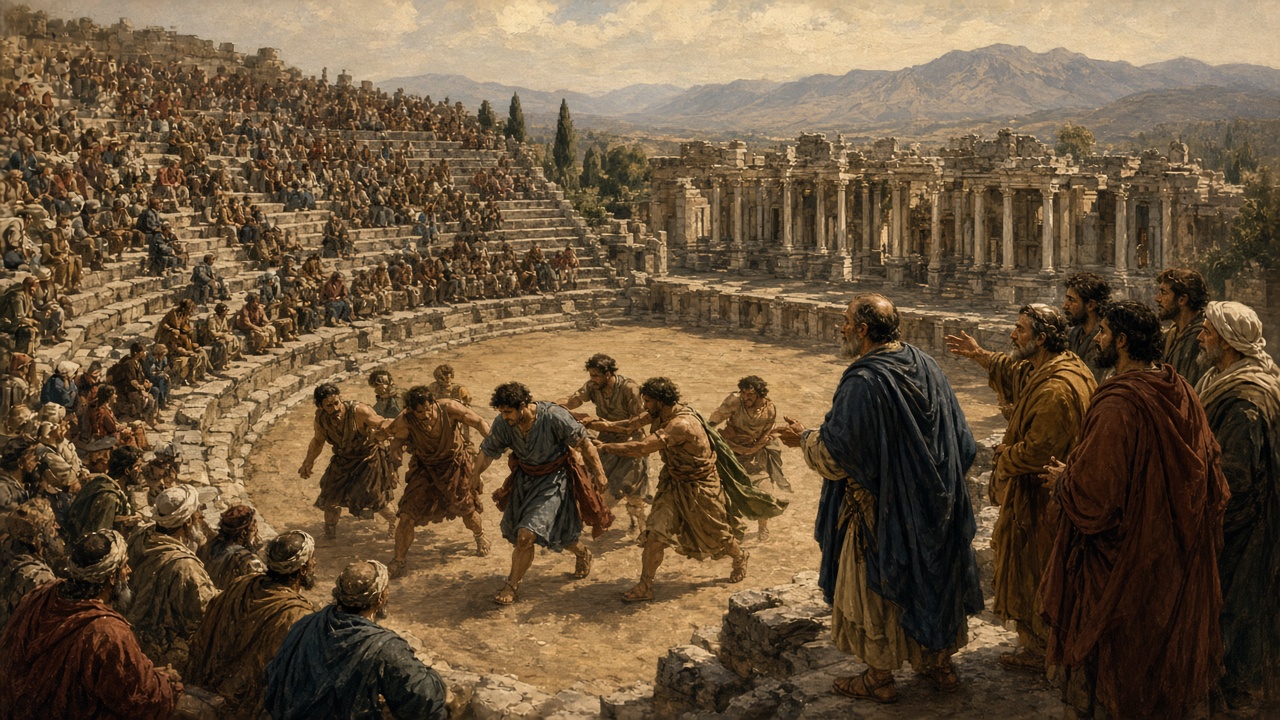
- A multidão correu para o teatro de Éfeso, que o Dicionário Bíblico de Easton (1897) descreve como o maior do mundo, a céu aberto e capaz de abrigar 50.000 espectadores. Amigos de Paulo entre os chefes da Ásia, cidadãos ricos eleitos a cada ano para presidir os jogos e as festas religiosas de suas cidades, pediram que ele não entrasse. O escrivão da cidade lembrou então à assembleia que Éfeso era guardiã do templo da grande Ártemis e da imagem que, segundo se dizia, caíra do céu.Fontes: Ephesus · Asia · o próprio texto bíblico
Notas escritas com auxílio de IA a partir de fontes abertas (Theographic Bible Metadata, CC BY-SA 4.0; Easton’s Bible Dictionary, domínio público) e revisadas antes de publicar.
Lugares deste capítulo
- Corinth · 37.906, 22.879 · versículo 1
- Ephesus · 37.939, 27.341 · versículos 1, 17, 23, 26, 35
- Asia · 38.400, 28.300 · versículos 10, 22, 26, 27, 31
- Achaia · 38.720, 22.540 · versículo 21
- Jerusalem · 31.777, 35.234 · versículo 21
- Macedonia · 41.600, 22.540 · versículos 21, 22, 29
- Rome · 41.892, 12.485 · versículos 21, 40
Só aparecem lugares com identificação de alta confiança (90% ou mais segundo as fontes acadêmicas reunidas pelo OpenBible). Mapa da época: DARE (Digital Atlas of the Roman Empire), CC BY 4.0; mapa atual: © colaboradores do OpenStreetMap; lugares: OpenBible.info (CC BY 4.0).
Créditos e licença desta tradução
Tupã Je'ẽha
New Testament in Kaapor (BR:urb:Kaapor)
copyright © 2012 Wycliffe Bible Translators, Inc.
Language: Kaapor
Translation by: Wycliffe Bible Translators, Inc.
Copyright Information
© 2012, Wycliffe Bible Translators, Inc. All rights reserved.
This translation text is made available to you under the
terms of the Creative Commons License: Attribution-Noncommercial-No Derivative Works.
( http://creativecommons.org/licenses/by-nc-nd/3.0/ )
In addition, you have permission to port the text to different file formats, as long as you
do not change any of the text or punctuation of the Bible.
You may share, copy, distribute, transmit, and extract portions
or quotations from this work, provided that you include the above copyright
information:
You must give Attribution to the work.
You do not sell this work for a profit.
You do not make any derivative works that change any of the actual words or punctuation of the Scriptures.
Permissions beyond the scope of this license may be
available if you contact
us with your request.
The New Testament
in Kaapor
© 2012, Wycliffe Bible Translators, Inc. All rights reserved.
This translation is made available to you under the terms of the
Creative Commons Attribution-Noncommercial-No Derivatives license 4.0.
You may share and redistribute this Bible translation or extracts from it in any format, provided that:
You include the above copyright and source information.
You do not sell this work for a profit.
You do not change any of the words or punctuation of the Scriptures.
Pictures included with Scriptures and other documents on this site are licensed just for use with those Scriptures and documents.
For other uses, please contact the respective copyright owners.
2014-04-27
Fonte: http://ebible.org/urbNT/ · eBible.org