Zacarias 4
Bib Sen An · Toque num versículo para ver as referências cruzadas.
1Konsa, zanj ki t ap pale avè m nan te retounen. E te Li fè m leve tankou yon nonm yo te leve soti nan dòmi. 2Li te di m: “Kisa ou wè?”
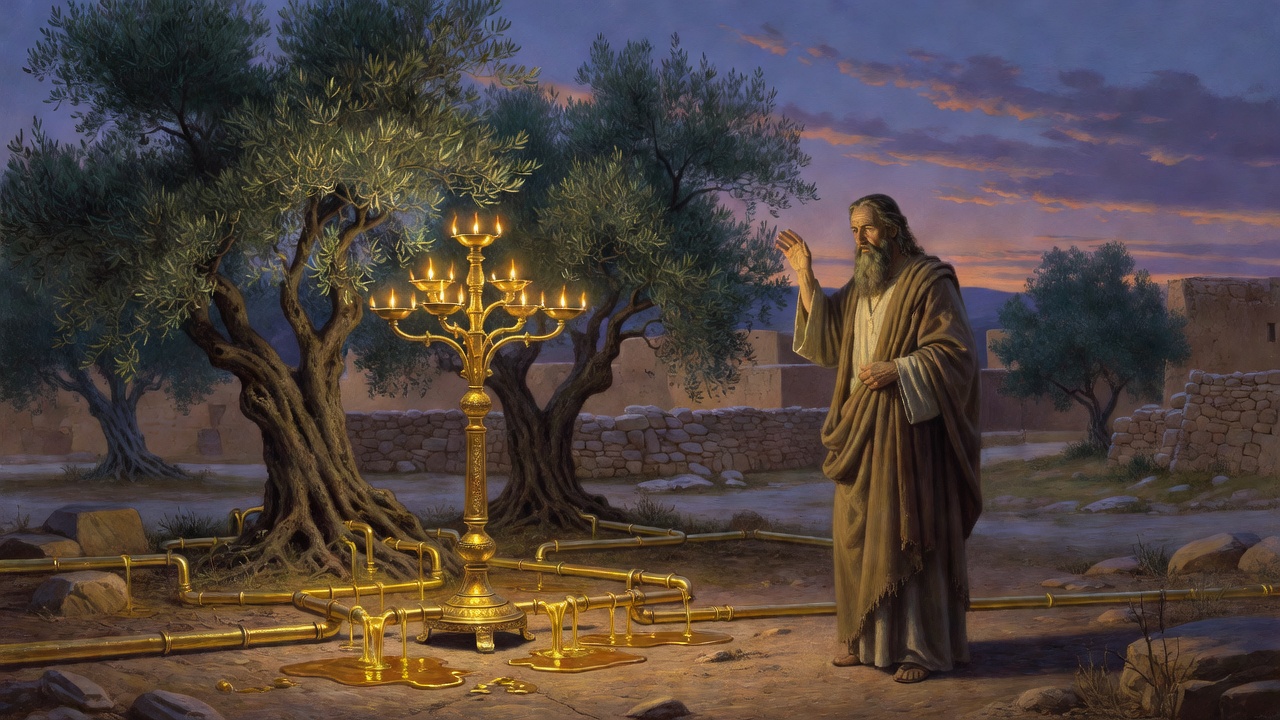
Mwen te di: “Mwen te wè e vwala, yon chandelye ki fèt nèt an lò, avèk bòl li sou tèt li, ak sèt lanp li yo. Gen sèt bòbèch pou chak lanp ki sou li yo. 3Anplis, gen de bwa doliv yo sou kote li, youn sou kote dwat bòl la, e lòt la sou kote goch la.”
4Mwen te di a zanj ki t ap pale avè m nan. Mwen te di: “Kisa sa yo ye mèt mwen?”
5Konsa, zanj ki t ap pale avè m nan te reponn. Li te di m: “Èske ou pa konnen kisa sa yo ye?”
Mwen te reponn: “Non, mèt mwen.”
6Epi li te di m: “Sa se pawòl SENYÈ a Zorobabel la ki di: ‘Se pa pa lafòs, ni pa pwisans, men pa Lespri Mwen,’ pale SENYÈ dèzame yo. 7‘Se kilès ou ye, O gran montay la? Devan Zorobabel, ou va vin tounen tè pla. Konsa, li va fè vin parèt ak wòch prensipal la, ak gwo kri k ap di: “Gras, gras a li!”’”
8Anplis, pawòl SENYÈ a te vin kote mwen. Li te di: 9“Men a Zorobabel te poze fondasyon kay sa. Se men l k ap fin fè l. Konsa, ou va konnen ke se SENYÈ dèzame yo ki te voye mwen kote ou. 10Paske se kilès ki te meprize jou a ti bagay yo? Men sèt sila yo va rejwi lè yo wè liy a plòn an nan men Zorobabel. Sa yo se zye SENYÈ a k ap veye toupatou sou tout tè a.”
11Mwen te di li: “Se kisa de bwa doliv sila yo ki sou kote dwat ak sou kote goch a chandelye yo ye?”
12Mwen te mande l yon dezyèm fwa. Mwen te di li: “Se kisa de branch doliv sila yo ki sou kote de tij an lò k ap vide lwil an lò k ap soti nan yo a?”
13Li te reponn mwen, e te di: “Èske ou pa konnen kisa yo ye?” Mwen te di: “Non mèt mwen.” 14Li te di: “Sa yo se de moun onksyone yo ki kanpe akote Mèt a tout tè a.”
Você sabia?
O candelabro e Zorobabel
- Zorobabel liderou o primeiro grupo de exilados judeus que retornaram da Babilônia e lançou os alicerces do templo reconstruído. Nesta visão, o profeta recebe a garantia de que, apesar dos grandes obstáculos, Zorobabel completará o templo e colocará a pedra de remate com o prumo na mão.Fontes: Zerubbabel · o próprio texto bíblico
- A visão do candelabro de ouro maciço alimentado pelo azeite de duas oliveiras ilustra que a obra de Deus seria realizada não por força nem por poder, mas pelo seu Espírito. Os dois ramos de oliveira são identificados como dois ungidos que estão ao lado do Senhor de toda a terra.Fontes: o próprio texto bíblico
Notas escritas com auxílio de IA a partir de fontes abertas (Theographic Bible Metadata, CC BY-SA 4.0; Easton’s Bible Dictionary, domínio público) e revisadas antes de publicar.
Créditos e licença desta tradução
Bib Sen An
The Holy Bible in Haitian Creole, 2023 update
copyright © 2017-2023 Ron Smith
Language: Kreyòl Ayisyen (Haitian)
Translation by: Ron Smith
Contributor: Felix Nixon
This translation is made available to you under the terms of the
Creative Commons Attribution Share-Alike license 4.0.
You have permission to share and redistribute this Bible translation in any format and to make reasonable revisions and adaptations of this translation, provided that:
You include the above copyright and source information.
If you make any changes to the text, you must indicate that you did so in a way that makes it clear that the original licensor is not necessarily endorsing your changes.
If you redistribute this text, you must distribute your contributions under the same license as the original.
Pictures included with Scriptures and other documents on this site are licensed just for use with those Scriptures and documents.
For other uses, please contact the respective copyright owners.
Note that in addition to the rules above, revising and adapting God's Word involves a great responsibility to be true to God's Word. See Revelation 22:18-19.
2026-06-11
Fonte: http://ebible.org/hatbsa/ · eBible.org