Salmos 1
Wycliffe's Bible with Modern Spelling (Enhanced) · Toque num versículo para ver as referências cruzadas.
Sobre este livro
Sobre os Salmos
- O Dicionário Bíblico de Easton (1897) apresenta os Salmos como obra de vários autores, devida sobretudo a Davi e a seus contemporâneos, enquanto poetas de gerações posteriores acrescentaram outros cânticos. Easton observa que, por isso, a coleção reflete de modo mais completo cada fase da emoção e das circunstâncias humanas do que refletiria de outro modo. Os títulos atribuem 73 salmos a Davi; Easton também nota que Pedro e João (Atos 4:25) atribuem a ele o Salmo 2, que é anônimo, e que cerca de dois terços da coleção têm sido atribuídos a Davi.Fontes: Easton: Psalms
- O Dicionário Bíblico de Easton (1897) sustenta que nenhum salmo pode ser provado como posterior ao tempo de Esdras e Neemias, de modo que a coleção abrange cerca de mil anos. Ele registra a presunção de que as cinco coleções menores foram reunidas em tempos de elevada vida religiosa: a primeira perto do fim da vida de Davi, a segunda nos dias de Salomão, a terceira pelos cantores de Josafá, a quarta pelos homens de Ezequias e a quinta nos dias de Esdras.Fontes: Easton: Psalms
- À semelhança do Pentateuco, o Saltério divide-se em cinco livros, cada um encerrado com uma doxologia ou bênção: Salmos 1-41, 42-72, 73-89, 90-106 e os 44 restantes. Easton registra muitas atribuições a Davi, a Salomão nos Salmos 72 e 127, a Moisés no Salmo 90, a Hemã, o ezraíta, no Salmo 88, e a Etã, o ezraíta, no Salmo 89, enquanto muitos outros salmos são anônimos.Fontes: Easton: Psalms
- Alguns títulos ligam salmos aos cantores do culto. Os Salmos 50 e 73-83 são dirigidos a Asafe, um levita e um dos líderes do coro de Davi, hábil na música e chamado vidente; o verbete sobre Asafe diz que os filhos de Asafe eram seus descendentes ou, mais provavelmente, uma classe de poetas ou cantores que o reconheciam como mestre. Os filhos de Corá, parte de destaque entre os cantores coatitas, foram encarregados de arranjar e cantar os Salmos 42, 44-49, 84, 85, 87 e 88, e os Salmos 39, 62 e 77 são dirigidos a Jedutum, para serem cantados segundo o seu modo ou no seu coro.Fontes: Easton: Psalms · Asaph (Levite)
- O Salmo 136 é em geral chamado o grande hallel, embora o Talmude inclua também os Salmos 120-135. Os Salmos 113-118 formam o hallel recitado nas três grandes festas, na lua nova e nos oito dias da festa da dedicação. Easton conta 116 citações diretas do Saltério no Novo Testamento e observa que, em Lucas 24:44, a palavra salmos designa os Hagiógrafos, os escritos sagrados, uma das seções em que os judeus dividiam o Antigo Testamento.Fontes: Easton: Psalms
Notas escritas com auxílio de IA a partir de fontes abertas (Theographic Bible Metadata, CC BY-SA 4.0; Easton’s Bible Dictionary, domínio público) e revisadas antes de publicar.
The Two Paths
1Blessed is the man, that goeth not in the counsel of wicked men; and stood not in the way of sinners, and sat not in the chair of pestilence. (Happy is the person, who goeth not in the counsel of the wicked; and walketh not in the way of sinners, and sitteth not in the chair of pestilence.)
2But his will is in the law of the Lord; and he shall bethink in the law of him day and night. (But his delight is in the Law of the Lord; and he shall think about his Law day and night.)
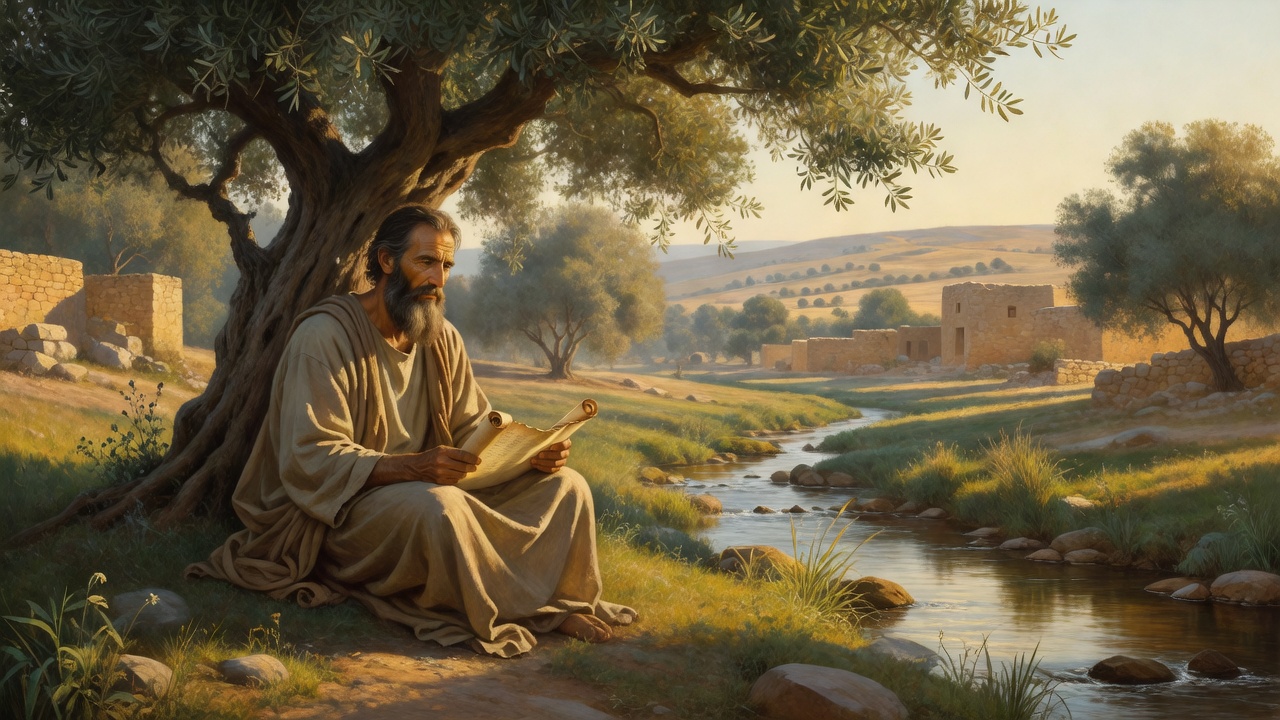
3And he shall be as a tree, which is planted beside the runnings of waters; that shall give his fruit in his time. And his leaf shall not fall down; and all things, whichever he shall do, shall have prosperity. (And he shall be like a tree, which is planted beside the running water; it shall give its fruit at its proper time, and its leaves shall not fall down. Yea, everything, whatever he shall do, shall prosper.)
4Not so wicked men, not so; but they be as dust, which the wind casteth away from the face of the earth. (Not so the wicked, not so; but they be like the dust, which the wind bloweth away from off the face of the earth.)
5Therefore wicked men rise not again in doom; neither sinners in the council of just men [nor (the) sinful in the council of (the) rightwise]. (And so the wicked shall not stand long at the judgement; nor shall the sinners stand with the congregation of the righteous.)
6For the Lord knoweth the way of just men [or For the Lord hath known the way of the rightwise]; and the way of wicked men shall perish. (For the Lord knoweth the way of the righteous; but the way of the wicked shall perish.)
Você sabia?
Os dois caminhos
- O Salmo 1 contrasta dois modos de vida por meio de imagens da agricultura: a pessoa justa é comparada a uma árvore frutífera nutrida junto a correntes de água, enquanto os ímpios são comparados à palha leve facilmente dispersada pelo vento.Fontes: o próprio texto bíblico
- Os versículos iniciais descrevem uma clara postura de afastamento do mal — recusando andar no conselho dos ímpios, parar no caminho dos pecadores ou sentar-se com os zombadores —, voltando-se para a meditação contínua na Lei do SENHOR.Fontes: o próprio texto bíblico
Notas escritas com auxílio de IA a partir de fontes abertas (Theographic Bible Metadata, CC BY-SA 4.0; Easton’s Bible Dictionary, domínio público) e revisadas antes de publicar.
Créditos e licença desta tradução
Wycliffe's Bible with Modern Spelling (Enhanced)
English: Wycliffe's Bible Modern Spelling (Enhanced) (with Deuterocanon)
Copyright © 2001,2010,2011,2012,2013,2015 Terry Noble
Language: English
Dialect: Archaic
Translation by: Terry Noble
Wycliffe's Bible with Modern Spelling (Enhanced)
Wycliffe’s Bible with Modern Spelling (Enhanced) is a composite of my Wycliffe’s Bible, a modern-spelling version of the 14th century Middle English translation, consisting of Wycliffe’s Old Testament and Wycliffe’s New Testament, and my modern-spelling version of Wycliffe’s Apocrypha. These books contain literally tens of thousands of rewritten verses, presented in parentheses “( ) “, to provide help in comprehending the 14th century Middle English vocabulary and grammar. Wycliffe’s Apocrypha also includes the books of the Apocrypha from the 1st edition of the King James Version of the Bible.
This translation is made available to you under the terms of the
Creative Commons Attribution-Noncommercial-No Derivatives license 4.0.
You may share and redistribute this Bible translation or extracts from it in any format, provided that:
You include the above copyright and source information.
You do not sell this work for a profit.
You do not change any of the words or punctuation of the Scriptures.
Pictures included with Scriptures and other documents on this site are licensed just for use with those Scriptures and documents.
For other uses, please contact the respective copyright owners.
2019-09-25
Títulos de seção adaptados da Berean Standard Bible (domínio público); não fazem parte do texto bíblico desta tradução.
Fonte: http://ebible.org/engwyc2018/ · eBible.org