Salmos 1
Wycliffe's Bible with Modern Spelling (Enhanced) · Toca un versículo para ver sus referencias cruzadas.
Acerca de este libro
Acerca de los Salmos
- El Diccionario Bíblico de Easton (1897) presenta los Salmos como obra de varios autores, debida sobre todo a David y a sus contemporáneos, mientras poetas de generaciones posteriores añadieron otros cantos. Easton observa que, por ello, la colección refleja de modo más completo cada fase de la emoción y de las circunstancias humanas de lo que lo haría de otro modo. Los títulos atribuyen 73 salmos a David; Easton también señala que Pedro y Juan (Hechos 4:25) le atribuyen el Salmo 2, que es anónimo, y que cerca de dos tercios de la colección se han atribuido a David.Fuentes: Easton: Psalms
- El Diccionario Bíblico de Easton (1897) sostiene que ningún salmo puede demostrarse posterior al tiempo de Esdras y Nehemías, de modo que la colección abarca unos mil años. Recoge la presunción de que las cinco colecciones menores se reunieron en tiempos de elevada vida religiosa: la primera cerca del final de la vida de David, la segunda en días de Salomón, la tercera por los cantores de Josafat, la cuarta por los hombres de Ezequías y la quinta en días de Esdras.Fuentes: Easton: Psalms
- A semejanza del Pentateuco, el Salterio se divide en cinco libros, cada uno cerrado con una doxología o bendición: Salmos 1-41, 42-72, 73-89, 90-106 y los 44 restantes. Easton registra muchas atribuciones a David, a Salomón en los Salmos 72 y 127, a Moisés en el Salmo 90, a Hemán ezraíta en el Salmo 88 y a Etán ezraíta en el Salmo 89, mientras muchos otros salmos son anónimos.Fuentes: Easton: Psalms
- Algunos títulos vinculan salmos con los cantores del culto. Los Salmos 50 y 73-83 se dirigen a Asaf, un levita y uno de los líderes del coro de David, diestro en la música y llamado vidente; la entrada sobre Asaf dice que los hijos de Asaf eran sus descendientes o, más probablemente, una clase de poetas o cantores que lo reconocían como maestro. Los hijos de Coré, parte destacada de los cantores coatitas, fueron encargados de organizar y cantar los Salmos 42, 44-49, 84, 85, 87 y 88, y los Salmos 39, 62 y 77 se dirigen a Jedutún, para ser cantados según su manera o en su coro.Fuentes: Easton: Psalms · Asaph (Levite)
- El Salmo 136 suele llamarse el gran hallel, aunque el Talmud incluye también los Salmos 120-135. Los Salmos 113-118 forman el hallel recitado en las tres grandes fiestas, en la luna nueva y en los ocho días de la fiesta de la dedicación. Easton cuenta 116 citas directas del Salterio en el Nuevo Testamento y señala que, en Lucas 24:44, la palabra salmos designa los Hagiógrafos, los escritos sagrados, una de las secciones en que los judíos dividían el Antiguo Testamento.Fuentes: Easton: Psalms
Notas escritas con ayuda de IA a partir de fuentes abiertas (Theographic Bible Metadata, CC BY-SA 4.0; Easton’s Bible Dictionary, dominio público) y revisadas antes de publicarse.
The Two Paths
1Blessed is the man, that goeth not in the counsel of wicked men; and stood not in the way of sinners, and sat not in the chair of pestilence. (Happy is the person, who goeth not in the counsel of the wicked; and walketh not in the way of sinners, and sitteth not in the chair of pestilence.)
2But his will is in the law of the Lord; and he shall bethink in the law of him day and night. (But his delight is in the Law of the Lord; and he shall think about his Law day and night.)
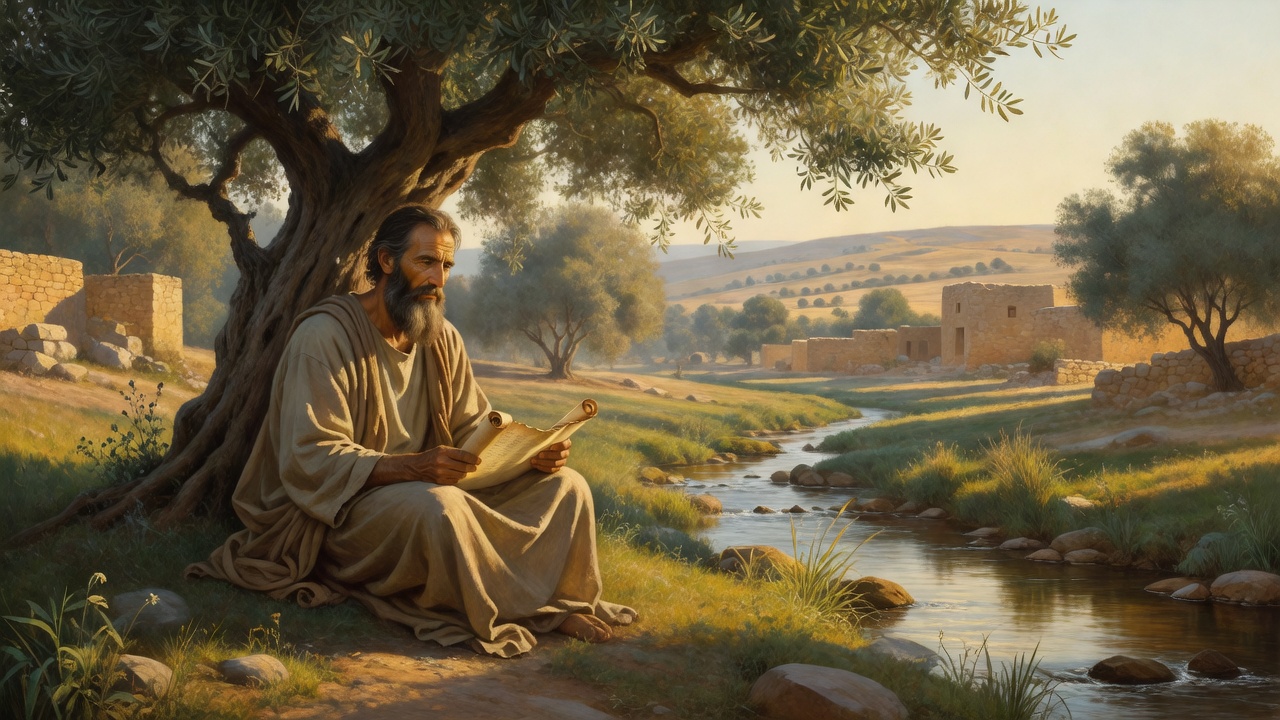
3And he shall be as a tree, which is planted beside the runnings of waters; that shall give his fruit in his time. And his leaf shall not fall down; and all things, whichever he shall do, shall have prosperity. (And he shall be like a tree, which is planted beside the running water; it shall give its fruit at its proper time, and its leaves shall not fall down. Yea, everything, whatever he shall do, shall prosper.)
4Not so wicked men, not so; but they be as dust, which the wind casteth away from the face of the earth. (Not so the wicked, not so; but they be like the dust, which the wind bloweth away from off the face of the earth.)
5Therefore wicked men rise not again in doom; neither sinners in the council of just men [nor (the) sinful in the council of (the) rightwise]. (And so the wicked shall not stand long at the judgement; nor shall the sinners stand with the congregation of the righteous.)
6For the Lord knoweth the way of just men [or For the Lord hath known the way of the rightwise]; and the way of wicked men shall perish. (For the Lord knoweth the way of the righteous; but the way of the wicked shall perish.)
¿Sabías que…?
Los dos caminos
- El Salmo 1 contrasta dos formas de vida mediante imágenes agrícolas: la persona justa es comparada con un árbol frondoso nutrido junto a corrientes de agua, mientras que los malvados son semejantes a la paja que el viento arrebata fácilmente.Fuentes: el propio texto bíblico
- Los versos iniciales describen una clara postura de rechazo al mal —no andar en el consejo de los impíos, no detenerse en el camino de los pecadores ni sentarse con los burladores—, eligiendo en su lugar meditar continuamente en la Ley del Señor.Fuentes: el propio texto bíblico
Notas escritas con ayuda de IA a partir de fuentes abiertas (Theographic Bible Metadata, CC BY-SA 4.0; Easton’s Bible Dictionary, dominio público) y revisadas antes de publicarse.
Créditos y licencia de esta traducción
Wycliffe's Bible with Modern Spelling (Enhanced)
English: Wycliffe's Bible Modern Spelling (Enhanced) (with Deuterocanon)
Copyright © 2001,2010,2011,2012,2013,2015 Terry Noble
Language: English
Dialect: Archaic
Translation by: Terry Noble
Wycliffe's Bible with Modern Spelling (Enhanced)
Wycliffe’s Bible with Modern Spelling (Enhanced) is a composite of my Wycliffe’s Bible, a modern-spelling version of the 14th century Middle English translation, consisting of Wycliffe’s Old Testament and Wycliffe’s New Testament, and my modern-spelling version of Wycliffe’s Apocrypha. These books contain literally tens of thousands of rewritten verses, presented in parentheses “( ) “, to provide help in comprehending the 14th century Middle English vocabulary and grammar. Wycliffe’s Apocrypha also includes the books of the Apocrypha from the 1st edition of the King James Version of the Bible.
This translation is made available to you under the terms of the
Creative Commons Attribution-Noncommercial-No Derivatives license 4.0.
You may share and redistribute this Bible translation or extracts from it in any format, provided that:
You include the above copyright and source information.
You do not sell this work for a profit.
You do not change any of the words or punctuation of the Scriptures.
Pictures included with Scriptures and other documents on this site are licensed just for use with those Scriptures and documents.
For other uses, please contact the respective copyright owners.
2019-09-25
Títulos de sección adaptados de la Berean Standard Bible (dominio público); no forman parte del texto bíblico de esta traducción.
Fuente: http://ebible.org/engwyc2018/ · eBible.org