Gênesis 2
Targum Onkelos Etheridge · Toque num versículo para ver as referências cruzadas.
The Seventh Day
1And the heavens and the earth and all their host were completed. 2And the Lord finished in the Seventh Day His work which He had wrought, and rested in the Seventh Day from all His work which He had wrought. 3And the Lord blessed the Seventh Day and made it holy, because in it He rested from all His work which the Lord had created to make.
Man and Woman in the Garden
4These are the memorials of the heavens and the earth, when they were created in the day when the Lord God made the earth and the heavens. 5And all trees of the field were not yet in the earth, and every herb of the field had not yet sprung up, because the Lord God had not caused rain to come upon the earth, and there was no man to cultivate the ground. 6And a mist ascended from the earth, and moistened all the face of the ground. 7And the Lord God created Adam from dust of the ground, and breathed upon his face the breath of lives, and it became in Adam a Discoursing Spirit. 8And the Lord God planted a garden in a region of pleasantness in the time of the beginning, and He made to dwell there the man whom He had created. 9And the Lord God caused to grow from the earth every tree desirable to look upon, and good for food, and the Tree of Life (Lives) in the midst of the garden, and the Tree of whose fruit they who eat know between good and evil.
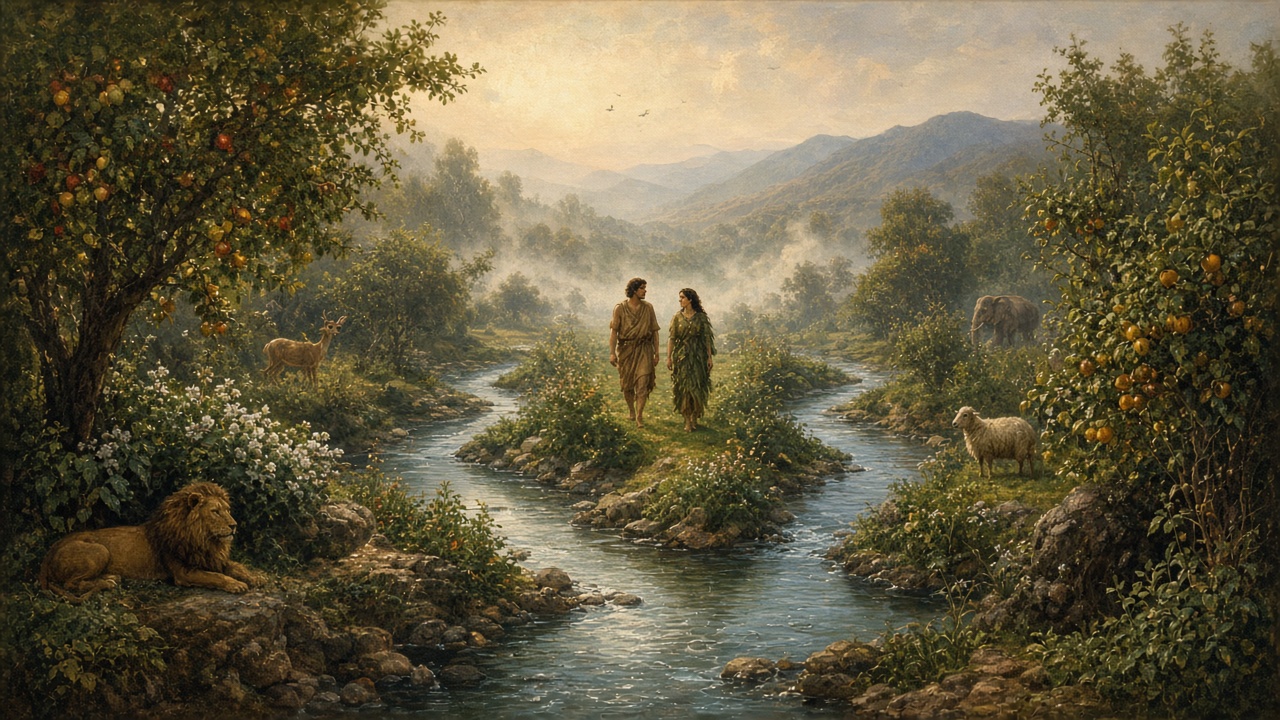
10And a river went forth from Eden to water the garden, and from thence it was divided and became four heads of rivers (or four chief rivers). 11The name of the first is Pishon, that which encompasseth all the land of Havilah, where is gold; 12and the gold of that land is good; there is bedalcha and Burilla stones. 13And the name of the second river is Gichon, which encompasseth all the land of Kush. 14And the name of the third river is Digelatlh, which goeth to the east of Athur. And the fourth river is Pherat.
15And the Lord God took Adam and placed him in the garden of Eden to culture it and keep it. 16And the Lord God commanded Adam, saying, Of every tree of the garden eating thou mayest eat; 17but of the tree of whose fruit they who eat know between good and evil thou shalt not eat; for in the day that thou eatest of it dying thou shalt die.
18And the Lord God said, It is not right that Adam should be solitary; I will make for him a helper as for his sake (or, as suited to him: Heb., kenegdo, as his counterpart). 19And the Lord God created from the earth every beast of the field and every fowl of the heavens, and brought them to Adam to see what he would call him; and every (name by) which Adam called the living animal, that was its name. 20And Adam called the name of all cattle, and of the fowl of the heaven, and of every beast of the field; but to Adam was not found a helper as for him. 21And the Lord God threw a sleep upon Adam, and he slept; and He took one of his ribs, and filled with flesh in place thereof; 22and the Lord God builded the rib which He took from Adam into Woman, and He brought her unto Adam. 23And Adam said, This now (this time) is bone of my bone, and flesh of my flesh: this shall be called Woman, because from her husband this was taken. 24Therefore shall a man forsake the couch ( beth mishkeb, the sleeping-house) of his father and his mother, and shall cleave to his wife, and they shall be of one flesh. 25And they were both naked, Adam and his wife, and were not ashamed.
Você sabia?
Adão, o Éden e os quatro rios
- Adão, que significa “vermelho”, é uma palavra babilônica e o nome comum do ser humano, com o mesmo sentido em hebraico e em assírio. Foi dado ao primeiro homem. Ele foi formado do pó da terra — daí o nome — e Deus soprou em suas narinas o fôlego da vida.Fontes: Adam · o próprio texto bíblico
- Um rio saía do Éden e se dividia em quatro braços: o Pisom, o Giom, o Hidequel e o Eufrates. Alguns identificam o Pisom com o Fásis ou o Hális; outros, com o Indo, o Ganges ou ainda outros rios. O Giom já foi identificado com o Nilo, e outros o consideram o Oxo, o Araxes ou o Ganges. O Hidequel é o Tigre, chamado pelos acádios de rio de Idikla; Gesenius entendeu o nome como “o Tigre rápido”.Fontes: o próprio texto bíblico · Pison · Gihon · Hiddekel
- O lugar do Éden, o jardim em que viveram os primeiros pais, foi discutido mais do que quase qualquer outra questão geográfica. Já foi situado na Armênia, na região a oeste do mar Cáspio, na Média, perto de Damasco, na Palestina, no sul da Arábia e na Babilônia. O Easton's Bible Dictionary (1897) o procura ao longo do Tigre e do Eufrates da Ásia ocidental, na terra de Sinar, ou Babilônia.Fontes: Eden
Notas escritas com auxílio de IA a partir de fontes abertas (Theographic Bible Metadata, CC BY-SA 4.0; Easton’s Bible Dictionary, domínio público) e revisadas antes de publicar.
Lugares deste capítulo
- Assyria · 36.359, 43.153 · versículo 14
- Euphrates · Hoje: Euphrates River · 31.004, 47.442 · versículo 14
- Tigris · Hoje: Tigris River · 31.004, 47.442 · versículo 14
Só aparecem lugares com identificação de alta confiança (90% ou mais segundo as fontes acadêmicas reunidas pelo OpenBible). Mapa da época: DARE (Digital Atlas of the Roman Empire), CC BY 4.0; mapa atual: © colaboradores do OpenStreetMap; lugares: OpenBible.info (CC BY 4.0).
Créditos e licença desta tradução
Targum Onkelos Etheridge
The Targums of Onkelos and Jonathan Ben Uzziel On the Pentateuch With The Fragments of the Jerusalem Targum From the Chaldee by J. W. Etheridge, M.A. First Published 1862-65.
Public Domain
Language: English
2020-12-20
Títulos de seção adaptados da Berean Standard Bible (domínio público); não fazem parte do texto bíblico desta tradução.
Fonte: http://ebible.org/engoke/ · eBible.org