Êxodo 5
Targum Onkelos Etheridge · Toque num versículo para ver as referências cruzadas.
Pharaoh’s First Refusal
1And afterward Mosheh and Aharon went in, and said to Pharoh: Thus saith the Lord, the God of Israel, Let My people go, to solemnize a feast ( yechagun) before Me in the desert. 2And Pharoh said, The name of the Lord is not know to me, that I should hearken to His word to send Israel away. The name of the Lord is not revealed to me, and Israel I shall not release. 3And they said, The God of the Jehudaee hath revealed Himself to us; let us now go three days’ journey into the desert to sacrifice before the Lord our God, lest He come upon us with death or with slaughter. 4And the king of Mizraim said to them, Why, Mosheh and Aharon, do you hinder the people from their works? Go to your employment. 5And Pharoh said, Behold now, the people of the land are many, and you make them relax from their employment.
Bricks and Straw
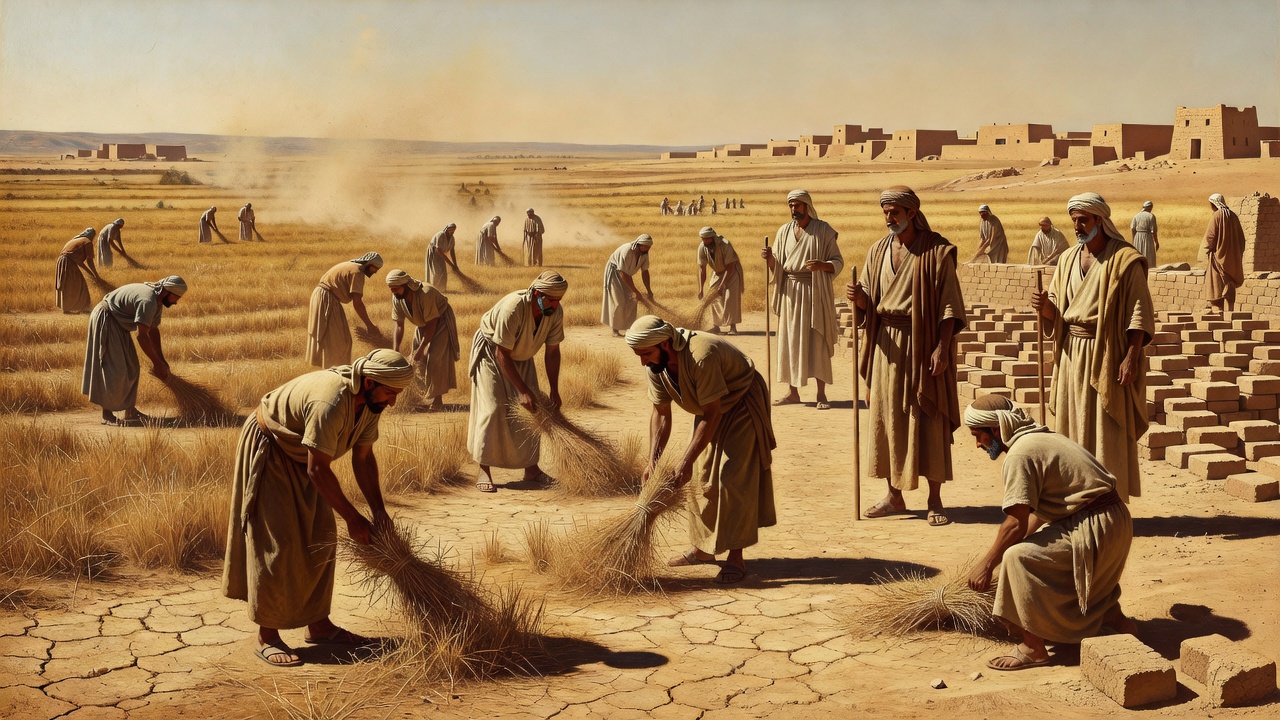
6And Pharoh that day commanded the masters of the people and the overseers, saying, 7You shall not continue (add) to give straw to the people to cast bricks, as heretofore; let them go and collect straw for themselves; 8Yet the number of bricks which they have made heretofore you shall still lay upon them and not diminish; for they are idle, and therefore cry, saying, We will go and sacrifice before our God. 9Make labour heavy upon the men: let them be occupied with it, and not with vain words.
10And the masters of the people and the overseers went forth and spake to the people, saying, Thus saith Pharoh, I will not give you straw; 11You shall go and gather up straw for yourselves wheresoever you can find it; though from you work there shall be mother diminished. 12And the people were scattered abroad over all the country of Mizraim to gather stubble for straw. 13And the masters were urgent, saying, Fulfil your work, the matter of a day in a day, as you did when straw was given to you. 14And the masters whom Pharoh set over the sons of Israel smote them, saying, Why do you not fulfil your requirement to cast bricks as heretofore, as yesterday, so also today?
The Cry of the Israelites
15And the overseers of the sons of Israel came and complained before Pharoh, saying, Why hast thou done thus with thy servants? 16Thou hast not given thy servants straw, yet they say to us, Make bricks; and, behold, thy servants are beaten, and thy people sin against us. 17But he said, You are idle: therefore you say, We will go and sacrifice before the Lord. 18And now go, work: but straw I will not give you; yet the number of bricks you shall render. 19And the overseers of the sons of Israel perceived that they were in evil: for they said to them, You shall not diminish form your bricks the matter of a day, in a day. 20And they met Mosheh and Aharon standing before them in their coming out from being with Pharoh. 21And they said to them, May the Lord manifest Himself to you and adjudge; because you have made our savour evil in the eyes of Pharoh, and in the eyes of his servants, and have put a sword into their hands to kill us!
22And Mosheh returned before the Lord and said, O Lord, why hast Thou done evil unto this people, and wherefore didst Thou send me? 23And from the time that I went in to Pharoh to speak in Thy name he hath done evil to this people, but liberating Thou hast not liberated Thy people.
Você sabia?
Trabalho mais duro depois da recusa do faraó
- O Easton's Bible Dictionary (1897) diz que o faraó do Êxodo foi provavelmente Menephtah I, o décimo quarto e mais velho filho sobrevivente de Ramsés II, mas trata a identificação como uma questão ainda em aberto: alguns estudiosos, observa a obra, preferem Seti II, cujo reinado ela descreve como iniciado em paz e terminado num desastre repentino. O verbete diz que ele residia em Zoã, onde recebeu Moisés e Arão nas audiências registradas em Êxodo.Fontes: Pharaoh (of the Exodus) · o próprio texto bíblico
- O Easton's Bible Dictionary (1897) situa a chegada de Jacó ao Egito provavelmente cerca de 350 anos antes do nascimento de Moisés. Diz que um rei hicso, de um povo semita pastoril da Ásia e chamado rei pastor, recebeu a família com favor e lhes destinou Gósen, a melhor terra; neste capítulo o faraó trata o povo de Israel, já numeroso, como trabalhadores que não pretende deixar partir.Fontes: Moses · o próprio texto bíblico
- O faraó responde ao pedido de celebrar uma festa no deserto deixando de fornecer a palha para os tijolos, mas ainda exigindo a mesma cota diária. O povo se espalha por toda a terra do Egito para recolher restolho, e os oficiais israelitas que os capatazes do faraó haviam posto sobre eles são espancados quando essa cota não é cumprida.Fontes: o próprio texto bíblico
Notas escritas com auxílio de IA a partir de fontes abertas (Theographic Bible Metadata, CC BY-SA 4.0; Easton’s Bible Dictionary, domínio público) e revisadas antes de publicar.
Lugares deste capítulo
Só aparecem lugares com identificação de alta confiança (90% ou mais segundo as fontes acadêmicas reunidas pelo OpenBible). Mapa da época: DARE (Digital Atlas of the Roman Empire), CC BY 4.0; mapa atual: © colaboradores do OpenStreetMap; lugares: OpenBible.info (CC BY 4.0).
Créditos e licença desta tradução
Targum Onkelos Etheridge
The Targums of Onkelos and Jonathan Ben Uzziel On the Pentateuch With The Fragments of the Jerusalem Targum From the Chaldee by J. W. Etheridge, M.A. First Published 1862-65.
Public Domain
Language: English
2020-12-20
Títulos de seção adaptados da Berean Standard Bible (domínio público); não fazem parte do texto bíblico desta tradução.
Fonte: http://ebible.org/engoke/ · eBible.org