Éxodo 5
Targum Onkelos Etheridge · Toca un versículo para ver sus referencias cruzadas.
Pharaoh’s First Refusal
1And afterward Mosheh and Aharon went in, and said to Pharoh: Thus saith the Lord, the God of Israel, Let My people go, to solemnize a feast ( yechagun) before Me in the desert. 2And Pharoh said, The name of the Lord is not know to me, that I should hearken to His word to send Israel away. The name of the Lord is not revealed to me, and Israel I shall not release. 3And they said, The God of the Jehudaee hath revealed Himself to us; let us now go three days’ journey into the desert to sacrifice before the Lord our God, lest He come upon us with death or with slaughter. 4And the king of Mizraim said to them, Why, Mosheh and Aharon, do you hinder the people from their works? Go to your employment. 5And Pharoh said, Behold now, the people of the land are many, and you make them relax from their employment.
Bricks and Straw
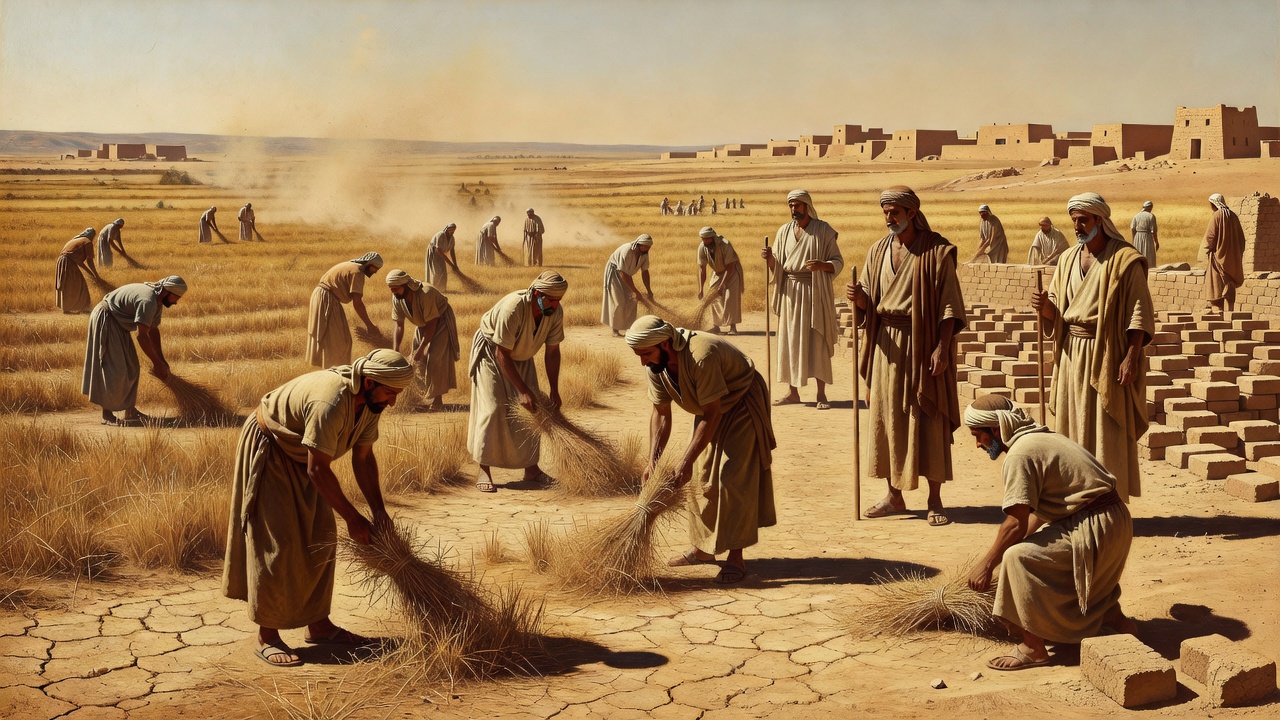
6And Pharoh that day commanded the masters of the people and the overseers, saying, 7You shall not continue (add) to give straw to the people to cast bricks, as heretofore; let them go and collect straw for themselves; 8Yet the number of bricks which they have made heretofore you shall still lay upon them and not diminish; for they are idle, and therefore cry, saying, We will go and sacrifice before our God. 9Make labour heavy upon the men: let them be occupied with it, and not with vain words.
10And the masters of the people and the overseers went forth and spake to the people, saying, Thus saith Pharoh, I will not give you straw; 11You shall go and gather up straw for yourselves wheresoever you can find it; though from you work there shall be mother diminished. 12And the people were scattered abroad over all the country of Mizraim to gather stubble for straw. 13And the masters were urgent, saying, Fulfil your work, the matter of a day in a day, as you did when straw was given to you. 14And the masters whom Pharoh set over the sons of Israel smote them, saying, Why do you not fulfil your requirement to cast bricks as heretofore, as yesterday, so also today?
The Cry of the Israelites
15And the overseers of the sons of Israel came and complained before Pharoh, saying, Why hast thou done thus with thy servants? 16Thou hast not given thy servants straw, yet they say to us, Make bricks; and, behold, thy servants are beaten, and thy people sin against us. 17But he said, You are idle: therefore you say, We will go and sacrifice before the Lord. 18And now go, work: but straw I will not give you; yet the number of bricks you shall render. 19And the overseers of the sons of Israel perceived that they were in evil: for they said to them, You shall not diminish form your bricks the matter of a day, in a day. 20And they met Mosheh and Aharon standing before them in their coming out from being with Pharoh. 21And they said to them, May the Lord manifest Himself to you and adjudge; because you have made our savour evil in the eyes of Pharoh, and in the eyes of his servants, and have put a sword into their hands to kill us!
22And Mosheh returned before the Lord and said, O Lord, why hast Thou done evil unto this people, and wherefore didst Thou send me? 23And from the time that I went in to Pharoh to speak in Thy name he hath done evil to this people, but liberating Thou hast not liberated Thy people.
¿Sabías que…?
Trabajo más duro tras la negativa del faraón
- El Easton's Bible Dictionary (1897) dice que el faraón del Éxodo fue probablemente Menephtah I, el decimocuarto y mayor hijo sobreviviente de Ramsés II, pero trata la identificación como una cuestión aún abierta: algunos eruditos, señala la obra, se inclinan por Seti II, cuyo reinado describe como iniciado en paz y terminado en un desastre repentino. La entrada dice que residía en Zoán, donde recibió a Moisés y a Aarón en las audiencias registradas en Éxodo.Fuentes: Pharaoh (of the Exodus) · el propio texto bíblico
- El Easton's Bible Dictionary (1897) sitúa la llegada de Jacob a Egipto probablemente unos 350 años antes del nacimiento de Moisés. Dice que un rey hicso, de un pueblo semita pastoril de Asia y llamado rey pastor, recibió a la familia con favor y les asignó Gosén, la mejor tierra; en este capítulo el faraón trata al pueblo de Israel, ya numeroso, como trabajadores a los que no dejará ir.Fuentes: Moses · el propio texto bíblico
- El faraón responde a la petición de celebrar una fiesta en el desierto dejando de suministrar la paja para los ladrillos, pero exigiendo todavía la misma cuota diaria. El pueblo se dispersa por toda la tierra de Egipto para recoger rastrojo, y los oficiales israelitas que los capataces del faraón habían puesto sobre ellos son golpeados cuando esa cuota no se cumple.Fuentes: el propio texto bíblico
Notas escritas con ayuda de IA a partir de fuentes abiertas (Theographic Bible Metadata, CC BY-SA 4.0; Easton’s Bible Dictionary, dominio público) y revisadas antes de publicarse.
Lugares de este capítulo
Solo aparecen lugares identificados con alta confianza (90 % o más según las fuentes académicas reunidas por OpenBible). Mapa de la época: DARE (Digital Atlas of the Roman Empire), CC BY 4.0; mapa actual: © colaboradores de OpenStreetMap; lugares: OpenBible.info (CC BY 4.0).
Créditos y licencia de esta traducción
Targum Onkelos Etheridge
The Targums of Onkelos and Jonathan Ben Uzziel On the Pentateuch With The Fragments of the Jerusalem Targum From the Chaldee by J. W. Etheridge, M.A. First Published 1862-65.
Public Domain
Language: English
2020-12-20
Títulos de sección adaptados de la Berean Standard Bible (dominio público); no forman parte del texto bíblico de esta traducción.
Fuente: http://ebible.org/engoke/ · eBible.org