Êxodo 3
Targum Onkelos Etheridge · Toque num versículo para ver as referências cruzadas.
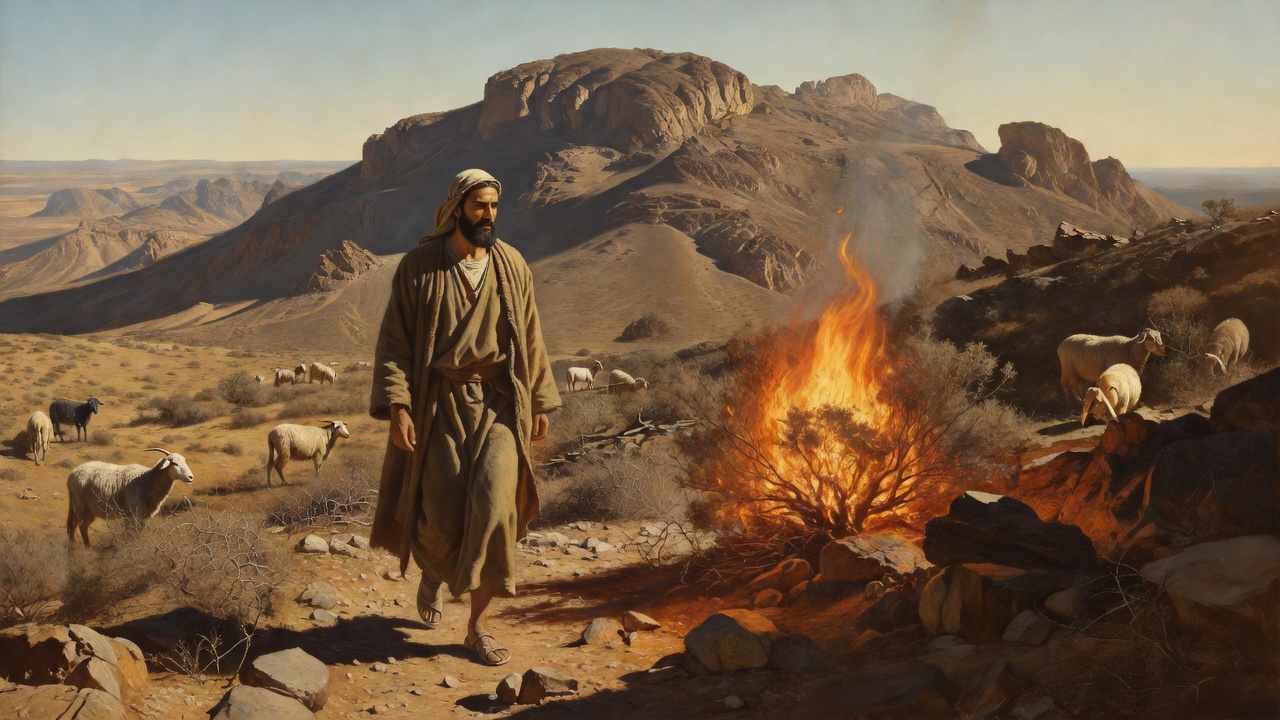
Moses at the Burning Bush
1And Mosheh tended the flock of Jethro his father-in-law, the rabba of Midian, and he led the flock to the place of the best pastures of the wilderness, and came to the mountain on which was revealed the glory of the Lord, unto Horeb. 2And the Angel of the Lord appeared to him in a flame of fire in the midst of a bush. And he gazed, and, behold, the bush burned with fire, but the bush was not consumed. 3And Mosheh said, I will now turn and see this great sight, why the bush is not burned up. 4And the Lord saw that he turned to see, and the Lord called to him from the midst of the bush, and said, Mosheh, Mosheh! And he said, Behold me. 5And He said, Approach not hither; loose the sandal from thy foot, for the place where thou standest is holy. 6And He said, I am the God of thy fathers; the God of Abraham, the God of Izhak, and the God of Jakob. And Mosheh bowed with his face; for he was afraid to look up to the glory of the Lord.
7And the Lord said, The bondage of My people who is in Mizraim is verily disclosed before Me, and before Me is heard their cry on account of their toils; for their afflictions are disclosed before me; 8And I have appeared to deliver them from the hand of the Mizraee, and to bring them up from that land, unto a land good and large, a land producing milk and honey, unto the place of the Kenaanaee, an the Hittaee, and the Amoraee, and the Perizaee, and the Hivaee, and the Yevusaee. 9And now, behold, the cry of the sons of Israel ascendeth before Me, and the affliction is also revealed before Me wherewith the Mizraee afflict them. 10And now, come, I will send thee to Pharoh, and will bring forth the sons of Israel form Mizraim. 11And Mosheh said before the Lord, Who am I, that I should go unto Pharoh to bring forth the sons of Israel from Mizraim? 12And He said, Because My Word shall be thy helper: and this shall be the sign that I have sent thee: In thy leading forth of the people from Mizraim you shall do service before the Lord upon this mountain.
13And Mosheh said before the Lord, Behold, when I am come to the sons of Israel, and say to them, The God of your fathers hath sent me to you, and they say to me, What is His name? What shall I say to them? 14And the Lord said unto Mosheh, EHEYEH ASHER EHEYEH. And he said, Thus shalt thou speak to the sons of Israel, EHEYEH hath sent me unto you. 15The Lord said moreover to Mosheh, Thus shalt thou speak to the sons of Israel, The Lord, the God of your fathers, the God of Abraham, the God of Izhak, and the God of Jakob, hath sent me unto you. This is My Name forever, and this is My Memorial in every generation and generation. 16Go and assemble the elders of Israel and say to them, The Lord, the God of your fathers, hath revealed Himself to me, the God of Abraham, Izhak, and Jakob, saying, Remembering I have remembered you, and that which hath been done to you in Mizraim; 17And I have said that I would bring you up from the bondage of Mizraim to the land of the Kenaanaee, and Hittaee, and Emoraee, and the Pherizaee, and Hivaee, and Jebusaee, to a land producing milk and honey. 18And they will be obedient to thee, and thou shalt go, thou and the elders of Israel, to the king of Mizraim, and say to him, The Lord, the God of the Jehudaee, hath called us; and now let us go, as (for) a journey of three days into the desert, that we may sacrifice before the Lord our God. 19But it is manifest before Me that the king of Mizraim will not release you, that you may go, not even on account of Him whose power is mighty. 20But I will send forth the stroke of My power, and will smite the Mizraee with all My miracles which I will perform among them, and afterward they will send you away. 21And I will give this people to become favourites in the eyes of the Mizraee, and it shall be that when you go you shall not go empty. 22But you shall demand, a woman of her neighbour and the inmates of her house, articles of silver and of gold and vestments, and put them upon you sons and upon your daughters, and shall make the Mizraee empty.
Você sabia?
O chamado de Moisés na sarça ardente
- Moisés está pastoreando em Midiã quando este capítulo começa. Os midianitas eram uma tribo árabe nômade, descendente de Midiã, o quarto filho de Abraão com Quetura, cujo nome se explica como contenda. Viviam sobretudo no deserto ao norte da Arábia, e a península do Sinai era pasto para seus rebanhos; foi ali, depois de fugir do Egito, que Moisés se tornou servo e, em seguida, genro do sacerdote.Fontes: o próprio texto bíblico · Midian · Midian
- Seu sogro é Jetro, chamado sacerdote de Midiã. O Dicionário Bíblico de Easton (1897) identifica esse sacerdote com Raguel e diz que, se os dois nomes pertencem ao mesmo homem, Raguel pode ser considerado seu nome pessoal e Jetro, que significa excelência, um título oficial.Fontes: o próprio texto bíblico · Jethro
- Moisés conduz o rebanho até Horebe, o monte de Deus. O nome é explicado como deserto, ou monte, do chão ressecado, um termo geral para toda a cordilheira da qual o Sinai era um dos cumes; o Dicionário Bíblico de Easton (1897) dá à cordilheira o nome moderno de Jebel Musa e a descreve como um enorme bloco de cerca de duas milhas de comprimento por cerca de uma milha de largura, com uma planície muito ampla chamada Er Rahah na extremidade nordeste, onde os israelitas depois acamparam por quase um ano.Fontes: o próprio texto bíblico · Horeb
Notas escritas com auxílio de IA a partir de fontes abertas (Theographic Bible Metadata, CC BY-SA 4.0; Easton’s Bible Dictionary, domínio público) e revisadas antes de publicar.
Lugares deste capítulo
- Midian · 28.495, 35.012 · versículo 1
- Mount Horeb · Hoje: Jebel Musa · 28.540, 33.973 · versículo 1
- Egypt · 30.129, 31.308 · versículos 7, 8, 10, 11, 12, 16, 17, 18, 19, 20, 22
Só aparecem lugares com identificação de alta confiança (90% ou mais segundo as fontes acadêmicas reunidas pelo OpenBible). Mapa da época: DARE (Digital Atlas of the Roman Empire), CC BY 4.0; mapa atual: © colaboradores do OpenStreetMap; lugares: OpenBible.info (CC BY 4.0).
Créditos e licença desta tradução
Targum Onkelos Etheridge
The Targums of Onkelos and Jonathan Ben Uzziel On the Pentateuch With The Fragments of the Jerusalem Targum From the Chaldee by J. W. Etheridge, M.A. First Published 1862-65.
Public Domain
Language: English
2020-12-20
Títulos de seção adaptados da Berean Standard Bible (domínio público); não fazem parte do texto bíblico desta tradução.
Fonte: http://ebible.org/engoke/ · eBible.org