Exodus 3
Targum Onkelos Etheridge · Tap a verse to see its cross-references.
Moses at the Burning Bush
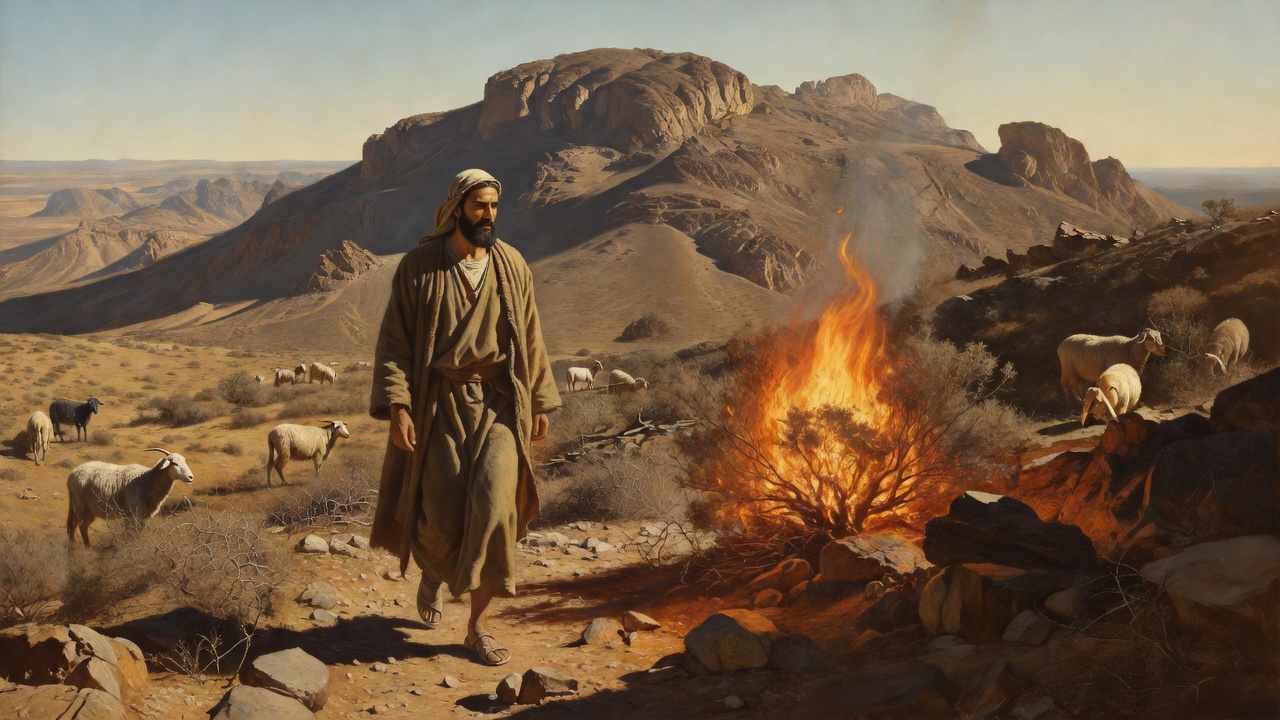
1And Mosheh tended the flock of Jethro his father-in-law, the rabba of Midian, and he led the flock to the place of the best pastures of the wilderness, and came to the mountain on which was revealed the glory of the Lord, unto Horeb. 2And the Angel of the Lord appeared to him in a flame of fire in the midst of a bush. And he gazed, and, behold, the bush burned with fire, but the bush was not consumed. 3And Mosheh said, I will now turn and see this great sight, why the bush is not burned up. 4And the Lord saw that he turned to see, and the Lord called to him from the midst of the bush, and said, Mosheh, Mosheh! And he said, Behold me. 5And He said, Approach not hither; loose the sandal from thy foot, for the place where thou standest is holy. 6And He said, I am the God of thy fathers; the God of Abraham, the God of Izhak, and the God of Jakob. And Mosheh bowed with his face; for he was afraid to look up to the glory of the Lord.
7And the Lord said, The bondage of My people who is in Mizraim is verily disclosed before Me, and before Me is heard their cry on account of their toils; for their afflictions are disclosed before me; 8And I have appeared to deliver them from the hand of the Mizraee, and to bring them up from that land, unto a land good and large, a land producing milk and honey, unto the place of the Kenaanaee, an the Hittaee, and the Amoraee, and the Perizaee, and the Hivaee, and the Yevusaee. 9And now, behold, the cry of the sons of Israel ascendeth before Me, and the affliction is also revealed before Me wherewith the Mizraee afflict them. 10And now, come, I will send thee to Pharoh, and will bring forth the sons of Israel form Mizraim. 11And Mosheh said before the Lord, Who am I, that I should go unto Pharoh to bring forth the sons of Israel from Mizraim? 12And He said, Because My Word shall be thy helper: and this shall be the sign that I have sent thee: In thy leading forth of the people from Mizraim you shall do service before the Lord upon this mountain.
13And Mosheh said before the Lord, Behold, when I am come to the sons of Israel, and say to them, The God of your fathers hath sent me to you, and they say to me, What is His name? What shall I say to them? 14And the Lord said unto Mosheh, EHEYEH ASHER EHEYEH. And he said, Thus shalt thou speak to the sons of Israel, EHEYEH hath sent me unto you. 15The Lord said moreover to Mosheh, Thus shalt thou speak to the sons of Israel, The Lord, the God of your fathers, the God of Abraham, the God of Izhak, and the God of Jakob, hath sent me unto you. This is My Name forever, and this is My Memorial in every generation and generation. 16Go and assemble the elders of Israel and say to them, The Lord, the God of your fathers, hath revealed Himself to me, the God of Abraham, Izhak, and Jakob, saying, Remembering I have remembered you, and that which hath been done to you in Mizraim; 17And I have said that I would bring you up from the bondage of Mizraim to the land of the Kenaanaee, and Hittaee, and Emoraee, and the Pherizaee, and Hivaee, and Jebusaee, to a land producing milk and honey. 18And they will be obedient to thee, and thou shalt go, thou and the elders of Israel, to the king of Mizraim, and say to him, The Lord, the God of the Jehudaee, hath called us; and now let us go, as (for) a journey of three days into the desert, that we may sacrifice before the Lord our God. 19But it is manifest before Me that the king of Mizraim will not release you, that you may go, not even on account of Him whose power is mighty. 20But I will send forth the stroke of My power, and will smite the Mizraee with all My miracles which I will perform among them, and afterward they will send you away. 21And I will give this people to become favourites in the eyes of the Mizraee, and it shall be that when you go you shall not go empty. 22But you shall demand, a woman of her neighbour and the inmates of her house, articles of silver and of gold and vestments, and put them upon you sons and upon your daughters, and shall make the Mizraee empty.
Did you know?
The Call of Moses at the Burning Bush
- Moses is shepherding in Midian when this chapter begins. The Midianites were a nomadic Arabian tribe descended from Midian, Abraham's fourth son by Keturah, whose name is explained as strife. They lived chiefly in the desert north of Arabia, and the Sinai peninsula was grazing land for their flocks; it was there, after fleeing Egypt, that Moses became a servant and then the priest's son-in-law.Sources: the Bible text itself · Midian · Midian
- His father-in-law is Jethro, called the priest of Midian. Easton's Bible Dictionary (1897) equates that priest with Raguel and says that, if the two names belong to one man, Raguel may be regarded as his personal name and Jethro, meaning excellency, as an official title.Sources: the Bible text itself · Jethro
- Moses leads the flock to Horeb, the mountain of God. The name is explained as desert, or mountain, of the dried-up ground, a general term for the whole range of which Sinai was one summit; Easton's Bible Dictionary (1897) gives the modern name of the range as Jebel Musa and describes a huge block about two miles long and about one mile wide, with a very spacious plain called Er Rahah at its north-east end, where the Israelites later camped for nearly a year.Sources: the Bible text itself · Horeb
Notes written with AI assistance from open sources (Theographic Bible Metadata, CC BY-SA 4.0; Easton’s Bible Dictionary, public domain) and reviewed before publishing.
Places in this chapter
- Midian · 28.495, 35.012 · verse 1
- Mount Horeb · Today: Jebel Musa · 28.540, 33.973 · verse 1
- Egypt · 30.129, 31.308 · verses 7, 8, 10, 11, 12, 16, 17, 18, 19, 20, 22
Only places identified with high confidence are shown (90% or more according to the scholarly sources compiled by OpenBible). Period map: DARE (Digital Atlas of the Roman Empire), CC BY 4.0; modern map: © OpenStreetMap contributors; places: OpenBible.info (CC BY 4.0).
Credits and license for this translation
Targum Onkelos Etheridge
The Targums of Onkelos and Jonathan Ben Uzziel On the Pentateuch With The Fragments of the Jerusalem Targum From the Chaldee by J. W. Etheridge, M.A. First Published 1862-65.
Public Domain
Language: English
2020-12-20
Section headings adapted from the Berean Standard Bible (public domain); they are not part of this translation’s text.
Source: http://ebible.org/engoke/ · eBible.org