Zacarias 14
The Orthodox Jewish Bible · Toque num versículo para ver as referências cruzadas.
The Destroyers of Jerusalem Destroyed
1Hinei, a day cometh for Hashem, when the plunder taken from thee shall among thee be divided. 2For I will gather kol HaGoyim against Yerushalayim for milchamah (battle, war); and HaIr (the city, Yerushalayim) shall be taken, and the batim (houses) plundered, and the women ravished; and half of HaIr shall go forth into the Golus (exile), and the rest of the people shall not be cut off from HaIr. 3Then shall Hashem go forth, and fight against those Goyim, as He fights in the Yom Krav (day of battle). 4And in Yom HaHu, His raglayim (feet) shall stand upon the Mount of Olives, which is east of Yerushalayim, and the Mount of Olives shall be split in two from east to west by a gey gedolah me'od (a very great valley), with half of the mountain moving to the north, and half of it to the south. 5And ye shall flee to the gey (valley) in the mountains; for the gey (valley) of the harim (mountains) shall extend unto Atzel; yea, ye shall flee, just as ye fled from before the ra'ash (earthquake) in the days of Uziyah Melech Yehudah; and Hashem Elohai shall come, and kol Kedoshim (all the holy ones) with Thee.
6And it shall come to pass in Yom HaHu, that there shall no longer be cold or frost: 7But it shall be Yom Echad, known to Hashem, with no Yom, nor Lailah; but it shall come to pass, that at erev it shall be ohr.
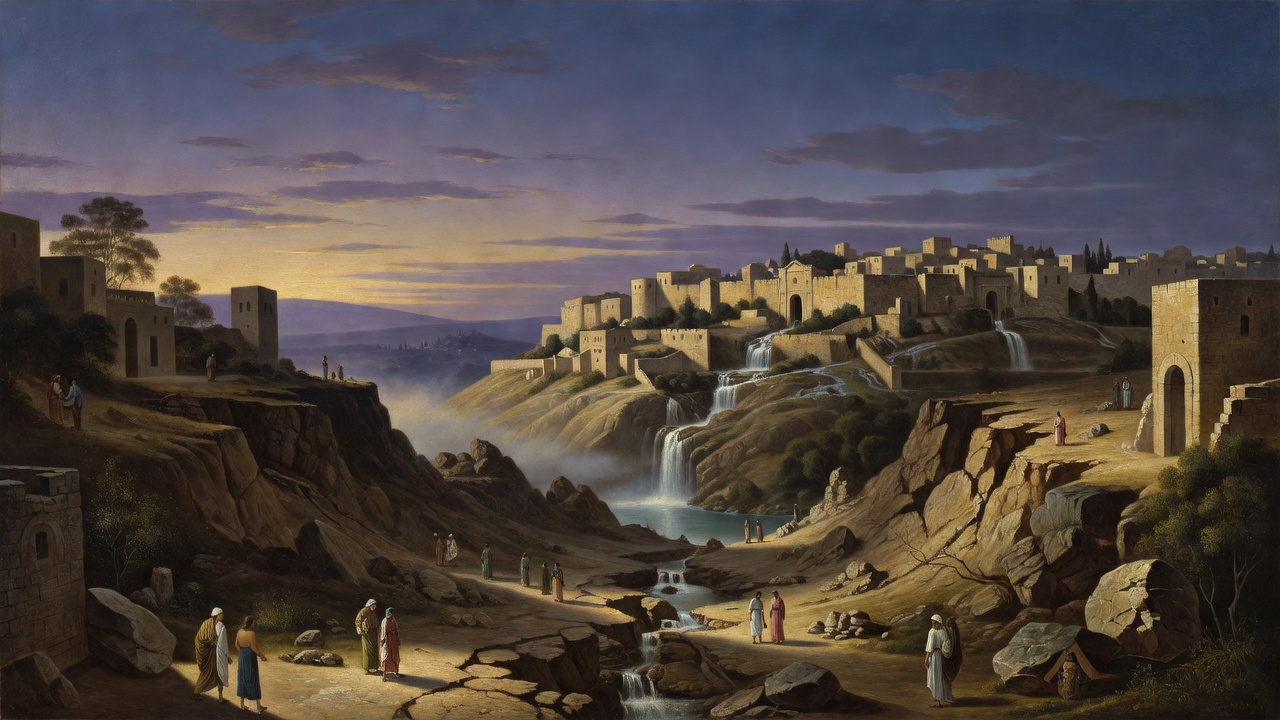
8And it shall be in Yom HaHu, that mayim chayyim (living waters) shall go out from Yerushalayim; half toward the eastern sea, and half toward the western sea; in kayitz (summer) and in khoref (winter) shall it be.
9And Hashem shall be Melech Al Kol HaAretz (King over all the earth); in Yom HaHu (in that day) shall Hashem be echad, and Shmo Echad.
10And kol ha'aretz shall be made like the Aravah from Geva to Rimmon in the Negev. Yerushalayim shall be lifted up, and inhabited in her place, from Sha'ar Binyamin unto the place of the Sha'ar Harishon (the first gate), unto the Corner Gate; and from the Migdal Chanan'el unto the kingʼs wine presses. 11And men shall inhabit her, and there shall be no more cherem (utter destruction, holy war); but Yerushalayim shall be inhabited labetach (in confidence, security).
12And this shall be the magefah (plague) wherewith Hashem will strike kol ha'amim (all the peoples) that have fought against Yerushalayim; their basar shall rot while they stand upon their feet, and their eyes shall rot in their sockets, and their tongue shall rot in their mouth.
13And in Yom HaHu it shall come to pass, that there shall be among them a mehumat Hashem (a panic from Hashem ), and they shall seize every one the hand of his neighbor, and the hand of each shall rise up against the hand of his neighbor. 14And Yehudah also shall fight at Yerushalayim; and the wealth of kol HaGoyim round about shall be gathered together, zahav, and kesef, and apparel, in great abundance. 15And so shall be the magefat hasus (plague on the horse), on the mule, on the camel, and on the donkey, and on all the beasts that shall be in those camps, like this magefah (plague).
All Nations Will Worship the King
16And it shall come to pass, that all who are left of kol HaGoyim which came against Yerushalayim shall even go up from year to year to worship HaMelech, Hashem Tzva'os, and to keep Chag HaSukkot. 17And it shall be, that whosoever will not make this aliyah from the mishpekhot ha'aretz unto Yerushalayim to worship HaMelech, Hashem Tzva'os, even upon them shall be no geshem (rain). 18And if the mishpakhat Mitzrayim go not up, and come not, upon them shall fall the magefah (plague) wherewith Hashem will strike the Goyim that come not up to keep Chag HaSukkot. 19This shall be the punishment of Mitzrayim, and the punishment of kol HaGoyim that come not up to keep Chag HaSukkot.
20In Yom HaHu shall there be upon the metzillot (bells) of the susim, kodesh l'hashem; and the sirot (cooking pots) in the Beis Hashem shall be like the mizrakim (libation bowls) before the mizbe'ach. 21Yea, every siyr (pot) in Yerushalayim and in Yehudah shall be kodesh l'hashem tzva'os: and all the zovechim (the ones sacrificing) shall come and take of them, and they shall cook in them; and in Yom HaHu there shall be no more Kena'ani (Canaanite, merchant) in the Beis Hashem Tzva'os.
Você sabia?
O Dia do Senhor e a Adoração Universal
- O Monte das Oliveiras é uma elevação situada a leste de Jerusalém, separada da cidade pelo vale do Cedrom. Fora desta passagem profética, ele é nomeado diretamente em apenas uma outra narrativa do Antigo Testamento, que relata a fuga do rei Davi durante a rebelião de Absalão.Fontes: Mount of Olives · o próprio texto bíblico
- O profeta relembra um terremoto marcante ocorrido no reinado de Uzias, rei de Judá, evento tão severo que fez a população fugir. Uzias era filho de Amazias e governou Judá durante um longo e próspero reinado de cerca de cinquenta e dois anos.Fontes: Uzziah · o próprio texto bíblico
- O capítulo descreve os sobreviventes de todas as nações, incluindo o Egito, subindo anualmente a Jerusalém para celebrar a Festa dos Tabernáculos. Zacarias adverte que qualquer povo que se recusar a peregrinar sofrerá a falta de chuva como castigo.Fontes: Egypt · o próprio texto bíblico
Notas escritas com auxílio de IA a partir de fontes abertas (Theographic Bible Metadata, CC BY-SA 4.0; Easton’s Bible Dictionary, domínio público) e revisadas antes de publicar.
Lugares deste capítulo
- Jerusalem · 31.777, 35.234 · versículos 1, 2, 4, 8, 10, 11, 12, 14, 16, 17, 21
- Mount of Olives · 31.778, 35.246 · versículo 4
- Great Sea · Hoje: Mediterranean Sea · 31.805, 34.170 · versículo 8
- Salt Sea · Hoje: Dead Sea · 31.500, 35.500 · versículo 8
- Arabah · 30.417, 35.151 · versículo 10
- Benjamin Gate · Hoje: in Jerusalem · 31.777, 35.234 · versículo 10
- Corner Gate · Hoje: in Jerusalem · 31.777, 35.234 · versículo 10
- Tower of Hananel · Hoje: Antonia Fortress · 31.780, 35.234 · versículo 10
- Egypt · 30.129, 31.308 · versículos 18, 19
Só aparecem lugares com identificação de alta confiança (90% ou mais segundo as fontes acadêmicas reunidas pelo OpenBible). Mapa da época: DARE (Digital Atlas of the Roman Empire), CC BY 4.0; mapa atual: © colaboradores do OpenStreetMap; lugares: OpenBible.info (CC BY 4.0).
Créditos e licença desta tradução
The Orthodox Jewish Bible
The Orthodox Jewish Bible - Tanakh and Orthodox Jewish Brit Chadasha - The Holy Bible
copyright © 2002-2011, 2021, 2024 Artists for Israel International
Language: English
Contributor: Artists for Israel International
THE ORTHODOX JEWISH TANAKH
Artists For Israel Intl Inc.
This version also appears with the Orthodox Yiddish Triglot which presents the Hebrew Yiddish script in Latin script and an English word for word translation, available at afii.org/Torah
To donate PayPal.Me
This translation is made available to you under the terms of the
Creative Commons Attribution license 4.0.
You may share and redistribute this Bible translation or extracts from it in any format, provided that:
You include the above copyright and source information.
If you make any changes to the text, you must indicate that you did so in a way that makes it clear that the original licensor is not necessarily endorsing your changes.
Pictures included with Scriptures and other documents on this site are licensed just for use with those Scriptures and documents.
For other uses, please contact the respective copyright owners.
Note that in addition to the rules above, revising and adapting God's Word involves a great responsibility to be true to God's Word. See Revelation 22:18-19.
2026-01-06
Títulos de seção adaptados da Berean Standard Bible (domínio público); não fazem parte do texto bíblico desta tradução.
Fonte: http://ebible.org/engojb/ · eBible.org