Salmos 87
The Orthodox Jewish Bible · Toque num versículo para ver as referências cruzadas.
The LORD Loves the Gates of Zion
1(Of the Bnei Korach. A mizmor. A shir)
1 On the Harei Kodesh (Holy Mountain) stands His foundation.
2Hashem loveth the sha'arei Tziyon
more than all the mishkenot Ya'akov.
3Glorious things are spoken of thee,
O Ir HaElohim.
Selah
4To them that know me, I will make mention of Rachav and Babylon;
hinei, Philistia, and Tzor, with Ethiopia:
this man was born there.
5But of Tziyon it shall be said,
This one and that one were born in her;
and Elyon Himself shall establish it.
6Hashem shall register, when He writeth up the people,
that this one was born there.
Selah
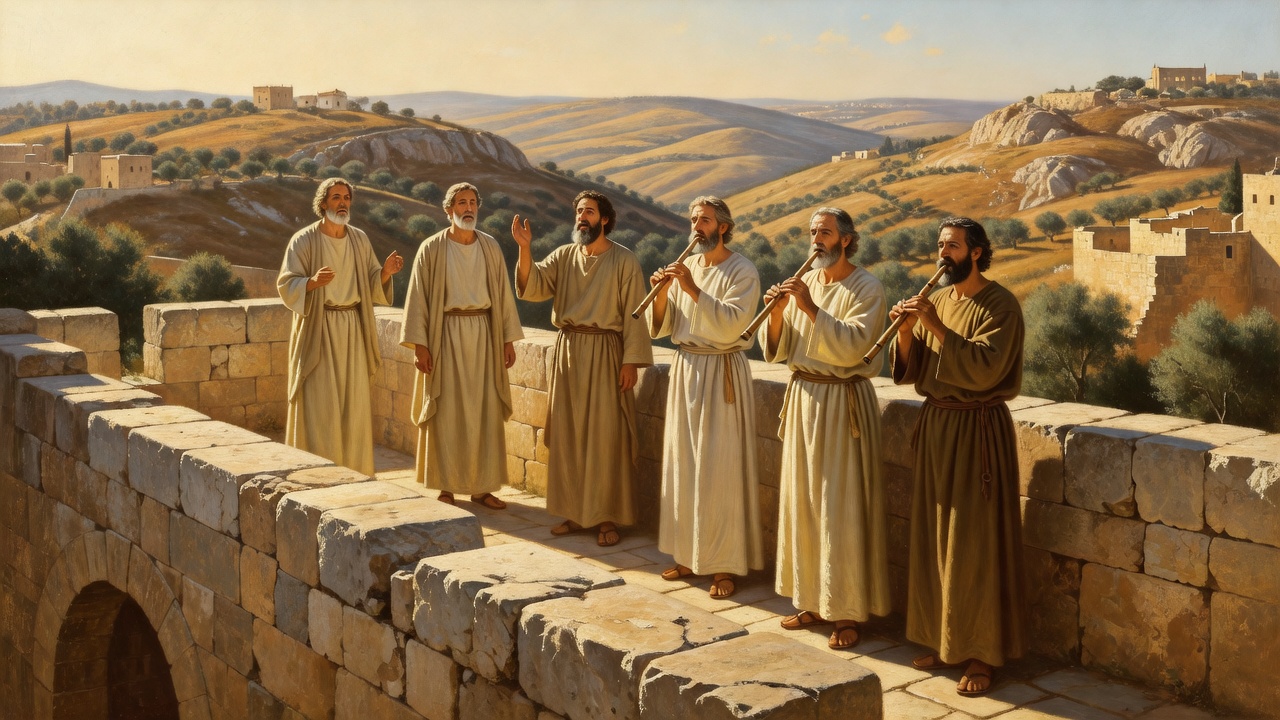
7The sharim (ones singing) as well as the cholelim (players on instruments) shall be there;
all my fountains are in thee.
Você sabia?
Sião e as nações
- No Salmo 87, regiões estrangeiras e historicamente rivais — incluindo Babilônia, Filístia, Tiro e Cuxe — são retratadas como sendo registradas como cidadãs nativas nascidas em Sião, a cidade de Deus.Fontes: o próprio texto bíblico · Zion · Tyre · Babylon
- O nome 'Raabe' no versículo 4 é um termo poético hebraico que significa insolência ou orgulho, empregado na poesia bíblica como uma designação simbólica para o Egito.Fontes: Rahab · o próprio texto bíblico
- O salmo é atribuído aos 'filhos de Corá', um grupo levítico que exercia liderança musical em Jerusalém séculos depois de seu antepassado Corá ter liderado uma rebelião no deserto.Fontes: Korah (Levite) · o próprio texto bíblico
Notas escritas com auxílio de IA a partir de fontes abertas (Theographic Bible Metadata, CC BY-SA 4.0; Easton’s Bible Dictionary, domínio público) e revisadas antes de publicar.
Lugares deste capítulo
- Zion · Hoje: Jerusalem · 31.777, 35.234 · versículos 2, 5
- Babylon · 32.543, 44.422 · versículo 4
- Cush · Hoje: Cush 1 · 16.935, 33.751 · versículo 4
- Egypt · 30.129, 31.308 · versículo 4
- Jerusalem · 31.777, 35.234 · versículos 4, 6, 7
- Philistia · 31.664, 34.546 · versículo 4
- Tyre · 33.271, 35.196 · versículo 4
Só aparecem lugares com identificação de alta confiança (90% ou mais segundo as fontes acadêmicas reunidas pelo OpenBible). Mapa da época: DARE (Digital Atlas of the Roman Empire), CC BY 4.0; mapa atual: © colaboradores do OpenStreetMap; lugares: OpenBible.info (CC BY 4.0).
Créditos e licença desta tradução
The Orthodox Jewish Bible
The Orthodox Jewish Bible - Tanakh and Orthodox Jewish Brit Chadasha - The Holy Bible
copyright © 2002-2011, 2021, 2024 Artists for Israel International
Language: English
Contributor: Artists for Israel International
THE ORTHODOX JEWISH TANAKH
Artists For Israel Intl Inc.
This version also appears with the Orthodox Yiddish Triglot which presents the Hebrew Yiddish script in Latin script and an English word for word translation, available at afii.org/Torah
To donate PayPal.Me
This translation is made available to you under the terms of the
Creative Commons Attribution license 4.0.
You may share and redistribute this Bible translation or extracts from it in any format, provided that:
You include the above copyright and source information.
If you make any changes to the text, you must indicate that you did so in a way that makes it clear that the original licensor is not necessarily endorsing your changes.
Pictures included with Scriptures and other documents on this site are licensed just for use with those Scriptures and documents.
For other uses, please contact the respective copyright owners.
Note that in addition to the rules above, revising and adapting God's Word involves a great responsibility to be true to God's Word. See Revelation 22:18-19.
2026-01-06
Títulos de seção adaptados da Berean Standard Bible (domínio público); não fazem parte do texto bíblico desta tradução.
Fonte: http://ebible.org/engojb/ · eBible.org