Salmos 87
The Orthodox Jewish Bible · Toca un versículo para ver sus referencias cruzadas.
The LORD Loves the Gates of Zion
1(Of the Bnei Korach. A mizmor. A shir)
1 On the Harei Kodesh (Holy Mountain) stands His foundation.
2Hashem loveth the sha'arei Tziyon
more than all the mishkenot Ya'akov.
3Glorious things are spoken of thee,
O Ir HaElohim.
Selah
4To them that know me, I will make mention of Rachav and Babylon;
hinei, Philistia, and Tzor, with Ethiopia:
this man was born there.
5But of Tziyon it shall be said,
This one and that one were born in her;
and Elyon Himself shall establish it.
6Hashem shall register, when He writeth up the people,
that this one was born there.
Selah
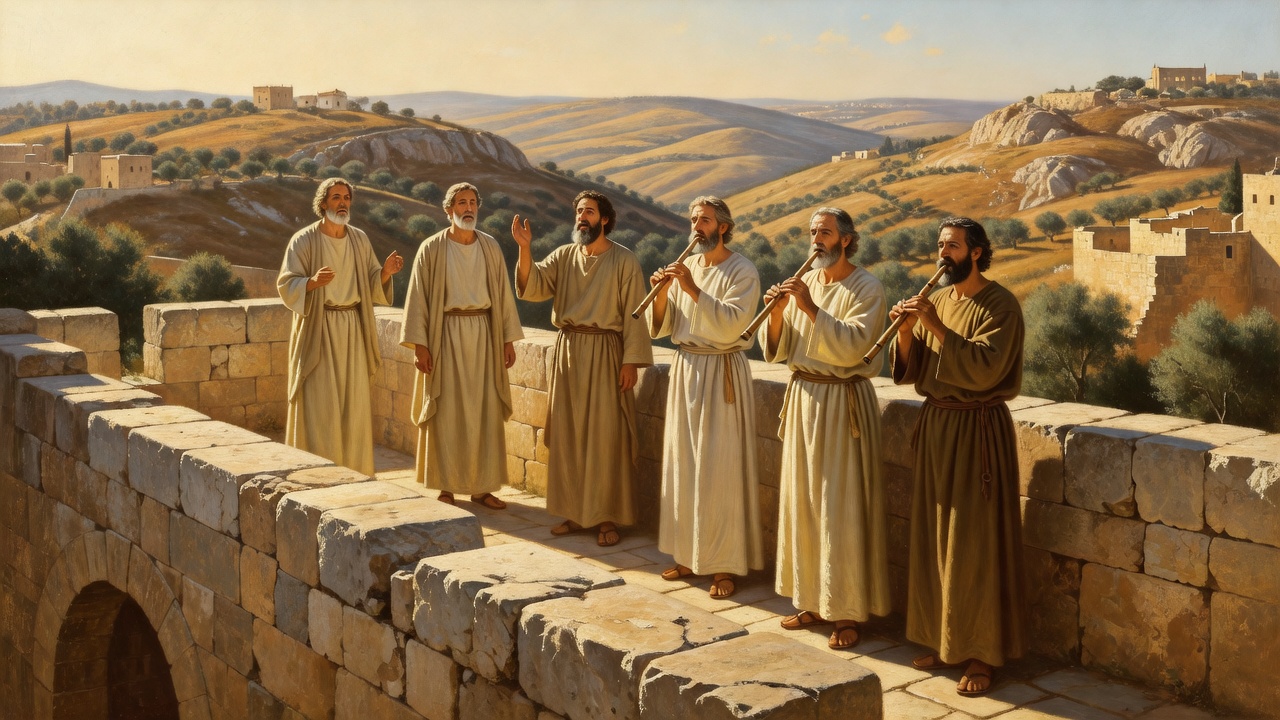
7The sharim (ones singing) as well as the cholelim (players on instruments) shall be there;
all my fountains are in thee.
¿Sabías que…?
Sion y las naciones
- En el Salmo 87, regiones extranjeras e históricamente rivales —incluidas Babilonia, Filistea, Tiro y Cus— son retratadas como registradas como ciudadanas nativas nacidas en Sion, la ciudad de Dios.Fuentes: el propio texto bíblico · Zion · Tyre · Babylon
- El nombre 'Rahab' en el versículo 4 es un término poético hebreo que significa insolencia u orgullo, empleado en la poesía bíblica como una designación simbólica de Egipto.Fuentes: Rahab · el propio texto bíblico
- El salmo está atribuido a los 'hijos de Coré', un grupo levítico encargado de la música en Jerusalén siglos después de que su antepasado Coré encabezara una rebelión en el desierto.Fuentes: Korah (Levite) · el propio texto bíblico
Notas escritas con ayuda de IA a partir de fuentes abiertas (Theographic Bible Metadata, CC BY-SA 4.0; Easton’s Bible Dictionary, dominio público) y revisadas antes de publicarse.
Lugares de este capítulo
- Zion · Hoy: Jerusalem · 31.777, 35.234 · versículos 2, 5
- Babylon · 32.543, 44.422 · versículo 4
- Cush · Hoy: Cush 1 · 16.935, 33.751 · versículo 4
- Egypt · 30.129, 31.308 · versículo 4
- Jerusalem · 31.777, 35.234 · versículos 4, 6, 7
- Philistia · 31.664, 34.546 · versículo 4
- Tyre · 33.271, 35.196 · versículo 4
Solo aparecen lugares identificados con alta confianza (90 % o más según las fuentes académicas reunidas por OpenBible). Mapa de la época: DARE (Digital Atlas of the Roman Empire), CC BY 4.0; mapa actual: © colaboradores de OpenStreetMap; lugares: OpenBible.info (CC BY 4.0).
Créditos y licencia de esta traducción
The Orthodox Jewish Bible
The Orthodox Jewish Bible - Tanakh and Orthodox Jewish Brit Chadasha - The Holy Bible
copyright © 2002-2011, 2021, 2024 Artists for Israel International
Language: English
Contributor: Artists for Israel International
THE ORTHODOX JEWISH TANAKH
Artists For Israel Intl Inc.
This version also appears with the Orthodox Yiddish Triglot which presents the Hebrew Yiddish script in Latin script and an English word for word translation, available at afii.org/Torah
To donate PayPal.Me
This translation is made available to you under the terms of the
Creative Commons Attribution license 4.0.
You may share and redistribute this Bible translation or extracts from it in any format, provided that:
You include the above copyright and source information.
If you make any changes to the text, you must indicate that you did so in a way that makes it clear that the original licensor is not necessarily endorsing your changes.
Pictures included with Scriptures and other documents on this site are licensed just for use with those Scriptures and documents.
For other uses, please contact the respective copyright owners.
Note that in addition to the rules above, revising and adapting God's Word involves a great responsibility to be true to God's Word. See Revelation 22:18-19.
2026-01-06
Títulos de sección adaptados de la Berean Standard Bible (dominio público); no forman parte del texto bíblico de esta traducción.
Fuente: http://ebible.org/engojb/ · eBible.org