Salmos 20
The Orthodox Jewish Bible · Toque num versículo para ver as referências cruzadas.
The Day of Trouble
1(For the one directing. Mizmor Dovid)
2Hashem hear thee in the Yom Tzarah (day of trouble);
the Shem Elohei Ya'akov set thee up on high;
3Send thee help from the Kodesh (Holy Sanctuary),
and strengthen thee out of Tziyon;
4Remember all thy minchot,
and accept thy olat;
Selah.
5Grant thee according to thine own levav,
and fulfil kol etzah (plan, counsel) of thine.
6We will shout for joy at thy Yeshu'ah (salvation),
and in the Shem of Eloheinu we will lift up our banners;
Hashem grant all thy requests.
7Now I have da'as that Hashem hoshi'a (He saves) His Moshiach;
He will answer him from His Sh'mei Kodesh (Holy Heaven)
with the saving strength of His right hand.
8Some trust in chariots, and some susim:
but we will trust in the Shem Hashem Eloheinu.
9They are brought down and fallen,
but we are risen up, and stand firm.
10Hoshi'ah, Hashem, HaMelech!
May He hear us on the day when we call.
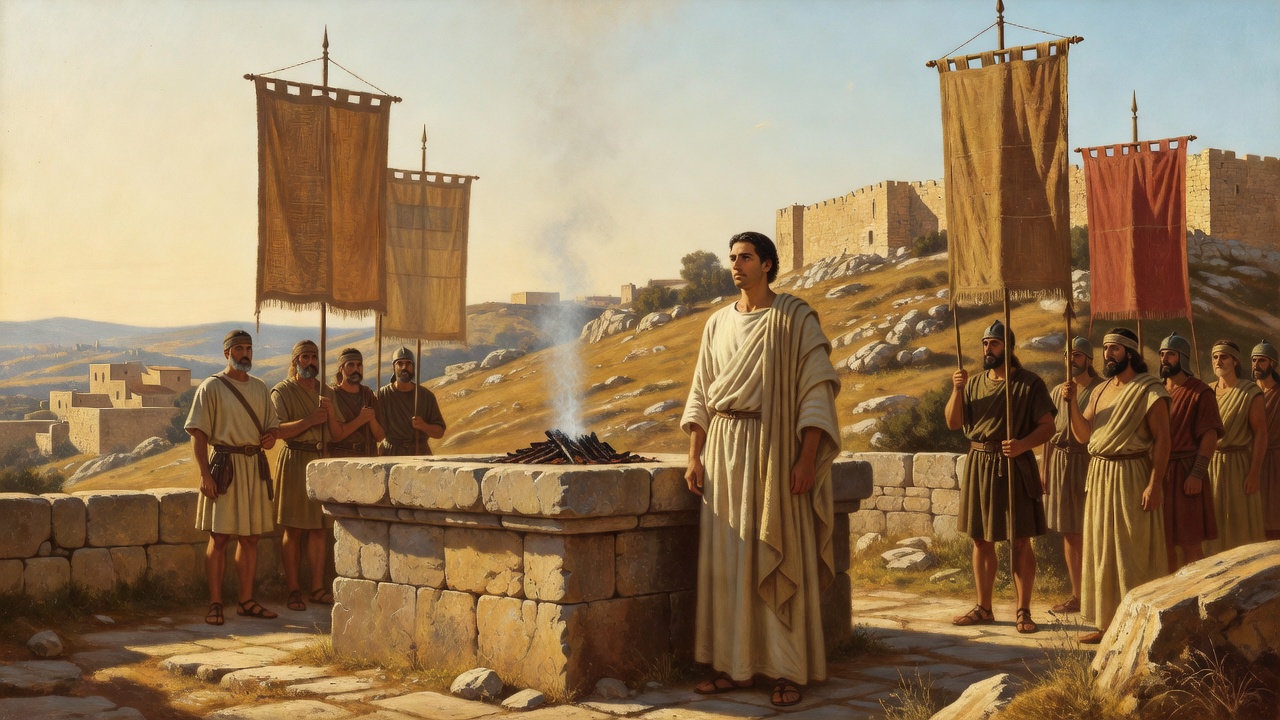
Você sabia?
Oração pela vitória do rei
- O Salmo 20 está estruturado como uma liturgia real em favor do rei antes da batalha, pedindo a Deus que se lembre de seus sacrifícios e lhe conceda a vitória.Fontes: o próprio texto bíblico
- A oração pede socorro a partir do santuário e de Sião, a colina de Jerusalém conquistada por Davi onde ele estabeleceu sua cidadela real.Fontes: o próprio texto bíblico · Zion
- Enquanto os exércitos do Antigo Oriente Próximo dependiam fortemente de carros de guerra e cavalaria para o poder militar, este salmo contrasta abertamente a força bélica com a confiança no nome do Senhor.Fontes: o próprio texto bíblico
Notas escritas com auxílio de IA a partir de fontes abertas (Theographic Bible Metadata, CC BY-SA 4.0; Easton’s Bible Dictionary, domínio público) e revisadas antes de publicar.
Lugares deste capítulo
- Zion · Hoje: Jerusalem · 31.777, 35.234 · versículo 2
Só aparecem lugares com identificação de alta confiança (90% ou mais segundo as fontes acadêmicas reunidas pelo OpenBible). Mapa da época: DARE (Digital Atlas of the Roman Empire), CC BY 4.0; mapa atual: © colaboradores do OpenStreetMap; lugares: OpenBible.info (CC BY 4.0).
Créditos e licença desta tradução
The Orthodox Jewish Bible
The Orthodox Jewish Bible - Tanakh and Orthodox Jewish Brit Chadasha - The Holy Bible
copyright © 2002-2011, 2021, 2024 Artists for Israel International
Language: English
Contributor: Artists for Israel International
THE ORTHODOX JEWISH TANAKH
Artists For Israel Intl Inc.
This version also appears with the Orthodox Yiddish Triglot which presents the Hebrew Yiddish script in Latin script and an English word for word translation, available at afii.org/Torah
To donate PayPal.Me
This translation is made available to you under the terms of the
Creative Commons Attribution license 4.0.
You may share and redistribute this Bible translation or extracts from it in any format, provided that:
You include the above copyright and source information.
If you make any changes to the text, you must indicate that you did so in a way that makes it clear that the original licensor is not necessarily endorsing your changes.
Pictures included with Scriptures and other documents on this site are licensed just for use with those Scriptures and documents.
For other uses, please contact the respective copyright owners.
Note that in addition to the rules above, revising and adapting God's Word involves a great responsibility to be true to God's Word. See Revelation 22:18-19.
2026-01-06
Títulos de seção adaptados da Berean Standard Bible (domínio público); não fazem parte do texto bíblico desta tradução.
Fonte: http://ebible.org/engojb/ · eBible.org