Psalms 20
The Orthodox Jewish Bible · Tap a verse to see its cross-references.
The Day of Trouble
1(For the one directing. Mizmor Dovid)
2Hashem hear thee in the Yom Tzarah (day of trouble);
the Shem Elohei Ya'akov set thee up on high;
3Send thee help from the Kodesh (Holy Sanctuary),
and strengthen thee out of Tziyon;
4Remember all thy minchot,
and accept thy olat;
Selah.
5Grant thee according to thine own levav,
and fulfil kol etzah (plan, counsel) of thine.
6We will shout for joy at thy Yeshu'ah (salvation),
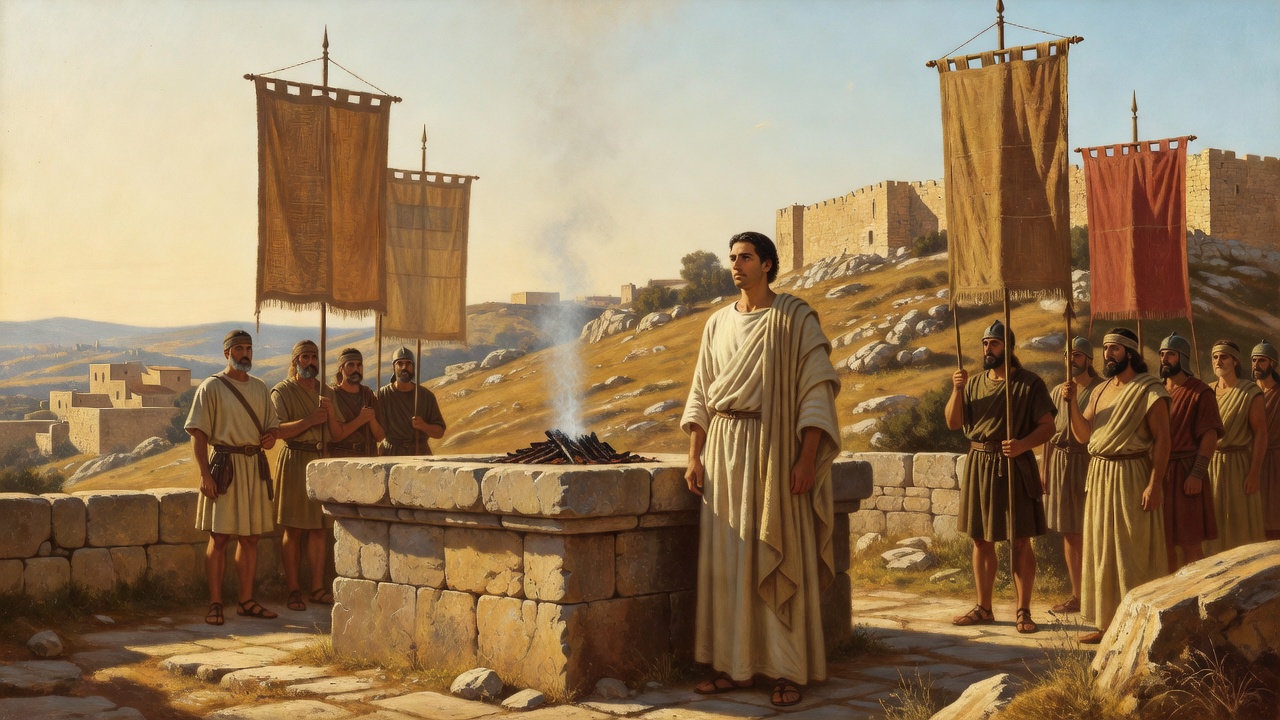
and in the Shem of Eloheinu we will lift up our banners;
Hashem grant all thy requests.
7Now I have da'as that Hashem hoshi'a (He saves) His Moshiach;
He will answer him from His Sh'mei Kodesh (Holy Heaven)
with the saving strength of His right hand.
8Some trust in chariots, and some susim:
but we will trust in the Shem Hashem Eloheinu.
9They are brought down and fallen,
but we are risen up, and stand firm.
10Hoshi'ah, Hashem, HaMelech!
May He hear us on the day when we call.
Did you know?
Prayer for the King’s Victory
- Psalm 20 is structured as a royal liturgy offered on behalf of the king before battle, asking God to remember his sacrifices and grant him victory.Sources: the Bible text itself
- The prayer asks for assistance from the sanctuary and from Zion, the hill in Jerusalem captured by David where he established his royal citadel.Sources: the Bible text itself · Zion
- While ancient Near Eastern armies relied heavily on war chariots and cavalry for military dominance, this psalm explicitly contrasts military technology with trust in the name of the Lord.Sources: the Bible text itself
Notes written with AI assistance from open sources (Theographic Bible Metadata, CC BY-SA 4.0; Easton’s Bible Dictionary, public domain) and reviewed before publishing.
Places in this chapter
- Zion · Today: Jerusalem · 31.777, 35.234 · verse 2
Only places identified with high confidence are shown (90% or more according to the scholarly sources compiled by OpenBible). Period map: DARE (Digital Atlas of the Roman Empire), CC BY 4.0; modern map: © OpenStreetMap contributors; places: OpenBible.info (CC BY 4.0).
Credits and license for this translation
The Orthodox Jewish Bible
The Orthodox Jewish Bible - Tanakh and Orthodox Jewish Brit Chadasha - The Holy Bible
copyright © 2002-2011, 2021, 2024 Artists for Israel International
Language: English
Contributor: Artists for Israel International
THE ORTHODOX JEWISH TANAKH
Artists For Israel Intl Inc.
This version also appears with the Orthodox Yiddish Triglot which presents the Hebrew Yiddish script in Latin script and an English word for word translation, available at afii.org/Torah
To donate PayPal.Me
This translation is made available to you under the terms of the
Creative Commons Attribution license 4.0.
You may share and redistribute this Bible translation or extracts from it in any format, provided that:
You include the above copyright and source information.
If you make any changes to the text, you must indicate that you did so in a way that makes it clear that the original licensor is not necessarily endorsing your changes.
Pictures included with Scriptures and other documents on this site are licensed just for use with those Scriptures and documents.
For other uses, please contact the respective copyright owners.
Note that in addition to the rules above, revising and adapting God's Word involves a great responsibility to be true to God's Word. See Revelation 22:18-19.
2026-01-06
Section headings adapted from the Berean Standard Bible (public domain); they are not part of this translation’s text.
Source: http://ebible.org/engojb/ · eBible.org