Isaías 21
The Orthodox Jewish Bible · Toque num versículo para ver as referências cruzadas.
Babylon Is Fallen
1The massa (burden) concerning the Midbar Yam (desert by the sea):
As sufot (whirlwinds) in the Negev sweep through;
so it cometh from the midbar, from eretz nora'ah.
2A chazut kashah (harsh vision) is declared unto me;
the boged (traitor) dealeth treacherously, and the shoded (destroyer) destroyeth.
Go up, O Eilam; besiege, O Media;
all the groaning she caused have I made to cease.
3Therefore are my loins filled with pain;
tzirim (pangs) have taken hold upon me,
as the tzirim (pangs) of a woman in labor;
I was bowed down at the hearing of it;
I was dismayed at the seeing of it.
4My lev panted,
fearfulness seized upon me;
the neshef (twilight) of my longing
hath become unto me as kharadah (shuddering horror).
5[They are] setting the shulchan, spreading the tzafit (dining carpet),
to eat, to drink;
arise, ye sarim (princes), and anoint the mogen.
6For thus hath Adonoi said unto me,
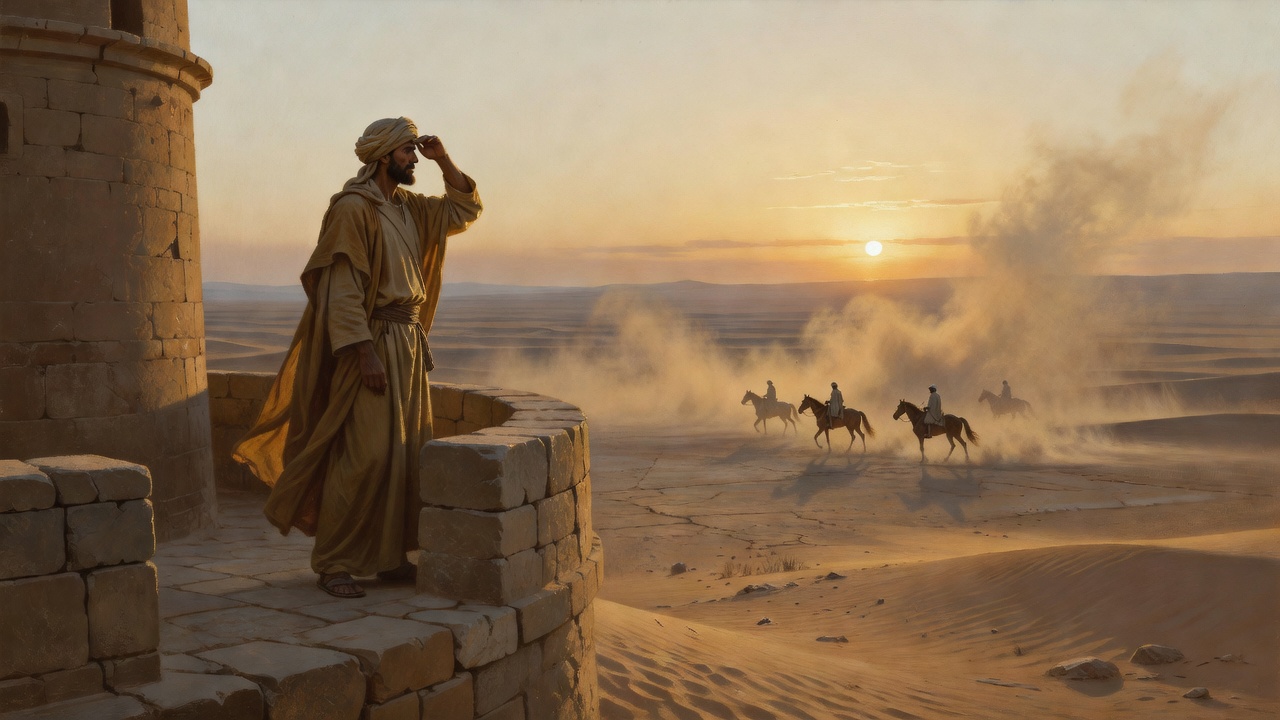
Go, post the metzapeh (watchman),
let him report what he seeth.
7When he sees riders with a pair of parashim,
donkey riders and camel riders,
then he pays heed diligently with great care;
8And the one seeing cried out,
Adonoi, I stand continually on the mitzpeh (watchtower) in the daytime,
and I am set in my mishmeret (guard duty) kol halailot (every night),
9And, hinei, here cometh a merkavah with a man,
a pair of parashim. And he answered and said,
Bavel (Babylon) is fallen, is fallen;
and all the pesilim (images) of her elohim (g-ds)
hath been shattered on the ground.
10O my threshed, and the grain of my goren (threshing floor);
that which I have heard of Hashem Tzva'os Elohei Yisroel,
have I declared unto you.
The Burden against Edom
11The massa (burden) of Dumah:
One calleth to me out of Se'ir,
Shomer (watchman), what of the lailah?
Shomer, what of the lailah?
12The shomer said, The boker cometh, and also the lailah;
if ye will inquire, inquire ye;
shuvu (return), come.
The Burden against Arabia
13The massa (burden) concerning Arabia:
In the ya'ar (forest) of Arabia shall ye encamp
O ye caravans of Dedanim.
14The inhabitants of Eretz Tema brought mayim
to him that was tzameh (thirsty),
they met with their lechem him that fled.
15For they fled from the charavot (swords),
from the drawn cherev,
and from the bent keshet (bow),
and from the grievousness of milchamah (war).
16For thus hath Adonoi said unto me, Within a shanah (year), according to the way a year is counted by a sakhir (hireling, hired servant), all the kavod of Kedar shall end; 17And the remainder of the mispar (number) of archers, the gibborim (mighty men) of the Bnei Kedar, shall be few; for Hashem Elohei Yisroel hath spoken.
Você sabia?
Visões sobre Babilônia e as Nações do Deserto
- Isaías 21 começa com uma visão que convoca Elão e a Média para o ataque, culminando no anúncio de que a Babilônia caiu e suas imagens esculpidas foram despedaçadas. Elão e a Média eram regiões montanhosas situadas a leste da Babilônia.Fontes: o próprio texto bíblico · Elam · Media
- O oráculo contra a Arábia menciona Quedar, nome associado às tribos nômades que habitavam o noroeste da Península Arábica. A profecia retrata caravanas fugindo da guerra pelo deserto e adverte que os famosos arqueiros e guerreiros de Quedar seriam reduzidos em apenas um ano.Fontes: o próprio texto bíblico · Kedar · Kedar
- O capítulo é estruturado em torno da figura de uma sentinela vigilante postada em uma torre de guarda dia e noite. Esse vigia observa a aproximação de cavaleiros e responde a perguntas ansiosas vindas de Seir sobre o quanto resta da noite.Fontes: o próprio texto bíblico
Notas escritas com auxílio de IA a partir de fontes abertas (Theographic Bible Metadata, CC BY-SA 4.0; Easton’s Bible Dictionary, domínio público) e revisadas antes de publicar.
Lugares deste capítulo
- Babylon · 32.543, 44.422 · versículos 1, 2, 9
- Negeb · 31.245, 34.841 · versículo 1
- Elam · 32.189, 48.258 · versículo 2
- Media · 34.806, 48.516 · versículo 2
- Arabia · Hoje: Arabian Peninsula · 23.000, 46.000 · versículo 13
- Tema · Hoje: Tayma · 27.630, 38.552 · versículo 14
- Kedar · 29.811, 39.868 · versículos 16, 17
Só aparecem lugares com identificação de alta confiança (90% ou mais segundo as fontes acadêmicas reunidas pelo OpenBible). Mapa da época: DARE (Digital Atlas of the Roman Empire), CC BY 4.0; mapa atual: © colaboradores do OpenStreetMap; lugares: OpenBible.info (CC BY 4.0).
Créditos e licença desta tradução
The Orthodox Jewish Bible
The Orthodox Jewish Bible - Tanakh and Orthodox Jewish Brit Chadasha - The Holy Bible
copyright © 2002-2011, 2021, 2024 Artists for Israel International
Language: English
Contributor: Artists for Israel International
THE ORTHODOX JEWISH TANAKH
Artists For Israel Intl Inc.
This version also appears with the Orthodox Yiddish Triglot which presents the Hebrew Yiddish script in Latin script and an English word for word translation, available at afii.org/Torah
To donate PayPal.Me
This translation is made available to you under the terms of the
Creative Commons Attribution license 4.0.
You may share and redistribute this Bible translation or extracts from it in any format, provided that:
You include the above copyright and source information.
If you make any changes to the text, you must indicate that you did so in a way that makes it clear that the original licensor is not necessarily endorsing your changes.
Pictures included with Scriptures and other documents on this site are licensed just for use with those Scriptures and documents.
For other uses, please contact the respective copyright owners.
Note that in addition to the rules above, revising and adapting God's Word involves a great responsibility to be true to God's Word. See Revelation 22:18-19.
2026-01-06
Títulos de seção adaptados da Berean Standard Bible (domínio público); não fazem parte do texto bíblico desta tradução.
Fonte: http://ebible.org/engojb/ · eBible.org