Oseias 5
The Orthodox Jewish Bible · Toque num versículo para ver as referências cruzadas.
Judgment on Israel and Judah
1Hear ye this, O kohanim;
and pay heed, ye Bais Yisroel;
and give ye ear, O Bais HaMelech;
for hamishpat (the judgment) is against you,
because ye have been a pach (snare, bird trap) at Mitzpah,
and a reshet (net) spread upon Tavor.
2And the revolters have deepened their slaughter,
and I will be musar (punishment) of them all.
3I know Ephrayim,
and Yisroel is not hid from Me;
for now, O Ephrayim, thou committest whoredom,
and Yisroel is tameh (unclean, defiled).
4Their doings do not permit them to turn unto Eloheihem;
for the ruach zenunim is in the midst of them,
and they have not known Hashem.
5And the ga'on Yisroel (pride of Yisroel) doth testify to his face;
therefore shall Yisroel and Ephrayim stumble and fall in their avon (iniquity);
Yehudah also shall fall with them.
6They shall go with their flocks
and with their herds to seek Hashem;
but they shall not find Him;
He hath withdrawn Himself from them.
7They have dealt treacherously against Hashem;
for they have begotten banim zarim (strange, illegitimate children);
now shall a [Rosh] Chodesh devour them with their fields.
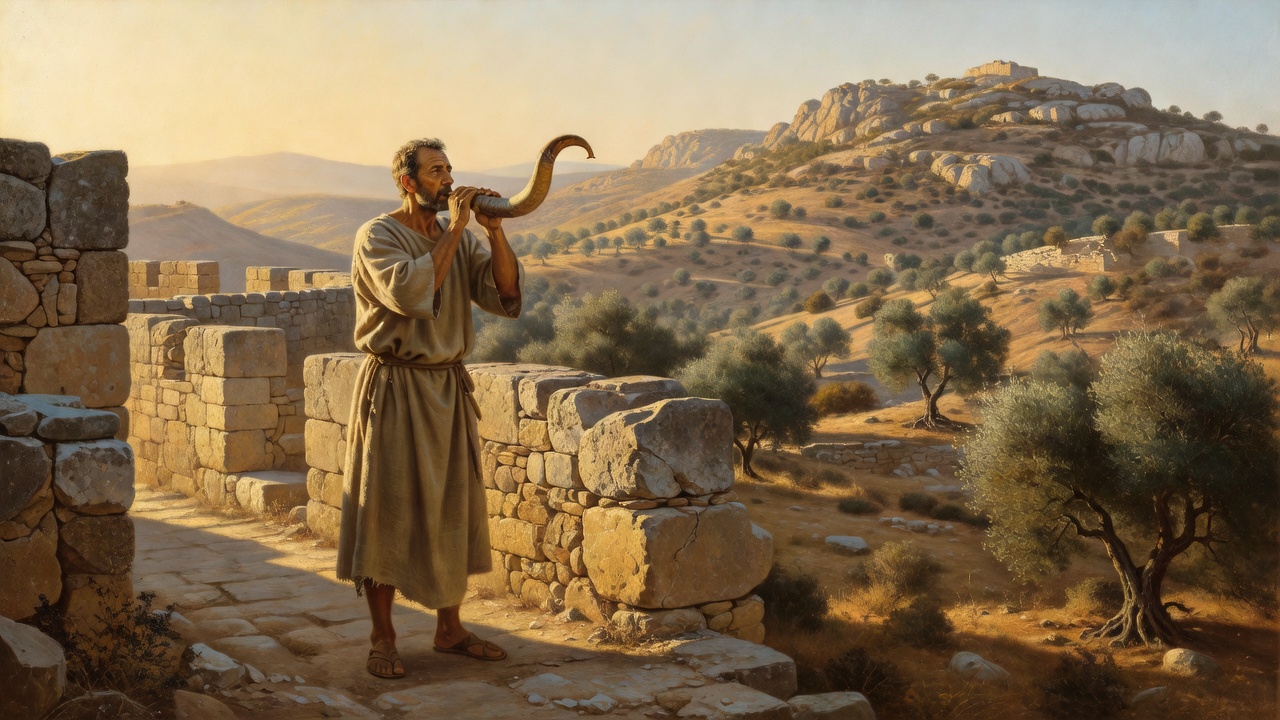
8Blow ye the shofar in Giv'ah, and the trumpet in Ramah;
cry aloud at Beit-Aven; after thee, O Binyamin!
9Ephrayim shall be desolate in the Yom Tokheichah (Day of Rebuke):
among the Shivtei Yisroel have I made known that which is certain.
10The sarim (princes) of Yehudah were like them that remove the gevul (boundary stone);
therefore I will pour out My wrath upon them like mayim.
11Ephrayim is oppressed and crushed in mishpat (judgment),
because he willingly walked after tzav (human statute).
12Therefore will I be unto Ephrayim like maggots,
and to the Bais Yehudah like rottenness.
13When Ephrayim saw his sickness,
and Yehudah saw his sores,
then went Ephrayim to the Assyrian,
and sent to the great king;
yet he was not able to heal you,
nor cure you of your wound.
14For I will be unto Ephrayim like a lion,
and as a great lion to the Bais Yehudah;
I, even I, will tear and go away;
I will carry off, and there will be no one rescuing.
15I will go and return to My place,
till they acknowledge their guilt, and seek My face;
in their tzar (affliction, distress) they will beg My favor.
Você sabia?
Julgamento sobre os líderes de Israel e Judá
- Oseias denuncia os sacerdotes e a casa real como um laço em Mispá e uma rede estendida sobre o monte Tabor. O monte Tabor é uma montanha cônica e proeminente a oeste do mar da Galileia, e Mispá era um local histórico em Gileade, ambos servindo como marcos geográficos elevados onde a liderança corrompida desencaminhou a nação.Fontes: o próprio texto bíblico · Tabor (Mountain) · Mizpah
- O alarme soar no versículo 8 menciona cidades ao longo das colinas de Benjamim: Gibeá, Ramá e Bete-Áven. Bete-Áven, que significa casa de ídolos ou de nada, era um termo profético depreciativo para Betel, satirizando o culto ao bezerro de ouro ali estabelecido.Fontes: o próprio texto bíblico · Beth-aven · Gibeah · Ramah
- O profeta censura Efraim por recorrer ao grande rei da Assíria para curar suas aflições nacionais em vez de buscar a Deus. Com centro ao longo do rio Tigre, o crescente Império Assírio subjugou o norte da Síria e cobrou tributos por toda a região sob governantes como Tiglate-Pileser.Fontes: o próprio texto bíblico · Assyria · Tilgath-pilneser
Notas escritas com auxílio de IA a partir de fontes abertas (Theographic Bible Metadata, CC BY-SA 4.0; Easton’s Bible Dictionary, domínio público) e revisadas antes de publicar.
Lugares deste capítulo
- Mount Tabor · Hoje: Jebel et Tur · 32.686, 35.393 · versículo 1
- Beth-aven · Hoje: Beitin · 31.923, 35.241 · versículo 8
- Assyria · 36.359, 43.153 · versículo 13
Só aparecem lugares com identificação de alta confiança (90% ou mais segundo as fontes acadêmicas reunidas pelo OpenBible). Mapa da época: DARE (Digital Atlas of the Roman Empire), CC BY 4.0; mapa atual: © colaboradores do OpenStreetMap; lugares: OpenBible.info (CC BY 4.0).
Créditos e licença desta tradução
The Orthodox Jewish Bible
The Orthodox Jewish Bible - Tanakh and Orthodox Jewish Brit Chadasha - The Holy Bible
copyright © 2002-2011, 2021, 2024 Artists for Israel International
Language: English
Contributor: Artists for Israel International
THE ORTHODOX JEWISH TANAKH
Artists For Israel Intl Inc.
This version also appears with the Orthodox Yiddish Triglot which presents the Hebrew Yiddish script in Latin script and an English word for word translation, available at afii.org/Torah
To donate PayPal.Me
This translation is made available to you under the terms of the
Creative Commons Attribution license 4.0.
You may share and redistribute this Bible translation or extracts from it in any format, provided that:
You include the above copyright and source information.
If you make any changes to the text, you must indicate that you did so in a way that makes it clear that the original licensor is not necessarily endorsing your changes.
Pictures included with Scriptures and other documents on this site are licensed just for use with those Scriptures and documents.
For other uses, please contact the respective copyright owners.
Note that in addition to the rules above, revising and adapting God's Word involves a great responsibility to be true to God's Word. See Revelation 22:18-19.
2026-01-06
Títulos de seção adaptados da Berean Standard Bible (domínio público); não fazem parte do texto bíblico desta tradução.
Fonte: http://ebible.org/engojb/ · eBible.org