Marcos 2
Nyangumarta English Bible · Toque num versículo para ver as referências cruzadas.
JESUS MADE SOMEONE WELL FROM SICKNESS (2:1-12)
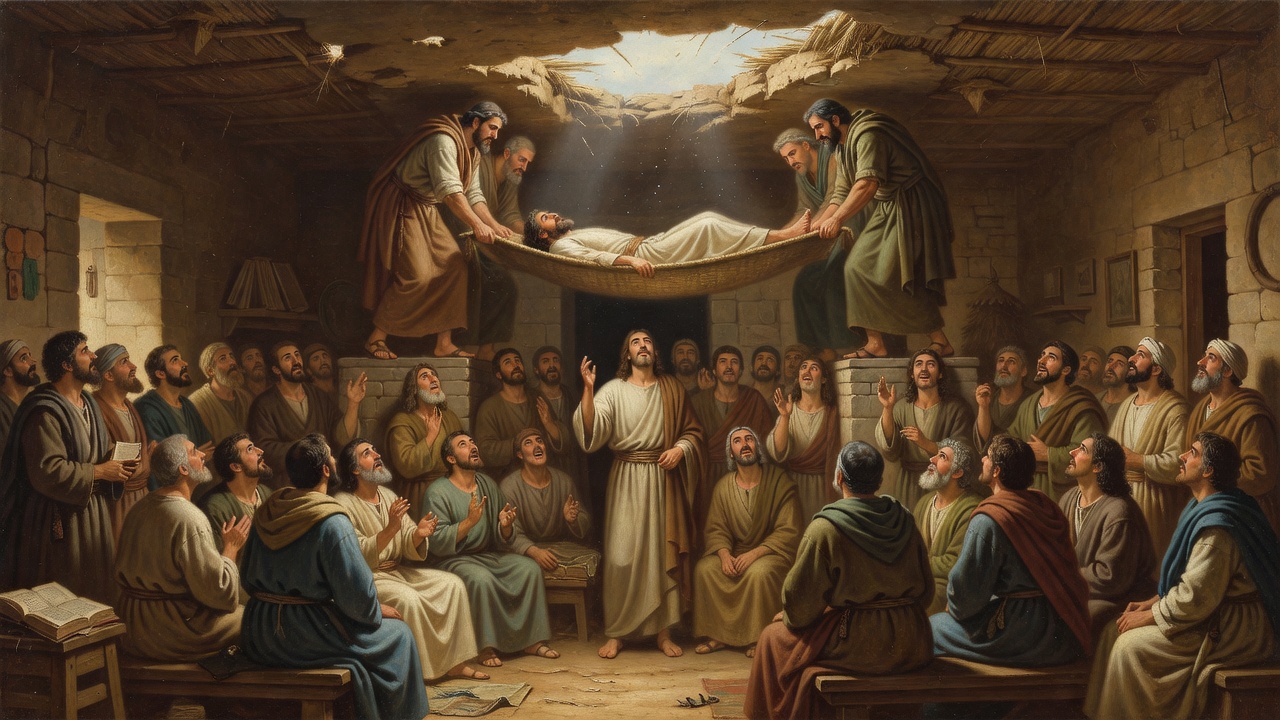
1After that Jesus returned to the town of Capernaum. There they were saying to each other, “Jesus has returned.” 2Many people came to his house to listen to him. He was teaching them about God. Very many people were inside that house, many others were standing around outside, they were listening to him. 3At that time four men came. They were carrying a sick man on a blanket, he was very weak, he could not walk. They brought him to Jesus to heal him. 4They tried in vain to enter the house, many people were there. Very many were standing close to Jesus. After that they climbed on top of the house. They made a hole on top close to Jesus, they lowered the sick man on the blanket in front of Jesus. 5Jesus said to himself, “They believe I will heal this sick person.” Then he spoke kindly to the sick one, “You have earlier been ignoring God. In response I will not hit you, I will not look on you with anger, I will be good to you.” 6There were a few of the Jews' teachers sitting in that house. They became upset at Jesus' words. They were thinking to themselves, 7“He should not talk like that. He said to him, 'You have earlier been ignoring God. In response I will not hit you, I will be good to you.' That is what he said. He spoke very badly. Only God can talk like that. People can't talk in that way. That Jesus is making himself like God.” 8Jesus knew about them, that they were thinking in that way, that they were criticising him in that sort of way. He asked them, “Why are you criticising me in that way? I said to this man, 'You have earlier been ignoring God. In response I will not hit you, I will be good to you.' You say I should not talk in this way. How shall I talk to this sick person? Perhaps I will say to him, Stand up, pick up your blanket, go on foot'. How about it? Should I talk to him in that way? Will he become well at my word? Will he be without sickness? 10Yes! Right now I will heal this sick one. Because of that you will know about me, God is the one who truly told me to make him well. You will know about me God truly told me to just leave bad people, to be good to them. After that Jesus told the sick one, 11Stand up, pick up your blanket, go to your camp.” 12Right then that man stood up, he picked up his blanket, he went straight outside. They were all watching him as he kept going. They were saying, “He did a good thing. This is new! We have not seen this.” They were praising God, they were saying to him, “Thank you! Truly you are good.”
JESUS TOLD LEVI, “FOLLOW ME.” (2:13-17)
13Again Jesus was going along the edge of the big water, the waterhole Galilee. Many people gathered with him. He was teaching them about God. 15Many who disregarded the laws of the Jews were following Jesus. Some of them were tax collectors (lit.'money removers'). They used to work from the Roman government, they would take money from people in accordance with the Government's word. They were thieves. They would take a lot of money from them, they would give some to the Government boss, the rest they would keep for themselves. Day after day many like them who were also disregarders of the law of the Jews were following Jesus. 14One day Jesus was going along the waterhole Galilee. He saw a man, a tax collector, his name was Levi. This Levi was sitting in his working house. When Jesus saw him he said to him, “Follow me.” Right then he left his work, he kept following Jesus. 15After that Jesus went to Levi's house to eat food. Some other tax collectors also, and others who were disregarders of the law of the Jews came to eat food there. 16Others who were Jewish teachers stood nearby. They called themselves Pharisees. They saw Jesus eating with those who were disregarders of the Jews' law. They said to Jesus' men. “Jesus should not eat with tax collectors and those who are disregarders of the law. He is doing a bad thing.” Like that the Pharisees were talking. 17Jesus heard them. In response he said to them, “The doctor will not come to heal those who are healthy, he will come only to those who sick. I do like that. I did not come to call those who are habitually good to God. I came to call to God those who are disregarders of God, in accordance with his word. Therefore I am eating with those people.”
Você sabia?
Perdão, um cobrador de impostos e o sábado
- Cafarnaum, a “cidade de Naum”, era uma cidade da Galileia que não é mencionada no Antigo Testamento. O dicionário bíblico de Easton (1897) diz que, depois de Jesus ser expulso de Nazaré, ela se tornou a “sua própria cidade”, o que combina com o relato de Marcos de que o povo soube que ele estava em casa e encheu a casa até não haver lugar nem fora da porta. Quatro homens então destelharam o telhado, abriram uma passagem e desceram um paralítico em sua maca.Fontes: Capernaum · o próprio texto bíblico
- O homem na coletoria era Levi, filho de Alfeu, cobrador de impostos em Cafarnaum. O dicionário bíblico de Easton (1897) diz que ele era conhecido como Levi e adotou o nome Mateus — um nome judeu comum depois do Exílio, que significa “dom de Deus” — possivelmente em grata lembrança do seu chamado. No mesmo dia, segundo o dicionário, ele ofereceu um grande banquete de despedida para Jesus e seus discípulos, e provavelmente para muitos antigos companheiros, o encontro que Marcos descreve com cobradores de impostos e pecadores.Fontes: Matthew · Alphaeus · o próprio texto bíblico
- Questionado porque seus discípulos colhiam espigas no sábado, Jesus falou de Davi entrando na casa de Deus e comendo os pães consagrados, lícitos apenas para os sacerdotes, “durante o sumo sacerdócio de Abiatar”, e compartilhando-os com seus companheiros famintos. O dicionário bíblico de Easton (1897) identifica Abiatar como filho do sumo sacerdote Aimeleque, que escapou quando seu pai e os sacerdotes de Nobe foram mortos, levou o éfode e se juntou a Davi na caverna de Adulão.Fontes: Abiathar · o próprio texto bíblico
Notas escritas com auxílio de IA a partir de fontes abertas (Theographic Bible Metadata, CC BY-SA 4.0; Easton’s Bible Dictionary, domínio público) e revisadas antes de publicar.
Créditos e licença desta tradução
Nyangumarta English Bible
Portions of the Holy Bible in English, translated to be a companion to the Nyangumarta Bible
copyright © 1980-2010 Wycliffe Bible Translators, Inc.
Language: English
Bible translation copyright © 1980-2010 Wycliffe Bible Translators, Inc.
Reader Series (book XXC) copyright © 1996 Bible Society Australia. Bible overview (XXA) copyright © 1996 Mission Publications of Australia (PO Box 21, Lawson NSW 2783)
This translation is made available to you under the terms of the
Creative Commons Attribution-Noncommercial-No Derivatives license 4.0.
You may share and redistribute this Bible translation or extracts from it in any format, provided that:
You include the above copyright and source information.
You do not sell this work for a profit.
You do not change any of the words or punctuation of the Scriptures.
Pictures included with Scriptures and other documents on this site are licensed just for use with those Scriptures and documents.
For other uses, please contact the respective copyright owners.
2026-01-06
Fonte: http://ebible.org/engnna/ · eBible.org