Juízes 17
NET Bible · Toque num versículo para ver as referências cruzadas.
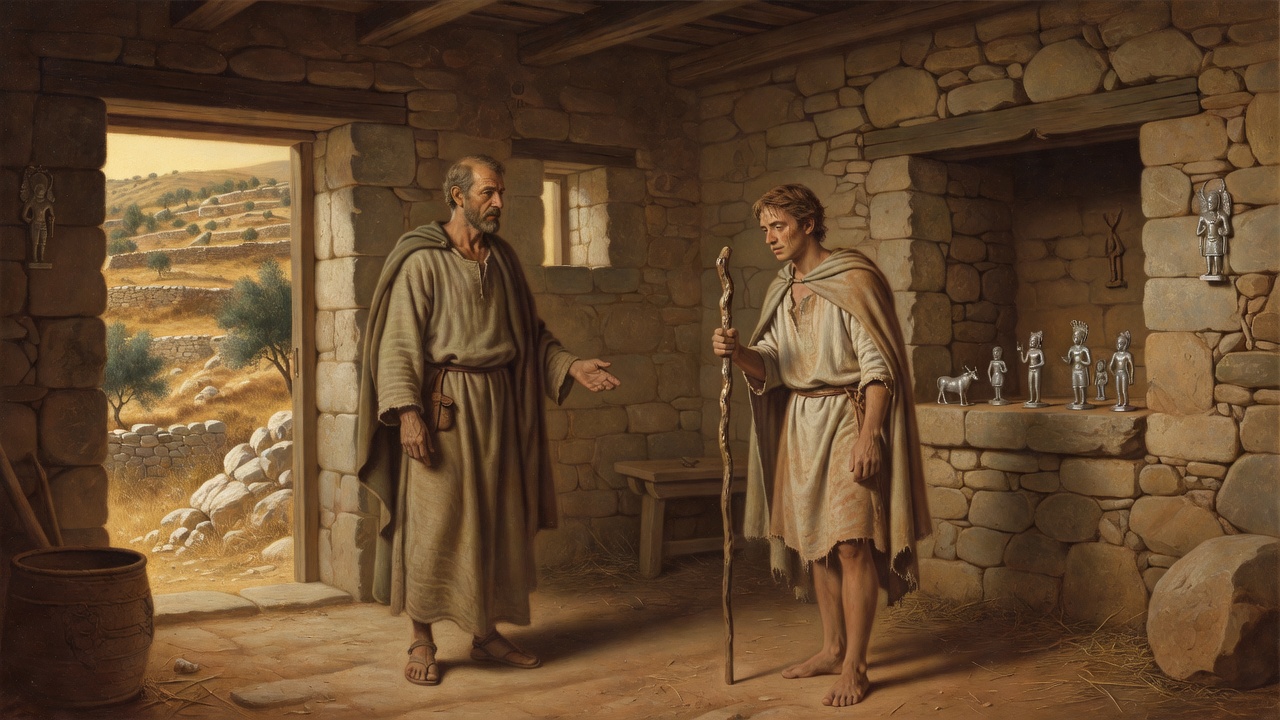
1There was a man named Micah from the Ephraimite hill country. 2He said to his mother, “You know the eleven hundred pieces of silver which were stolen from you, about which I heard you pronounce a curse? Look here, I have the silver. I stole it, but now I am giving it back to you.” His mother said, “May the Lord reward you, my son!” 3When he gave back to his mother the eleven hundred pieces of silver, his mother said, “I solemnly dedicate this silver to the Lord. It will be for my son’s benefit. We will use it to make a carved image and a metal image.” 4When he gave the silver back to his mother, she took two hundred pieces of silver to a silversmith, who made them into a carved image and a metal image. She then put them in Micah’s house. 5Now this man Micah owned a shrine. He made an ephod and some personal idols and hired one of his sons to serve as a priest. 6In those days Israel had no king. Each man did what he considered to be right.
Micah Hires a Professional
7There was a young man from Bethlehem in Judah. He was a Levite who had been temporarily residing among the tribe of Judah. 8This man left the town of Bethlehem in Judah to find another place to live. He came to the Ephraimite hill country and made his way to Micah’s house. 9Micah said to him, “Where do you come from?” He replied, “I am a Levite from Bethlehem in Judah. I am looking for a new place to live.” 10Micah said to him, “Stay with me. Become my adviser and priest. I will give you ten pieces of silver per year, plus clothes and food.” 11So the Levite agreed to stay with the man; the young man was like a son to Micah. 12Micah paid the Levite; the young man became his priest and lived in Micah’s house. 13Micah said, “Now I know God will make me rich, because I have this Levite as my priest.”
Você sabia?
O santuário doméstico de Mica
- Mica, um homem da região montanhosa de Efraim, montou um santuário particular contendo imagens de prata esculpidas e fundidas, um éfode e ídolos do lar. Inicialmente, ele consagrou um de seus próprios filhos como sacerdote antes de contratar um levita viajante para cuidar do santuário.Fontes: o próprio texto bíblico · Micah
- A narrativa destaca que naqueles dias não havia rei em Israel e cada um fazia o que era reto aos seus próprios olhos. O relato ilustra a desordem e a confusão religiosa do período anterior à monarquia.Fontes: o próprio texto bíblico · Micah
- Um levita errante vindo de Belém de Judá concordou em atuar como sacerdote de Mica em troca de comida, vestes e um salário anual de dez siclos de prata.Fontes: o próprio texto bíblico
Notas escritas com auxílio de IA a partir de fontes abertas (Theographic Bible Metadata, CC BY-SA 4.0; Easton’s Bible Dictionary, domínio público) e revisadas antes de publicar.
Lugares deste capítulo
Só aparecem lugares com identificação de alta confiança (90% ou mais segundo as fontes acadêmicas reunidas pelo OpenBible). Mapa da época: DARE (Digital Atlas of the Roman Empire), CC BY 4.0; mapa atual: © colaboradores do OpenStreetMap; lugares: OpenBible.info (CC BY 4.0).
Créditos e licença desta tradução
NET Bible
NET Bible®, New English Translation (NET)
copyright © 1996-2016 Biblical Studies Press, L. L. C.
Please see https://netbible.com/copyright/ for full NET Bible copyright and permissions information. You can also read the NET Bible at http://NETBible.org .
Language: English
Dialect (if applicable): American
Language in English: English
Translation by:
Please see https://netbible.com/copyright/ for full NET Bible copyright and permissions information. You can also read the NET Bible at http://NETBible.org .
The NET Bible (New English Translation) is a completely new translation of the Bible with 58,506 translators’ notes ! It was completed by more than 25 scholars – experts in the original biblical languages – who worked directly from the best currently available Hebrew, Aramaic, and Greek texts. Turn the pages and see the breadth of the translators’ notes, documenting their decisions and choices as they worked.
The translators’ notes make the original languages far more accessible, allowing you to look over the translator’s shoulder at the very process of translation. This level of documentation is a first for a Bible translation, making transparent the textual basis and the rationale for key renderings (including major interpretive options and alternative translations).
This unparalleled level of detail helps connect people to the Bible in the original languages in a way never before possible without years of study of Hebrew, Aramaic, and Greek. It unlocks the riches of the Bible’s truth from entirely new perspectives.
A donation is appreciated. Donate at Bible.org/donations_form so we can continue to provide our material for free for our 16,000+ articles on Bible.org and our world class Bible Study tool at lumina.bible.org .
2026-10-02
Fonte: http://ebible.org/engnet/ · eBible.org