Judges 17
NET Bible · Tap a verse to see its cross-references.
1There was a man named Micah from the Ephraimite hill country. 2He said to his mother, “You know the eleven hundred pieces of silver which were stolen from you, about which I heard you pronounce a curse? Look here, I have the silver. I stole it, but now I am giving it back to you.” His mother said, “May the Lord reward you, my son!” 3When he gave back to his mother the eleven hundred pieces of silver, his mother said, “I solemnly dedicate this silver to the Lord. It will be for my son’s benefit. We will use it to make a carved image and a metal image.” 4When he gave the silver back to his mother, she took two hundred pieces of silver to a silversmith, who made them into a carved image and a metal image. She then put them in Micah’s house. 5Now this man Micah owned a shrine. He made an ephod and some personal idols and hired one of his sons to serve as a priest. 6In those days Israel had no king. Each man did what he considered to be right.
Micah Hires a Professional
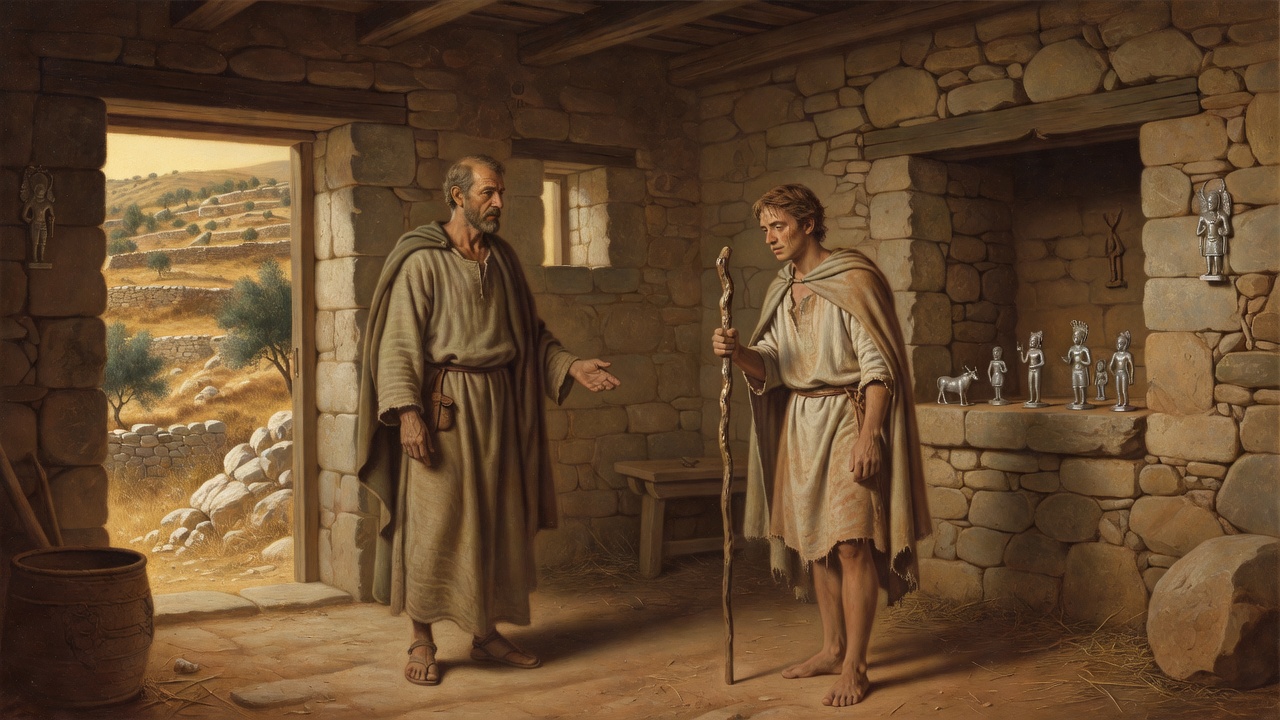
7There was a young man from Bethlehem in Judah. He was a Levite who had been temporarily residing among the tribe of Judah. 8This man left the town of Bethlehem in Judah to find another place to live. He came to the Ephraimite hill country and made his way to Micah’s house. 9Micah said to him, “Where do you come from?” He replied, “I am a Levite from Bethlehem in Judah. I am looking for a new place to live.” 10Micah said to him, “Stay with me. Become my adviser and priest. I will give you ten pieces of silver per year, plus clothes and food.” 11So the Levite agreed to stay with the man; the young man was like a son to Micah. 12Micah paid the Levite; the young man became his priest and lived in Micah’s house. 13Micah said, “Now I know God will make me rich, because I have this Levite as my priest.”
Did you know?
Micah's Domestic Shrine
- Micah, a man from the hill country of Ephraim, set up a private shrine containing carved and cast silver images, an ephod, and household idols. He initially ordained one of his own sons as his priest before hiring a traveling Levite to manage his shrine.Sources: the Bible text itself · Micah
- The narrative notes that there was no king in Israel during those days and everyone did what was right in their own eyes. This account serves to illustrate the lawlessness and religious confusion of the period before the monarchy.Sources: the Bible text itself · Micah
- A wandering Levite from Bethlehem in Judah agreed to serve as Micah's priest in exchange for food, clothing, and an annual wage of ten shekels of silver.Sources: the Bible text itself
Notes written with AI assistance from open sources (Theographic Bible Metadata, CC BY-SA 4.0; Easton’s Bible Dictionary, public domain) and reviewed before publishing.
Places in this chapter
Only places identified with high confidence are shown (90% or more according to the scholarly sources compiled by OpenBible). Period map: DARE (Digital Atlas of the Roman Empire), CC BY 4.0; modern map: © OpenStreetMap contributors; places: OpenBible.info (CC BY 4.0).
Credits and license for this translation
NET Bible
NET Bible®, New English Translation (NET)
copyright © 1996-2016 Biblical Studies Press, L. L. C.
Please see https://netbible.com/copyright/ for full NET Bible copyright and permissions information. You can also read the NET Bible at http://NETBible.org .
Language: English
Dialect (if applicable): American
Language in English: English
Translation by:
Please see https://netbible.com/copyright/ for full NET Bible copyright and permissions information. You can also read the NET Bible at http://NETBible.org .
The NET Bible (New English Translation) is a completely new translation of the Bible with 58,506 translators’ notes ! It was completed by more than 25 scholars – experts in the original biblical languages – who worked directly from the best currently available Hebrew, Aramaic, and Greek texts. Turn the pages and see the breadth of the translators’ notes, documenting their decisions and choices as they worked.
The translators’ notes make the original languages far more accessible, allowing you to look over the translator’s shoulder at the very process of translation. This level of documentation is a first for a Bible translation, making transparent the textual basis and the rationale for key renderings (including major interpretive options and alternative translations).
This unparalleled level of detail helps connect people to the Bible in the original languages in a way never before possible without years of study of Hebrew, Aramaic, and Greek. It unlocks the riches of the Bible’s truth from entirely new perspectives.
A donation is appreciated. Donate at Bible.org/donations_form so we can continue to provide our material for free for our 16,000+ articles on Bible.org and our world class Bible Study tool at lumina.bible.org .
2026-10-02
Source: http://ebible.org/engnet/ · eBible.org