Êxodo 5
JPS TaNaKH 1917 · Toque num versículo para ver as referências cruzadas.
Pharaoh’s First Refusal
1And afterward Moses and Aaron came, and said unto Pharaoh: 'Thus saith the LORD, the God of Israel: Let My people go, that they may hold a feast unto Me in the wilderness.' 2And Pharaoh said: 'Who is the LORD, that I should hearken unto His voice to let Israel go? I know not the LORD, and moreover I will not let Israel go.' 3And they said: 'The God of the Hebrews hath met with us. Let us go, we pray thee, three days' journey into the wilderness, and sacrifice unto the LORD our God; lest He fall upon us with pestilence, or with the sword.' 4And the king of Egypt said unto them: 'Wherefore do ye, Moses and Aaron, cause the people to break loose from their work? get you unto your burdens.' 5And Pharaoh said: 'Behold, the people of the land are now many, and will ye make them rest from their burdens?'
Bricks and Straw
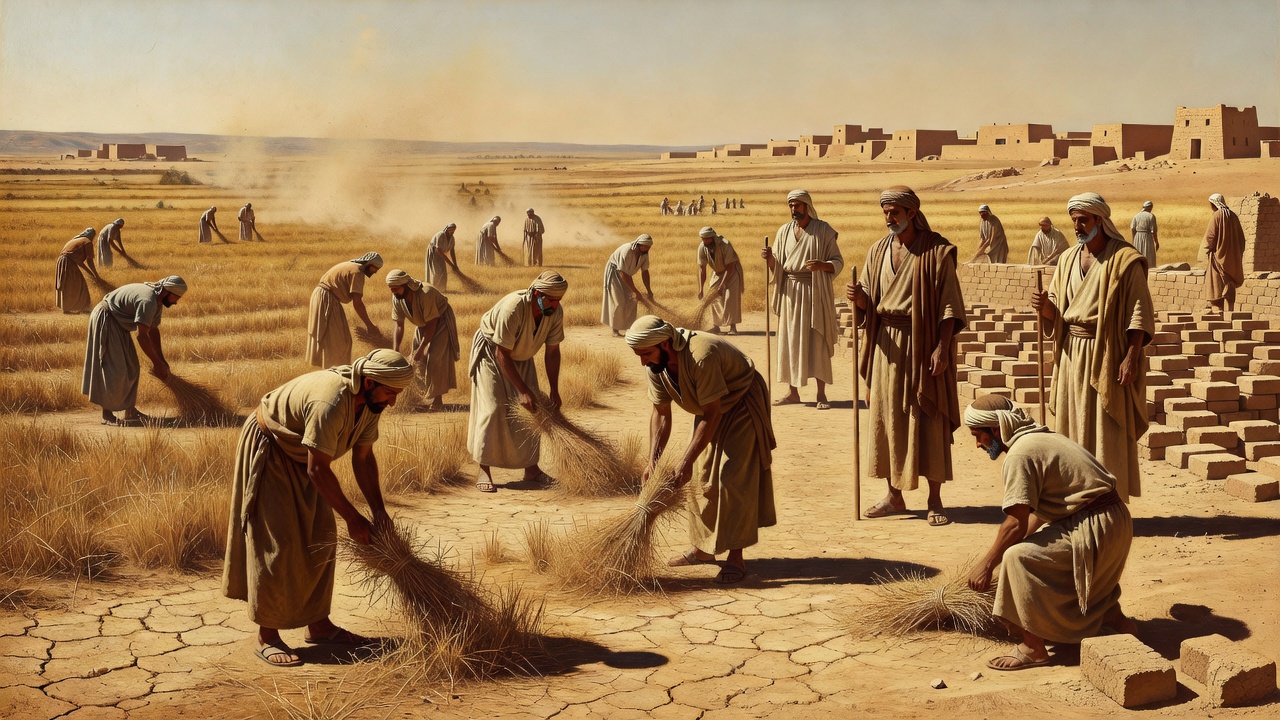
6And the same day Pharaoh commanded the taskmasters of the people, and their officers, saying: 7'Ye shall no more give the people straw to make brick, as heretofore. Let them go and gather straw for themselves. 8And the tale of the bricks, which they did make heretofore, ye shall lay upon them; ye shall not diminish aught thereof; for they are idle; therefore they cry, saying: Let us go and sacrifice to our God. 9Let heavier work be laid upon the men, that they may labour therein; and let them not regard lying words.' 10And the taskmasters of the people went out, and their officers, and they spoke to the people, saying: 'Thus saith Pharaoh: I will not give you straw. 11Go yourselves, get you straw where ye can find it; for nought of your work shall be diminished.' 12So the people were scattered abroad throughout all the land of Egypt to gather stubble for straw. 13And the taskmasters were urgent, saying: 'Fulfil your work, your daily task, as when there was straw.' 14And the officers of the children of Israel, whom Pharaoh's taskmasters had set over them, were beaten, saying: 'Wherefore have ye not fulfilled your appointed task in making brick both yesterday and today as heretofore?'
The Cry of the Israelites
15Then the officers of the children of Israel came and cried unto Pharaoh, saying: 'Wherefore dealest thou thus with thy servants? 16There is no straw given unto thy servants, and they say to us: Make brick; and, behold, thy servants are beaten, but the fault is in thine own people.' 17But he said: 'Ye are idle, ye are idle; therefore ye say: Let us go and sacrifice to the LORD. 18Go therefore now, and work; for there shall no straw be given you, yet shall ye deliver the tale of bricks.' 19And the officers of the children of Israel did see that they were set on mischief, when they said: 'Ye shall not diminish aught from your bricks, your daily task.' 20And they met Moses and Aaron, who stood in the way, as they came forth from Pharaoh; 21and they said unto them: 'The LORD look upon you, and judge; because ye have made our savour to be abhorred in the eyes of Pharaoh, and in the eyes of his servants, to put a sword in their hand to slay us.' 22And Moses returned unto the LORD, and said: 'Lord, wherefore hast Thou dealt ill with this people? why is it that Thou hast sent me? 23For since I came to Pharaoh to speak in Thy name, he hath dealt ill with this people; neither hast Thou delivered Thy people at all.'
Você sabia?
Trabalho mais duro depois da recusa do faraó
- O Easton's Bible Dictionary (1897) diz que o faraó do Êxodo foi provavelmente Menephtah I, o décimo quarto e mais velho filho sobrevivente de Ramsés II, mas trata a identificação como uma questão ainda em aberto: alguns estudiosos, observa a obra, preferem Seti II, cujo reinado ela descreve como iniciado em paz e terminado num desastre repentino. O verbete diz que ele residia em Zoã, onde recebeu Moisés e Arão nas audiências registradas em Êxodo.Fontes: Pharaoh (of the Exodus) · o próprio texto bíblico
- O Easton's Bible Dictionary (1897) situa a chegada de Jacó ao Egito provavelmente cerca de 350 anos antes do nascimento de Moisés. Diz que um rei hicso, de um povo semita pastoril da Ásia e chamado rei pastor, recebeu a família com favor e lhes destinou Gósen, a melhor terra; neste capítulo o faraó trata o povo de Israel, já numeroso, como trabalhadores que não pretende deixar partir.Fontes: Moses · o próprio texto bíblico
- O faraó responde ao pedido de celebrar uma festa no deserto deixando de fornecer a palha para os tijolos, mas ainda exigindo a mesma cota diária. O povo se espalha por toda a terra do Egito para recolher restolho, e os oficiais israelitas que os capatazes do faraó haviam posto sobre eles são espancados quando essa cota não é cumprida.Fontes: o próprio texto bíblico
Notas escritas com auxílio de IA a partir de fontes abertas (Theographic Bible Metadata, CC BY-SA 4.0; Easton’s Bible Dictionary, domínio público) e revisadas antes de publicar.
Lugares deste capítulo
Só aparecem lugares com identificação de alta confiança (90% ou mais segundo as fontes acadêmicas reunidas pelo OpenBible). Mapa da época: DARE (Digital Atlas of the Roman Empire), CC BY 4.0; mapa atual: © colaboradores do OpenStreetMap; lugares: OpenBible.info (CC BY 4.0).
Créditos e licença desta tradução
JPS TaNaKH 1917
The Jewish Bible (Old Testament) in English, published by the Jewish Publication Society in 1917
Public Domain
Language: English
Dialect: American
Translation by: Jewish Publication Society
This copy of the Old JPS TaNaKH by the Jewish Publication Society is brought to you courtesy of eBible.org . For the new JPS TaNaKH (1972, 1978, 1980), please see jps.org .
2023-09-19
Títulos de seção adaptados da Berean Standard Bible (domínio público); não fazem parte do texto bíblico desta tradução.
Fonte: http://ebible.org/engjps/ · eBible.org