Éxodo 5
JPS TaNaKH 1917 · Toca un versículo para ver sus referencias cruzadas.
Pharaoh’s First Refusal
1And afterward Moses and Aaron came, and said unto Pharaoh: 'Thus saith the LORD, the God of Israel: Let My people go, that they may hold a feast unto Me in the wilderness.' 2And Pharaoh said: 'Who is the LORD, that I should hearken unto His voice to let Israel go? I know not the LORD, and moreover I will not let Israel go.' 3And they said: 'The God of the Hebrews hath met with us. Let us go, we pray thee, three days' journey into the wilderness, and sacrifice unto the LORD our God; lest He fall upon us with pestilence, or with the sword.' 4And the king of Egypt said unto them: 'Wherefore do ye, Moses and Aaron, cause the people to break loose from their work? get you unto your burdens.' 5And Pharaoh said: 'Behold, the people of the land are now many, and will ye make them rest from their burdens?'
Bricks and Straw
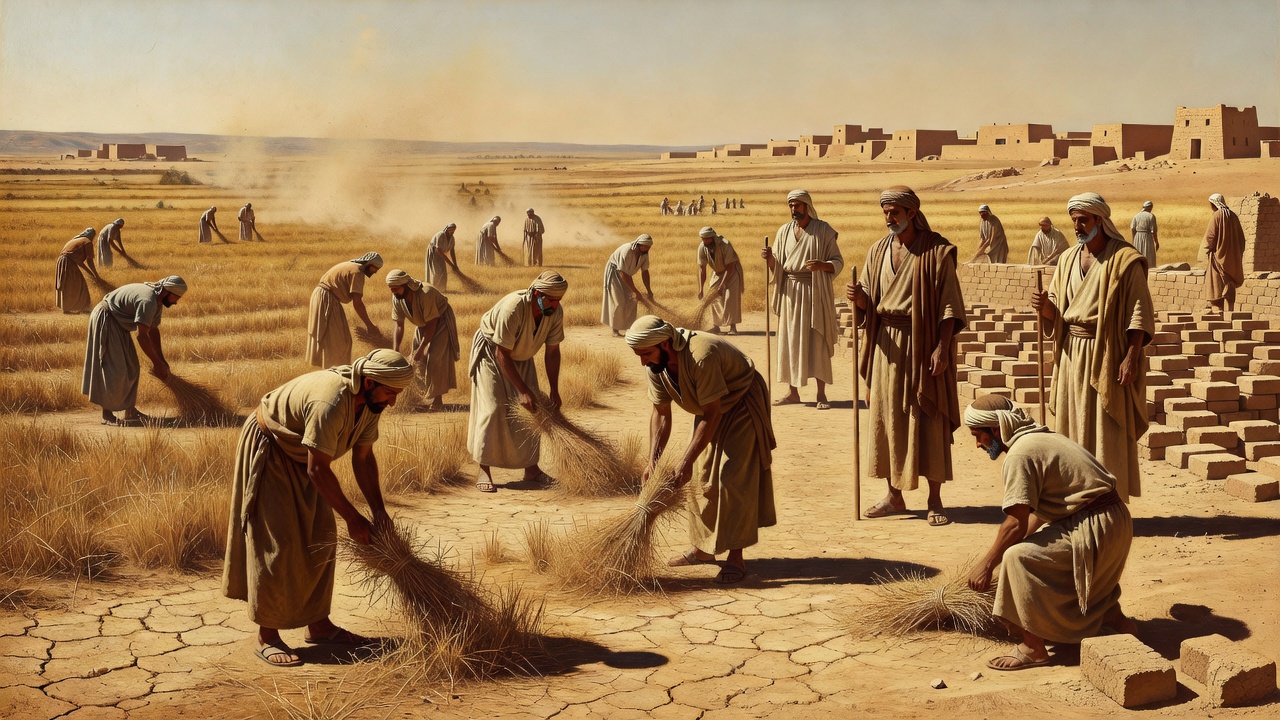
6And the same day Pharaoh commanded the taskmasters of the people, and their officers, saying: 7'Ye shall no more give the people straw to make brick, as heretofore. Let them go and gather straw for themselves. 8And the tale of the bricks, which they did make heretofore, ye shall lay upon them; ye shall not diminish aught thereof; for they are idle; therefore they cry, saying: Let us go and sacrifice to our God. 9Let heavier work be laid upon the men, that they may labour therein; and let them not regard lying words.' 10And the taskmasters of the people went out, and their officers, and they spoke to the people, saying: 'Thus saith Pharaoh: I will not give you straw. 11Go yourselves, get you straw where ye can find it; for nought of your work shall be diminished.' 12So the people were scattered abroad throughout all the land of Egypt to gather stubble for straw. 13And the taskmasters were urgent, saying: 'Fulfil your work, your daily task, as when there was straw.' 14And the officers of the children of Israel, whom Pharaoh's taskmasters had set over them, were beaten, saying: 'Wherefore have ye not fulfilled your appointed task in making brick both yesterday and today as heretofore?'
The Cry of the Israelites
15Then the officers of the children of Israel came and cried unto Pharaoh, saying: 'Wherefore dealest thou thus with thy servants? 16There is no straw given unto thy servants, and they say to us: Make brick; and, behold, thy servants are beaten, but the fault is in thine own people.' 17But he said: 'Ye are idle, ye are idle; therefore ye say: Let us go and sacrifice to the LORD. 18Go therefore now, and work; for there shall no straw be given you, yet shall ye deliver the tale of bricks.' 19And the officers of the children of Israel did see that they were set on mischief, when they said: 'Ye shall not diminish aught from your bricks, your daily task.' 20And they met Moses and Aaron, who stood in the way, as they came forth from Pharaoh; 21and they said unto them: 'The LORD look upon you, and judge; because ye have made our savour to be abhorred in the eyes of Pharaoh, and in the eyes of his servants, to put a sword in their hand to slay us.' 22And Moses returned unto the LORD, and said: 'Lord, wherefore hast Thou dealt ill with this people? why is it that Thou hast sent me? 23For since I came to Pharaoh to speak in Thy name, he hath dealt ill with this people; neither hast Thou delivered Thy people at all.'
¿Sabías que…?
Trabajo más duro tras la negativa del faraón
- El Easton's Bible Dictionary (1897) dice que el faraón del Éxodo fue probablemente Menephtah I, el decimocuarto y mayor hijo sobreviviente de Ramsés II, pero trata la identificación como una cuestión aún abierta: algunos eruditos, señala la obra, se inclinan por Seti II, cuyo reinado describe como iniciado en paz y terminado en un desastre repentino. La entrada dice que residía en Zoán, donde recibió a Moisés y a Aarón en las audiencias registradas en Éxodo.Fuentes: Pharaoh (of the Exodus) · el propio texto bíblico
- El Easton's Bible Dictionary (1897) sitúa la llegada de Jacob a Egipto probablemente unos 350 años antes del nacimiento de Moisés. Dice que un rey hicso, de un pueblo semita pastoril de Asia y llamado rey pastor, recibió a la familia con favor y les asignó Gosén, la mejor tierra; en este capítulo el faraón trata al pueblo de Israel, ya numeroso, como trabajadores a los que no dejará ir.Fuentes: Moses · el propio texto bíblico
- El faraón responde a la petición de celebrar una fiesta en el desierto dejando de suministrar la paja para los ladrillos, pero exigiendo todavía la misma cuota diaria. El pueblo se dispersa por toda la tierra de Egipto para recoger rastrojo, y los oficiales israelitas que los capataces del faraón habían puesto sobre ellos son golpeados cuando esa cuota no se cumple.Fuentes: el propio texto bíblico
Notas escritas con ayuda de IA a partir de fuentes abiertas (Theographic Bible Metadata, CC BY-SA 4.0; Easton’s Bible Dictionary, dominio público) y revisadas antes de publicarse.
Lugares de este capítulo
Solo aparecen lugares identificados con alta confianza (90 % o más según las fuentes académicas reunidas por OpenBible). Mapa de la época: DARE (Digital Atlas of the Roman Empire), CC BY 4.0; mapa actual: © colaboradores de OpenStreetMap; lugares: OpenBible.info (CC BY 4.0).
Créditos y licencia de esta traducción
JPS TaNaKH 1917
The Jewish Bible (Old Testament) in English, published by the Jewish Publication Society in 1917
Public Domain
Language: English
Dialect: American
Translation by: Jewish Publication Society
This copy of the Old JPS TaNaKH by the Jewish Publication Society is brought to you courtesy of eBible.org . For the new JPS TaNaKH (1972, 1978, 1980), please see jps.org .
2023-09-19
Títulos de sección adaptados de la Berean Standard Bible (dominio público); no forman parte del texto bíblico de esta traducción.
Fuente: http://ebible.org/engjps/ · eBible.org