Deuteronômio 24
Free Bible Version · Toque num versículo para ver as referências cruzadas.
Marriage and Divorce Laws
1Should a man marry a woman, but then isn't pleased with her because he finds out something shameful about her, he is allowed to write out a certificate of divorce for her, give it to her, and send her out of his house.
2Suppose that after leaving his house, she goes and marries another man, 3and suppose the second man also ends up hating her, writes out a certificate of divorce for her, gives it to her, and sends her out of his house—or he may happen to die. 4The first husband who divorced her is not permitted to marry her again after she was shamed, for that offends the Lord. You are not to bring guilt upon the land that the Lord your God is giving you to own.
5If a man has just got married, he is not to be sent to war or made to do any other duties. He is free to stay at home for one year and make his wife happy.
Additional Laws
6Don't accept a pair of millstones, or even just an upper millstone, as security for a debt, because that would put the borrower's life in danger.
7Anyone caught kidnapping a fellow Israelite must be executed, whether the kidnapper makes him a slave or sells him. You must eliminate the evil from among you.
8When it comes to infectious skin diseases, make sure you follow carefully all the instructions of the Levitical priests. Be careful to follow the orders I've given them. 9Remember what the Lord your God did to Miriam on the journey out of Egypt.
10If you lend anything to someone, don't go into their house to take some kind of security. 11Stand outside while they go inside and bring the security out to you. 12If he is a poor man he may give his cloak as security, but you must not keep it when you go to sleep. 13Make sure you give it back by sunset, so that he can sleep in his own cloak and thank you, and you will be counted as doing good by the Lord your God.
14Don't mistreat a paid servant who is poor and needy, whether he's an Israelite or a foreigner living in one of your towns. 15Pay his wages every day before sunset, because he is poor and is relying on them. If you don't he may complain to the Lord about you, and you will be found guilty of sin.
16Fathers are not to be executed because of their children, and children are not to be executed because of their fathers. Each person is to be executed because of their own sin.
17Don't treat foreigners or orphans unjustly; don't take a widow's cloak as security. 18Remember that you were once slaves in Egypt, and the Lord your God rescued you from that place. That's why I'm ordering you to do this.
19If when you're harvesting in your field you forget a sheaf there, don't go back for it. Leave it for the foreigners, the orphans, and the widows, so that the Lord your God may bless you in everything you do.
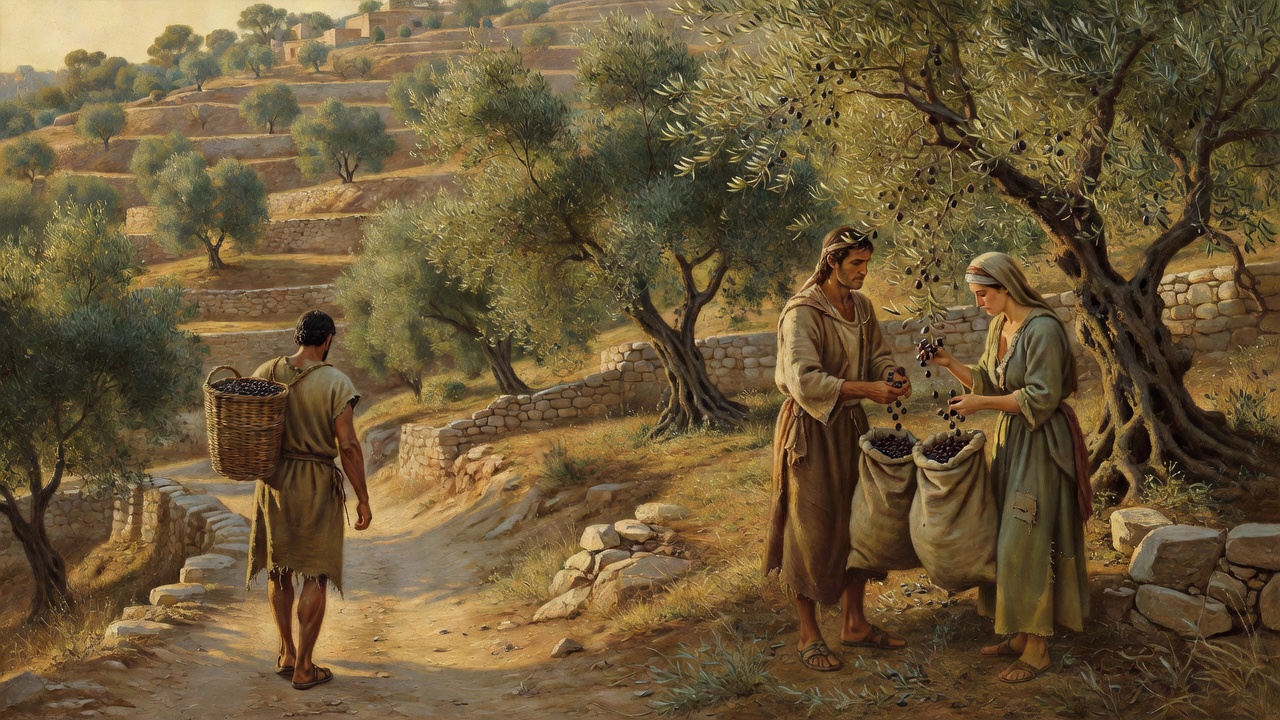
20When you shake the olive trees to knock down the olives, don't go over the branches again. What's left is for the foreigners, the orphans, and the widows.
21When you harvest the grapes in your vineyard, don't go over the vines again. What's left is for the foreigners, the orphans, and the widows. 22Remember you were once slaves in Egypt. That's why I'm ordering you to do this.
Você sabia?
Leis de Compaixão, Justiça e Proteção Social
- As leis de colheita israelitas exigiam que os proprietários deixassem feixes esquecidos de cereais, azeitonas restantes e respigos de uvas para os grupos vulneráveis: o estrangeiro residente, o órfão e a viúva. Esse sistema de assistência apoiava-se na memória coletiva de que os israelitas haviam sido escravos no Egito.Fontes: o próprio texto bíblico · Egypt
- Devedores e trabalhadores assalariados contavam com limites legais explícitos. Os credores eram proibidos de entrar na casa de um devedor para tomar penhores, de reter mós indispensáveis ao sustento diário ou de guardar a capa de dormir de uma pessoa pobre após o pôr do sol, além de deverem pagar os diaristas antes do anoitecer.Fontes: o próprio texto bíblico
- Ao dar instruções sobre doenças infecciosas da pele e as orientações dos sacerdotes levíticos, o texto relembra a aflição que atingiu Miriã, irmã de Moisés e Arão, durante a caminhada pelo deserto após a saída do Egito.Fontes: o próprio texto bíblico · Miriam · Egypt
Notas escritas com auxílio de IA a partir de fontes abertas (Theographic Bible Metadata, CC BY-SA 4.0; Easton’s Bible Dictionary, domínio público) e revisadas antes de publicar.
Lugares deste capítulo
Só aparecem lugares com identificação de alta confiança (90% ou mais segundo as fontes acadêmicas reunidas pelo OpenBible). Mapa da época: DARE (Digital Atlas of the Roman Empire), CC BY 4.0; mapa atual: © colaboradores do OpenStreetMap; lugares: OpenBible.info (CC BY 4.0).
Créditos e licença desta tradução
Free Bible Version
The New Testament and Psalms in the Free Bible Version translation in American English
Copyright © 2018 Dr. Jonathan Gallagher
Language: English
Dialect: American
Translation by: Dr. Jonathan Gallagher
This translation is made available to you under the terms of the
Creative Commons Attribution Share-Alike license 4.0.
You have permission to share and redistribute this Bible translation in any format and to make reasonable revisions and adaptations of this translation, provided that:
You include the above copyright and source information.
If you make any changes to the text, you must indicate that you did so in a way that makes it clear that the original licensor is not necessarily endorsing your changes.
If you redistribute this text, you must distribute your contributions under the same license as the original.
Pictures included with Scriptures and other documents on this site are licensed just for use with those Scriptures and documents.
For other uses, please contact the respective copyright owners.
Note that in addition to the rules above, revising and adapting God's Word involves a great responsibility to be true to God's Word. See Revelation 22:18-19.
2026-10-02
Títulos de seção adaptados da Berean Standard Bible (domínio público); não fazem parte do texto bíblico desta tradução.
Fonte: http://ebible.org/engfbv/ · eBible.org