Deuteronomio 24
Free Bible Version · Toca un versículo para ver sus referencias cruzadas.
Marriage and Divorce Laws
1Should a man marry a woman, but then isn't pleased with her because he finds out something shameful about her, he is allowed to write out a certificate of divorce for her, give it to her, and send her out of his house.
2Suppose that after leaving his house, she goes and marries another man, 3and suppose the second man also ends up hating her, writes out a certificate of divorce for her, gives it to her, and sends her out of his house—or he may happen to die. 4The first husband who divorced her is not permitted to marry her again after she was shamed, for that offends the Lord. You are not to bring guilt upon the land that the Lord your God is giving you to own.
5If a man has just got married, he is not to be sent to war or made to do any other duties. He is free to stay at home for one year and make his wife happy.
Additional Laws
6Don't accept a pair of millstones, or even just an upper millstone, as security for a debt, because that would put the borrower's life in danger.
7Anyone caught kidnapping a fellow Israelite must be executed, whether the kidnapper makes him a slave or sells him. You must eliminate the evil from among you.
8When it comes to infectious skin diseases, make sure you follow carefully all the instructions of the Levitical priests. Be careful to follow the orders I've given them. 9Remember what the Lord your God did to Miriam on the journey out of Egypt.
10If you lend anything to someone, don't go into their house to take some kind of security. 11Stand outside while they go inside and bring the security out to you. 12If he is a poor man he may give his cloak as security, but you must not keep it when you go to sleep. 13Make sure you give it back by sunset, so that he can sleep in his own cloak and thank you, and you will be counted as doing good by the Lord your God.
14Don't mistreat a paid servant who is poor and needy, whether he's an Israelite or a foreigner living in one of your towns. 15Pay his wages every day before sunset, because he is poor and is relying on them. If you don't he may complain to the Lord about you, and you will be found guilty of sin.
16Fathers are not to be executed because of their children, and children are not to be executed because of their fathers. Each person is to be executed because of their own sin.
17Don't treat foreigners or orphans unjustly; don't take a widow's cloak as security. 18Remember that you were once slaves in Egypt, and the Lord your God rescued you from that place. That's why I'm ordering you to do this.
19If when you're harvesting in your field you forget a sheaf there, don't go back for it. Leave it for the foreigners, the orphans, and the widows, so that the Lord your God may bless you in everything you do.
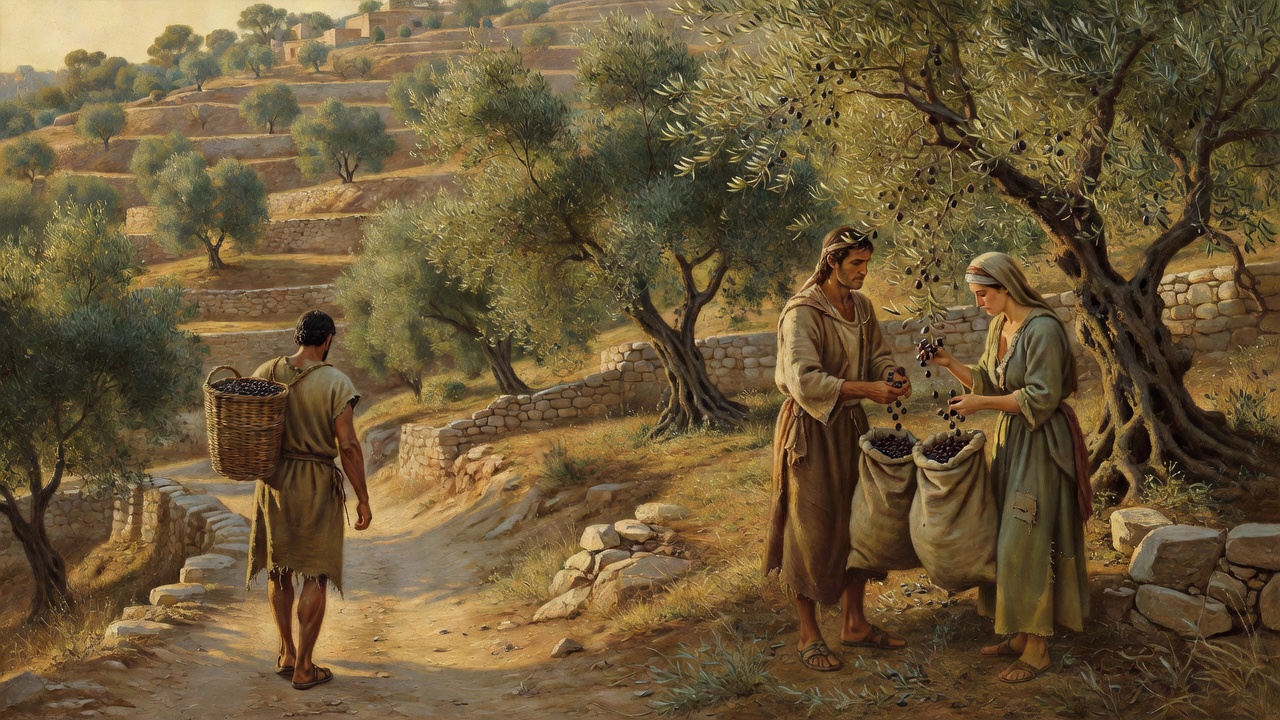
20When you shake the olive trees to knock down the olives, don't go over the branches again. What's left is for the foreigners, the orphans, and the widows.
21When you harvest the grapes in your vineyard, don't go over the vines again. What's left is for the foreigners, the orphans, and the widows. 22Remember you were once slaves in Egypt. That's why I'm ordering you to do this.
¿Sabías que…?
Leyes de Compasión, Justicia y Protección Social
- Las leyes de cosecha de Israel exigían que los propietarios dejaran gavillas olvidadas, aceitunas rezagadas y rebuscos de uvas para los grupos vulnerables: el extranjero residente, el huérfano y la viuda. Este sistema de ayuda social se fundamentaba en el recuerdo de que los propios israelitas habían sido esclavos en Egipto.Fuentes: el propio texto bíblico · Egypt
- Los deudores y jornaleros estaban protegidos por límites legales específicos. Se prohibía a los acreedores entrar en la casa de un deudor para tomar una prenda, retener piedras de molino esenciales para el sustento diario o quedarse con el manto de dormir de un necesitado tras la puesta del sol, y los pagos debían entregarse antes del anochecer.Fuentes: el propio texto bíblico
- Al dar instrucciones sobre enfermedades infecciosas de la piel y las directivas de los sacerdotes levitas, el texto evoca lo ocurrido a Miriam, hermana de Moisés y Aarón, durante la travesía por el desierto tras salir de Egipto.Fuentes: el propio texto bíblico · Miriam · Egypt
Notas escritas con ayuda de IA a partir de fuentes abiertas (Theographic Bible Metadata, CC BY-SA 4.0; Easton’s Bible Dictionary, dominio público) y revisadas antes de publicarse.
Lugares de este capítulo
Solo aparecen lugares identificados con alta confianza (90 % o más según las fuentes académicas reunidas por OpenBible). Mapa de la época: DARE (Digital Atlas of the Roman Empire), CC BY 4.0; mapa actual: © colaboradores de OpenStreetMap; lugares: OpenBible.info (CC BY 4.0).
Créditos y licencia de esta traducción
Free Bible Version
The New Testament and Psalms in the Free Bible Version translation in American English
Copyright © 2018 Dr. Jonathan Gallagher
Language: English
Dialect: American
Translation by: Dr. Jonathan Gallagher
This translation is made available to you under the terms of the
Creative Commons Attribution Share-Alike license 4.0.
You have permission to share and redistribute this Bible translation in any format and to make reasonable revisions and adaptations of this translation, provided that:
You include the above copyright and source information.
If you make any changes to the text, you must indicate that you did so in a way that makes it clear that the original licensor is not necessarily endorsing your changes.
If you redistribute this text, you must distribute your contributions under the same license as the original.
Pictures included with Scriptures and other documents on this site are licensed just for use with those Scriptures and documents.
For other uses, please contact the respective copyright owners.
Note that in addition to the rules above, revising and adapting God's Word involves a great responsibility to be true to God's Word. See Revelation 22:18-19.
2026-10-02
Títulos de sección adaptados de la Berean Standard Bible (dominio público); no forman parte del texto bíblico de esta traducción.
Fuente: http://ebible.org/engfbv/ · eBible.org