Êxodo 2
Berean Standard Bible · Toque num versículo para ver as referências cruzadas.
The Birth and Adoption of Moses
1Now a man of the house of Levi married a daughter of Levi, 2and she conceived and gave birth to a son. When she saw that he was a beautiful child, she hid him for three months.
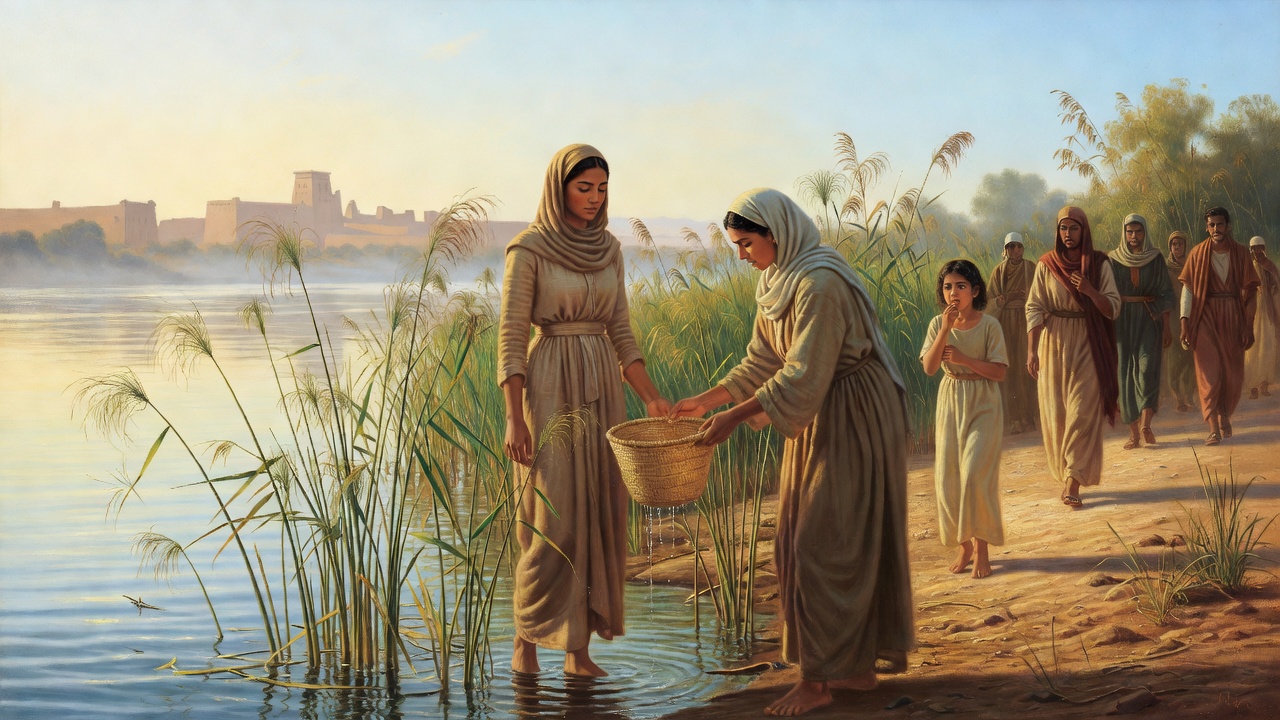
3But when she could no longer hide him, she got him a papyrus basket and coated it with tar and pitch. Then she placed the child in the basket and set it among the reeds along the bank of the Nile. 4And his sister stood at a distance to see what would happen to him.
5Soon the daughter of Pharaoh went down to bathe in the Nile, and her attendants were walking along the riverbank. And when she saw the basket among the reeds, she sent her maidservant to retrieve it. 6When she opened it, she saw the child, and behold, the little boy was crying. So she had compassion on him and said, “This is one of the Hebrew children.”
7Then his sister said to Pharaoh’s daughter, “Shall I go and call one of the Hebrew women to nurse the child for you?”
8“Go ahead,” Pharaoh’s daughter told her. And the girl went and called the boy’s mother.
9Pharaoh’s daughter said to her, “Take this child and nurse him for me, and I will pay your wages.” So the woman took the boy and nursed him.
10When the child had grown older, she brought him to Pharaoh’s daughter, and he became her son. She named him Moses and explained, “I drew him out of the water.”
The Rejection and Flight of Moses
11One day, after Moses had grown up, he went out to his own people and observed their hard labor. He saw an Egyptian beating a Hebrew, one of his own people. 12After looking this way and that and seeing no one, he struck down the Egyptian and hid his body in the sand.
13The next day Moses went out and saw two Hebrews fighting. He asked the one in the wrong, “Why are you attacking your companion?”
14But the man replied, “Who made you ruler and judge over us? Are you planning to kill me as you killed the Egyptian?”
Then Moses was afraid and thought, “This thing I have done has surely become known.”
15When Pharaoh heard about this matter, he sought to kill Moses. But Moses fled from Pharaoh and settled in the land of Midian, where he sat down beside a well.
16Now the priest of Midian had seven daughters, and they came to draw water and fill the troughs to water their father’s flock. 17And when some shepherds came along and drove them away, Moses rose up to help them and watered their flock.
18When the daughters returned to their father Reuel, he asked them, “Why have you returned so early today?”
19“An Egyptian rescued us from the shepherds,” they replied. “He even drew water for us and watered the flock.”
20“So where is he?” their father asked. “Why did you leave the man behind? Invite him to have something to eat.”
21Moses agreed to stay with the man, and he gave his daughter Zipporah to Moses in marriage. 22And she gave birth to a son, and Moses named him Gershom, saying, “I have become a foreigner in a foreign land.”
God Hears the Cry of the Israelites
23After a long time, the king of Egypt died. The Israelites groaned and cried out under their burden of slavery, and their cry for deliverance from bondage ascended to God.
24So God heard their groaning, and He remembered His covenant with Abraham, Isaac, and Jacob. 25God saw the Israelites and took notice.
Você sabia?
O nascimento e a fuga de Moisés
- A filha do faraó deu ao menino o nome de Moisés e explicou que o havia tirado da água. O Dicionário Bíblico de Easton (1897) liga o nome dele a “tirado”, ou à palavra egípcia mesu, “filho” — o elemento a partir do qual o dicionário também explica Ramsés como “filho real”.Fontes: o próprio texto bíblico · Moses
- Em Êxodo 2, uma filha de Levi esconde o filho por três meses, e a filha do faraó, ao achá-lo entre os juncos do Nilo, reconhece uma criança hebreia. O Dicionário Bíblico de Easton (1897) liga a aflição dos israelitas ao “novo rei que não conhecera a José”, por muito tempo tido como Aahmes I, chamado Amosis por Josefo, embora o dicionário, citando descobertas então recentes, o identifique como Seti. O sofrimento deles, diz a obra, começou depois que os hicsos, senhores do Egito por cerca de cinco séculos, foram expulsos e a antiga dinastia foi restaurada.Fontes: o próprio texto bíblico · Pharaoh
- Depois que o faraó procurou matá-lo, Moisés fugiu para Midiã e sentou-se junto a um poço; mais tarde casou-se com Zípora, uma das sete filhas do sacerdote de Midiã. Os midianitas eram árabes nômades, descendentes de Midiã, o quarto filho de Abraão com Quetura, e pastoreavam seus rebanhos na península do Sinai e no deserto ao norte da península Arábica. Neste capítulo o sacerdote se chama Reuel, a quem o Dicionário Bíblico de Easton (1897) chama Raguel, considerando essa forma seu nome pessoal e Jetro — “excelência” — um título oficial, caso os dois sejam identificados.Fontes: o próprio texto bíblico · Midian · Midian · Jethro
Notas escritas com auxílio de IA a partir de fontes abertas (Theographic Bible Metadata, CC BY-SA 4.0; Easton’s Bible Dictionary, domínio público) e revisadas antes de publicar.
Lugares deste capítulo
- Nile · Hoje: Nile River · 31.465, 30.367 · versículos 3, 5
- Midian · 28.495, 35.012 · versículos 15, 16
- Egypt · 30.129, 31.308 · versículo 23
Só aparecem lugares com identificação de alta confiança (90% ou mais segundo as fontes acadêmicas reunidas pelo OpenBible). Mapa da época: DARE (Digital Atlas of the Roman Empire), CC BY 4.0; mapa atual: © colaboradores do OpenStreetMap; lugares: OpenBible.info (CC BY 4.0).
Créditos e licença desta tradução
Berean Standard Bible
The Holy Bible in English: Berean Standard Bible
Public Domain
Language: English
Contributor: BSB Publishing, LLC
2026-10-02
Fonte: http://ebible.org/engbsb/ · eBible.org