Gênesis 19
Wycliffe Bible · Toque num versículo para ver as referências cruzadas.
Lot Welcomes the Angels
1And tweyne aungels camen to Sodom in the euentide, while Loth sat in the yatis of the citee. And whanne he hadde seyn hem, he roos, and yede ayens hem, and worschipide lowe to erthe, 2and seide, My lordis, Y biseche, bowe ye in to the hous of youre child, and dwelle ye there; waische ye youre feet, and in the morewtid ye schulen go in to youre weie. Whiche seiden, Nay, but we schulen dwelle in the street. 3He constreynede hem greetli, that thei schulden turne to hym. And whanne thei weren entrid in to his hous, he made a feeste, he bakide therf breed, and thei eten. 4Forsothe bifore that thei yeden to sleepe, men of the citee compassiden his hows, fro a child `til to an eld man, al the puple togidre; 5and thei clepiden Loth, and seiden to him, Where ben the men that entriden to thee to nyyt? brynge hem out hidur, that we `knowe hem. 6And Loth yede out to hem `bihynde the bak, and closide the dore, 7and seide, Y biseche, nyle ye, my britheren, nyle ye do this yuel. 8Y haue twey douytris, that knewen not yit man; Y schal lede out hem to you, and mys vse ye hem as it plesith you, so that ye doon noon yuel to these men, for thei entriden vndur the schadewe of my roof. 9And thei seiden, Go thou fro hennus. And eft thei seiden, Thou entridist as a comelyng; wher that thou deme? therfor we schulen turment thee more than these. And thei diden violentli to Loth ful greetli. Thanne it was nyy that thei wolden breke the doris; and lo! 10the men puttiden hoond, and ledden in Loth to hem, and thei closiden the dore. 11And thei smyten with blyndenesse hem that weren withoutforth, fro the leest til to the moost; so that thei myyten not fynde the dore.
Lot Flees to Zoar
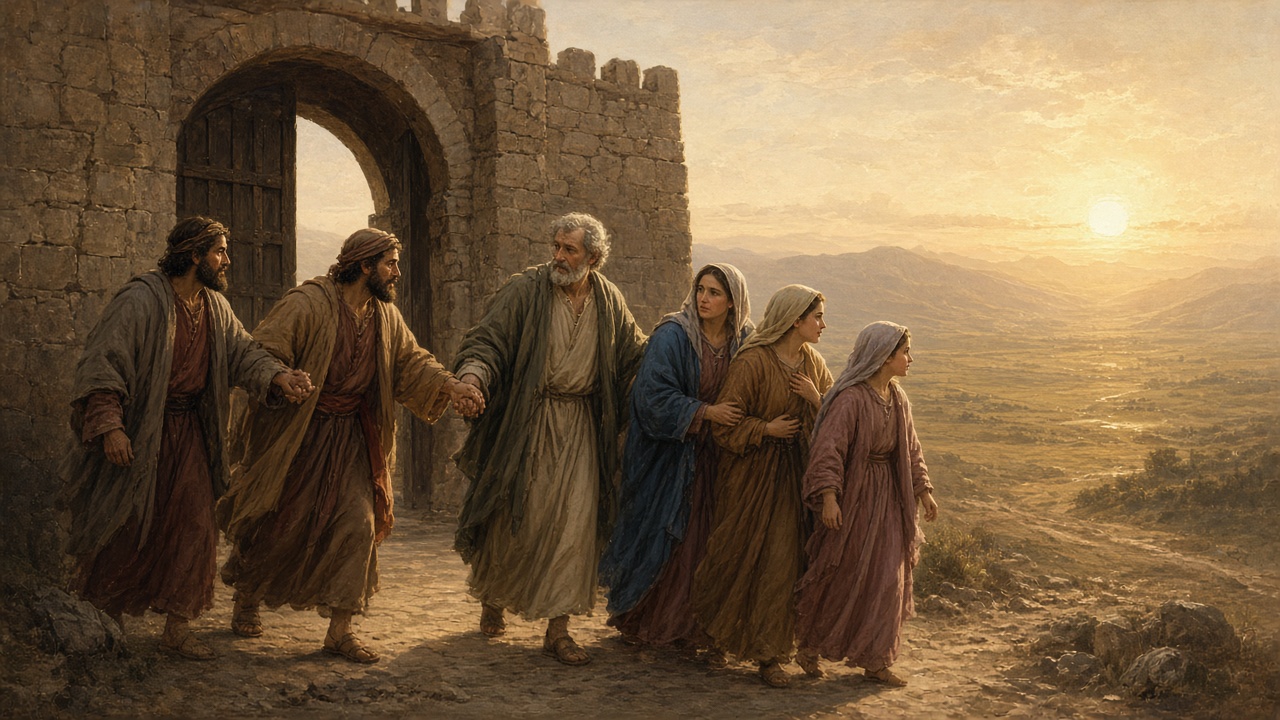
12Forsothe thei seiden to Loth, Hast thou here ony man of thine, hosebonde of thi douyter, ethir sones, ethir douytris; lede thou out of this citee alle men that ben thine, 13for we schulen do a wey this place, for the cry of hem encreesside bifor the Lord, which sente vs that we leese hem. 14And so Loth yede out, and spak to the hosebondys of his douytris, that schulden take hise douytris, and seide, Rise ye, and go ye out of this place; for the Lord schal do awey this citee. And he was seyn to hem to speke as pleiynge. 15And whanne the morewtid was, the aungels constreyneden hym, and seiden, Rise thou, and take thi wijf, and thi twey douytris whiche thou hast, lest also thou perische to gidere in the synne of the citee. 16While he dissymelide, thei token his hond, and the hond of his wijf, and of his twey doutris; for the Lord sparide hym. 17And thei ledden out hym, and settiden with out the citee. There thei spaken to him, and seiden, Saue thou thi lijf; nyle thou biholde bihynde thi bac, nether stond thou in al the cuntre aboute, but make thee saaf in the hil; lest also thou perische togidere. 18And Loth seide to hem, My lord, Y biseche, 19for thi seruaunt hath founde grace bifore thee, and thou hast magnyfied thi grace and mercy, which thou hast do with me, that thou schuldist saue my lijf; Y may not be saued in the hil, lest perauenture yuel take me, and Y die; 20a litil citee is here bisidis, to which Y may fle, and Y schal be saued ther ynne; where it is not a litil citee? and my soule schal lyue ther ynne. 21And he seide to Loth, Lo! also in this Y haue resseyued thi preieris, that Y distrye not the citee, for which thou hast spoke; 22haste thou, and be thou saued there, for Y may not do ony thing til thou entre thidur. Therfor the name of that citee was clepid Segor. 23The sunne roos on erthe, and Loth entride in to Segor.
The Destruction of Sodom and Gomorrah
24Therfor the Lord reynede on Sodom and Gomorre brynston and fier, fro the Lord fro heuene, 25and distriede these citees, and al the cuntrey aboute; he destriede alle enhabiters of citees, and all grene thingis of erthe. 26And his wijf lokide abac, and was turned in to an ymage of salt. 27Forsothe Abraham risynge eerly, where he stood bifore with the Lord, bihelde Sodom and Gomorre, 28and al the lond of that cuntrey; and he seiy a deed sparcle stiynge fro erthe, as the smoke of a furneis. 29For whanne God distriede the citees of that cuntrey, he hadde mynde of Abraham, and delyuerede Loth fro destriynge of the citees in whiche he dwellide.
Lot and His Daughters
30And Loth stiede fro Segor, and dwellide in the hil, and hise twey douytris with him, for he dredde to dwelle in Segor; and he dwellide in a denne, he and his twey douytris with hym. 31And the more douytre seide to the lasse, Oure fadre is eld, and no man is left in erthe, that may entre to vs, bi the custom of al erthe; 32come thou, make we him drunkun of wyn, and slepe we with him, that we moun kepe seed of oure fadir. 33And so thei yauen to her fadir to drynke wyn in that nyyt, and the more douyter entrede, and slepte with hir fadir; and he feelide not, nethir whanne the douytir lay doun, nether whanne sche roos. 34And in the tothir dai the more douytir seide to the lasse, Lo! Y slepte yistirdai with my fadir, yyue we to hym to drynk wyn also in this nyyt; and thou schalt slepe with hym, that we saue seed of oure fadir. 35And thei yauen to her fadir also in that nyyt to drynke wyn, and the lesse douytir entride, and slepte with him; and sotheli he feelide not thanne whanne sche lay doun, nether whanne sche roos. 36Therfor the twei douytris of Loth conseyuede of hir fadir. 37And the more douytre childide a sone, and clepide his name Moab; he is the fadir of men of Moab `til in to present dai. 38And the lesse douyter childide a sone, and clepide his name Amon, that is, the sone of my puple; he is the fadir of men of Amon til to day.
Você sabia?
A destruição de Sodoma e Gomorra
- A cidade para a qual Ló pediu para fugir chamava-se Zoar, nome que o Dicionário Bíblico de Easton (1897) explica como “pequena”, o que combina com o pedido dele de que era apenas um lugar pequeno. O mesmo verbete diz que antes se chamava Bela e ficava a leste ou a sudeste do Mar Morto, e que os profetas Isaías e Jeremias a mencionam depois.Fontes: Zoar · o próprio texto bíblico
- O Dicionário Bíblico de Easton (1897) dá a Sodoma, no vale de Sidim, o sentido de “ardente” ou “a amuralhada”, e diz que a maldade dos seus habitantes fez cair fogo do céu, que destruiu a cidade. O mesmo dicionário explica Gomorra como “submersão”, uma das cinco cidades daquela planície, e afirma que provavelmente ficavam próximas, perto da extremidade norte do que hoje é o Mar Morto, e que Gomorra é sempre mencionada logo depois de Sodoma.Fontes: Sodom · Gomorrah · o próprio texto bíblico
- A filha mais velha de Ló chamou o filho de Moabe, e a narrativa o apresenta como pai dos moabitas, nome que livros posteriores usam para esse povo. A filha mais nova chamou o seu de Ben-Ami, pai dos amonitas; o Dicionário Bíblico de Easton (1897) explica Ben-Ami como “filho da minha parentela” e o identifica como filho de Ló com a filha mais nova.Fontes: o próprio texto bíblico · Moab · Ben-ammi
Notas escritas com auxílio de IA a partir de fontes abertas (Theographic Bible Metadata, CC BY-SA 4.0; Easton’s Bible Dictionary, domínio público) e revisadas antes de publicar.
Lugares deste capítulo
Só aparecem lugares com identificação de alta confiança (90% ou mais segundo as fontes acadêmicas reunidas pelo OpenBible). Mapa da época: DARE (Digital Atlas of the Roman Empire), CC BY 4.0; mapa atual: © colaboradores do OpenStreetMap; lugares: OpenBible.info (CC BY 4.0).
Créditos e licença desta tradução
Wycliffe Bible
This is the Pentateuch and Gospels from The Holy Bible, containing the Old and New Testaments, with the apocryphal books, in the earliest English version made from the latin Vulgate by John Wycliffe and his followers. c.1395
Public Domain
Language: Middle English (English)
Dialect: Middle
Translation by: John Wycliffe
2016-11-08
Títulos de seção adaptados da Berean Standard Bible (domínio público); não fazem parte do texto bíblico desta tradução.
Fonte: http://ebible.org/engWycliffe/ · eBible.org