Gênesis 18
Wycliffe Bible · Toque num versículo para ver as referências cruzadas.
The Three Visitors
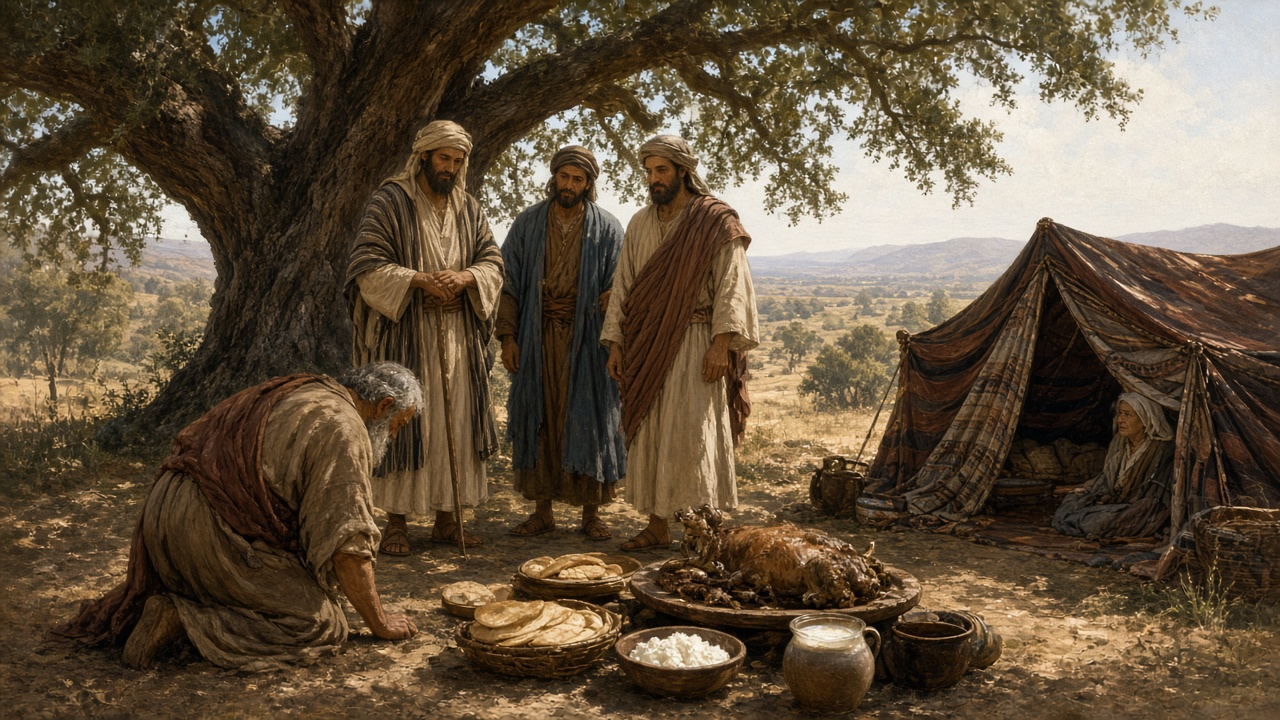
1Forsothe in the valei of Mambre the Lord apperide to Abraham, sittynge in the dore of his tabernacle, in thilke heete of the dai. 2And whanne he hadde reisid his iyen, thre men apperiden to hym, and stoden nyy hym. And whanne he hadde seyn hem, he ran fro the dore of his tabernacle in to the meting of hem, and he worschipide on erthe, 3and seide, Lord, if Y haue founde grace in thin iyen, passe thou not thi seruaunt, 4but I schal brynge a litil watir, and youre feet be waischid, and reste ye vndur the tre; 5and Y schal sette a mussel of breed, and youre herte be coumfortid; aftirward ye schulen passe; for herfor ye bowiden to youre seruaunt. Whiche seiden, Do thou as thou hast spoke. 6Abraham hastide in to the tabernacle, to Sare, and seide to hir, Hast thou, meddle thou thre half buschelis of clene flour; and make thou looues bakun vndur aischis. 7Forsothe he ran to the droue of beestis, and took therof a calf moost tendre and best, and yaf to a child, which hastide, and sethede the calfe; 8and he took botere, and mylk, and the calf which he hadde sode, and settide bifore hem; forsothe Abraham stood bisidis hem vndur the tre.
Sarah Laughs at the Promise
9And whanne thei hadden ete, thei seiden to hym, Where is Sare thi wijf? He answerde, Lo! sche is in the tabernacle. 10To whom the Lord seide, Y schal turne ayen, and Y schal come to thee in this tyme, if Y lyue; and Sare, thi wijf, schal haue a sone. Whanne this was herd, Sare leiyede bihynde the dore of the tabernacle. 11Forsothe bothe weren olde, and of greet age, and wommans termes ceessiden to be maad to Sare. 12And she leiyede, seiynge pryueli, after that Y wexede eld, and my lord is eld, schal Y yyue diligence to lust? 13Forsothe the Lord seide to Abraham, Whi leiyeth Sare, thi wijf, seiynge, whether Y an eld womman schal bere child verili? 14whether ony thing is hard to God? Bi the biheeste Y schal turne ayen to thee in this same tyme, if Y lyue; and Sara schal haue a sone. 15Sare was aferd for drede, and denyede, seiynge, Y leiyede not. Forsothe the Lord seide, It is not so, but thou leiyedist.
Abraham Intercedes for Sodom
16Therfor whanne the men hadden risen fro thennus, thei dressiden the iyen ayens Sodom; and Abraham yede to gidre, ledynge hem forth. 17And the Lord seide, Wher Y mowe hele fro Abraham what thingis Y schal do, 18sithen he schal be in to a greet folk and moost strong, and alle naciouns of erthe schulen be blessid in hym? 19For Y woot that Abraham schal comaunde hise children, and his hows after hym, that thei kepe the weie of the Lord, and that thei do riytfulnesse and dom, that the Lord bringe for Abraham alle thingis whiche he spak to Abraham. 20And so the Lord seide, The cry of men of Sodom and of men of Gomorre is multiplied, and her synne is agreggid greetli; Y schal come doun, 21and schal se whether thei han fillid in werk the cry that cam to me, that Y wite whether it is not so. 22And thei turneden han fro thennus, and yeden to Sodom. Abraham sotheli stood yit bifore the Lord, 23and neiyede, and seide, Whether thou schalt leese a iust man with the wickid man? 24if fifti iust men ben in the citee, schulen thei perische togidere, and schalt thou not spare that place for fifti iust men, if thei ben ther ynne? 25Fer be it fro thee that thou do this thing, and sle a iust man with a wickid man, and that a iust man be maad as a wickid man; this is not thin that demest al erthe; thou schalt not make this doom. 26And the Lord seide to him, If Y schal fynde in Sodom fifti iust men in the myddis of the citee, Y schal foryyue to al the place for hem. 27Abraham answerde and seide, For Y bigan onys, Y schal speke to my Lord, sithen Y am dust and aische; 28what if lesse than fifti iust men bi fyue ben, schalt thou do a wey al the cite for fyue and fourti? And the Lord seide, Y schal not do a wei, if I schal fynde fyue and fourti there. 29And eft Abraham seide to hym, But if fourti ben there, what schalt thou do? The Lord seide, Y schal not smyte for fourti. 30Abraham seide, Lord, Y biseche, take thou not to indignacioun, if Y speke; what if thretti be foundun there? The Lord answerde, Y schal not do, if Y schal fynde thretti there. 31Abraham seide, For Y bigan onys, Y schal speke to my Lord; what if twenti be foundun there? The Lord seide, Y schal not sle for twenti. 32Abraham seide, Lord, Y biseche, be thou not wrooth, if Y speke yit onys; what if ten be founden there? The Lord seide, Y schal not do a wey for ten. 33The Lord yede forth, after that he ceesside to speke to Abraham, and Abraham turnede ayen in to his place.
Você sabia?
Visitantes em Manre e um apelo por Sodoma
- Em Gênesis 18, o Senhor apareceu a Abraão junto aos carvalhos de Manre, no calor do dia, enquanto Abraão estava sentado à entrada da sua tenda. Manre era um chefe amorreu em aliança com Abraão. Abraão correu ao encontro de três homens, inclinou-se até o chão, ofereceu-lhes água para os pés e descanso debaixo da árvore, e depois pôs diante deles pão, um bezerro tenro e escolhido, coalhada e leite.Fontes: o próprio texto bíblico · Mamre
- Sara, esposa de Abraão, recebe no Dicionário Bíblico de Easton (1897) o sentido de “Princesa”; o dicionário diz que esse nome lhe foi dado quando se anunciou que ela seria a mãe do filho prometido. Em Gênesis 18, o Senhor disse que voltaria dentro de cerca de um ano e que Sara teria um filho, embora os dois já fossem idosos e ela já tivesse passado da idade de ter filhos. Ela riu consigo mesma e, por medo, negou que tivesse rido.Fontes: Sarah · o próprio texto bíblico
- Sodoma, uma cidade no vale de Sidim, e Gomorra, uma das cinco cidades dessa planície, são mencionadas juntas em Gênesis 18 por causa do grande clamor contra o seu pecado grave. O Dicionário Bíblico de Easton (1897) diz que as cidades dessa planície provavelmente ficavam próximas umas das outras, perto da extremidade norte do que hoje é o mar Morto, e explica Sodoma e Gomorra como “Queima; a murada” e “Submersão”. Dois dos homens seguiram em direção a Sodoma, enquanto Abraão permaneceu e pediu ao Senhor que poupasse a cidade por causa dos justos, reduzindo o número de cinquenta para dez.Fontes: Sodom · Gomorrah · o próprio texto bíblico
Notas escritas com auxílio de IA a partir de fontes abertas (Theographic Bible Metadata, CC BY-SA 4.0; Easton’s Bible Dictionary, domínio público) e revisadas antes de publicar.
Créditos e licença desta tradução
Wycliffe Bible
This is the Pentateuch and Gospels from The Holy Bible, containing the Old and New Testaments, with the apocryphal books, in the earliest English version made from the latin Vulgate by John Wycliffe and his followers. c.1395
Public Domain
Language: Middle English (English)
Dialect: Middle
Translation by: John Wycliffe
2016-11-08
Títulos de seção adaptados da Berean Standard Bible (domínio público); não fazem parte do texto bíblico desta tradução.
Fonte: http://ebible.org/engWycliffe/ · eBible.org