Êxodo 14
Wycliffe Bible · Toque num versículo para ver as referências cruzadas.
Pharaoh Pursues the Israelites
1Forsothe the Lord spak to Moises, and seide, Speke thou to the sones of Israel; 2turne thei ayen, and sette thei tentis euene ayens Fiayroth, which is bitwixe Magdalum and the see, ayens Beelsefon; in the siyt therof ye schulen sette tentis ouer the see. 3And Farao schal seie on the sones of Israel, Thei ben maad streit in the lond, the deseert hath closid hem to gidere. 4And Y schal make hard his herte, and he schal pursue you, and Y schal be glorified in Farao, and in al his oost; and Egipcians schulen wite that Y am the Lord; and thei diden so. 5And it was teld to the kyng of Egipcians, that the puple hadde fled; and the herte of Farao and of hise seruauntis was chaungid on the puple, and thei seiden, What wolden we do, that we leften Israel, that it schulde not serue us? 6Therfor Farao ioynede the chare, and took with him al his puple; 7and he took sixe hundrid chosyn charis, and what euer thing of charis was in Egipt, and duykis of al the oost. 8And the Lord made hard `the herte of Farao, kyng of Egipt, and he pursuede the sones of Israel; and thei weren go out in an hiy hond. 9And whanne Egipcians pursueden the steppis of the sones of Israel bifor goynge, thei founden hem in tentis on the see; al the chyualrye and charis of Farao, and al the oost weren in Fiayroth, ayens Beelsefon. 10And whanne Farao hadde neiyed the sones of Israel, reisiden her iyen, and thei sien Egipcians bihynde hem, and dredden greetli; and thei crieden to the Lord, 11and seiden to Moises, In hap sepulcris weren not in Egipt, therfor thou hast take vs awei, that we schulen die in wildirnesse? what woldist thou do this, that thou leddist vs out of Egipt? 12Whether this is not the word which we spaken to thee in Egipt, `and seiden, Go awei fro vs, that we serue Egipcians? for it is myche betere to serue hem, than to die in wildirnesse. 13And Moises seide to the puple, Nyle ye drede, stonde ye, and `se ye the grete werkys of God, whiche he schal do to dai; for ye schulen no more se Egipcians, whiche ye seen now, til in to with outen ende; 14the Lord schal fiyte for you, and ye schulen be stille.
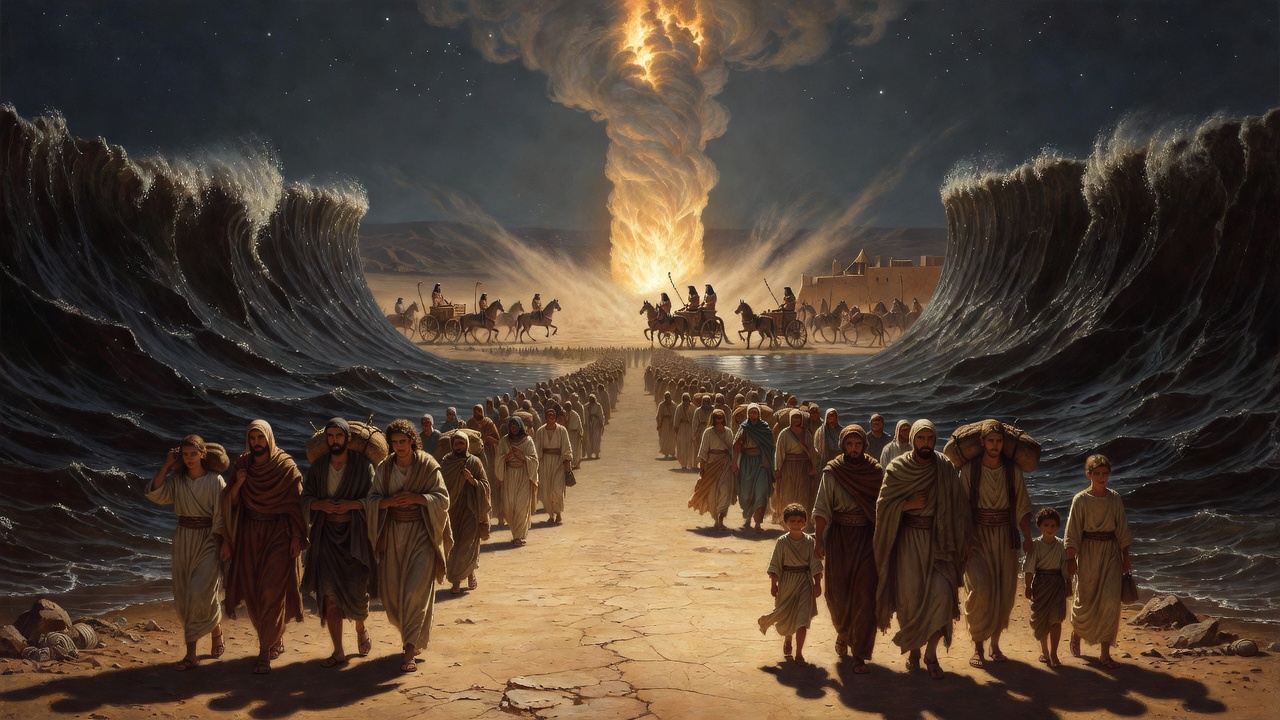
Parting the Red Sea
15And the Lord seide to Moises, What criest thou to me? Speke thou to the sones of Israel, that thei go forth; forsothe reise thou thi yerde, 16and stretche forth thin hond on the see, and departe thou it, that the sones of Israel go in the myddis of the see, by drie place. 17Forsothe Y schal make hard the herte of Egipcians, that thei pursue you, and Y schal be glorified in Farao, and in al the oost of hym, and in the charis, and in the knyytis of hym; 18and Egipcians schulen wite that Y am the Lord God, whanne Y schal be glorified in Farao, and in the charis, and in the knyytis of hym. 19And the aungel of the Lord, that yede bifore the castellis of Israel, took hym silf, and yede bihynde hem; and the piler of cloude yede to gidir with hym, and lefte the formere thingis aftir the bak, 20and stood bitwixe the `castels of Egipcians and castels of Israel; and the cloude was derk toward Egipcians, and liytnynge `the nyyt toward `the children of Israel, so that in al the tyme of the niyt thei miyten not neiy togidere to hem silf. 21And whanne Moises hadde stretchid forth the hond on the see, the Lord took it awei, the while a greet wynde and brennynge blew in al the niyt, and turnede in to dryenesse; and the watir was departid. 22And the sones of Israel entriden by the myddis of the drye see; for the watir was as a wal at the riyt side and left side of hem. 23And Egipcians pursueden, and entriden aftir hem, al the ridyng of Farao, hise charis, and knyytis, bi the myddis of the see. 24And the wakyng of the morewtid cam thanne, and lo! the Lord bihelde on the castels of Egipcians, bi a piler of fier, and of cloude, and killide the oost of hem; and he destriede the wheelis of charis, 25and tho weren borun in to the depthe. Therfor Egipcians seiden, Fle we Israel; for the Lord fiytith for hem ayenus vs. 26And the Lord seide to Moises, Holde forth thin hond on the see, that the watris turne ayen to Egipcians, on the charis, and knyytis of hem. 27And whanne Moises hadde hold forth the hoond ayens the see, it turnede ayen first in the morewtid to the formere place; and whanne Egipcians fledden, the watris camen ayen, and the Lord wlappide hem in the myddis of the floodis. 28And the watris turneden ayen, and hiliden the charis, and knyytis of al the oost of Farao, which sueden, and entriden in to the see; sotheli not oon of hem was alyue. 29Forsothe the sones of Israel yeden thorouy the myddis of the drye see, and the watris weren to hem as for a wal, on the riyt side and left side. 30And in that dai the Lord delyuerede Israel fro the hond of Egipcians, and thei sien Egipcians deed on the brynke of the see, 31and thei seiyen the greet hond which the Lord hadde vsid ayens hem; and the puple dredde the Lord, and thei bileueden to the Lord, and to Moises his seruaunt.
Você sabia?
Israel encurralado entre o faraó e o mar
- Israel recebeu ordem de voltar atrás e acampar diante de Pi-Hairote, entre Migdol e o mar, bem em frente a Baal-Zefom, para que o faraó pensasse que o deserto os havia encurralado. Pi-Hairote significa lugar onde crescem os juncos, embora a Septuaginta e o copta leiam fazenda, e Baal-Zefom significa Baal do norte.Fontes: o próprio texto bíblico · Pi-hahiroth · Baal-zephon
- O dicionário bíblico de Easton (1897) descreve Baal-Zefom como uma cidade egípcia à beira do golfo de Suez, provavelmente o atual Jebel Deraj ou Kulalah, na margem ocidental, e observa que Baal-zapuna, dos egípcios, era um lugar de culto. Alguns identificaram Pi-Hairote com Ajrud, uma fortaleza entre Etã e Suez. O verbete de Pi-Hairote acrescenta que a condição do istmo de Suez na época do Êxodo não é conhecida com exatidão, de modo que Pi-Hairote e os outros acampamentos de Israel no Egito não podem ser localizados com certeza; o istmo foi formado por depósitos do Nilo.Fontes: Baal-zephon · Pi-hahiroth
- O dicionário bíblico de Easton (1897) diz que o faraó do Êxodo foi provavelmente Menephtah I, o décimo quarto e mais velho filho sobrevivente de Ramsés II, e que ele residia em Zoã, onde ocorreram as entrevistas com Moisés e Arão registradas em Êxodo. O mesmo verbete ainda trata como questão aberta se esse rei foi Seti II ou seu pai Menephtah, e observa que alguns julgam que o peso das evidências favorece Seti II.Fontes: Pharaoh (of the Exodus)
Notas escritas com auxílio de IA a partir de fontes abertas (Theographic Bible Metadata, CC BY-SA 4.0; Easton’s Bible Dictionary, domínio público) e revisadas antes de publicar.
Lugares deste capítulo
Só aparecem lugares com identificação de alta confiança (90% ou mais segundo as fontes acadêmicas reunidas pelo OpenBible). Mapa da época: DARE (Digital Atlas of the Roman Empire), CC BY 4.0; mapa atual: © colaboradores do OpenStreetMap; lugares: OpenBible.info (CC BY 4.0).
Créditos e licença desta tradução
Wycliffe Bible
This is the Pentateuch and Gospels from The Holy Bible, containing the Old and New Testaments, with the apocryphal books, in the earliest English version made from the latin Vulgate by John Wycliffe and his followers. c.1395
Public Domain
Language: Middle English (English)
Dialect: Middle
Translation by: John Wycliffe
2016-11-08
Títulos de seção adaptados da Berean Standard Bible (domínio público); não fazem parte do texto bíblico desta tradução.
Fonte: http://ebible.org/engWycliffe/ · eBible.org