Cântico dos Cânticos 7
LXX2012: Septuagint in British/International English 2012 · Toque num versículo para ver as referências cruzadas.
Admiration by the Bridegroom
1Your steps are beautiful in shoes, O daughter of the prince: the joints of your thighs are like chains, the work of the craftsman. 2Your navel is as a turned bowl, not lacking liquor; your belly is as a heap of wheat set about with lilies. 3Your two breasts are as two twin fawns. 4Your neck is as an ivory tower; your eyes are as pools in Esebon, by the gates of the daughter of many: your nose is as the tower of Libanus, looking towards Damascus. 5Your head upon you is as Carmel, and the curls of your hair like scarlet; the king is bound in the galleries. 6How beautiful are you, and how sweet are you, my love! 7This is your greatness in your delights: you were made like a palm tree, and your breasts to cluster. 8I said, I will go up to the palm tree, I will take hold of its high boughs: and now shall your breasts be as clusters of the vine, and the smell of your nose of apples; 9and your throat as good wine, going well with my kinsman, suiting my lips and teeth.
The Bride
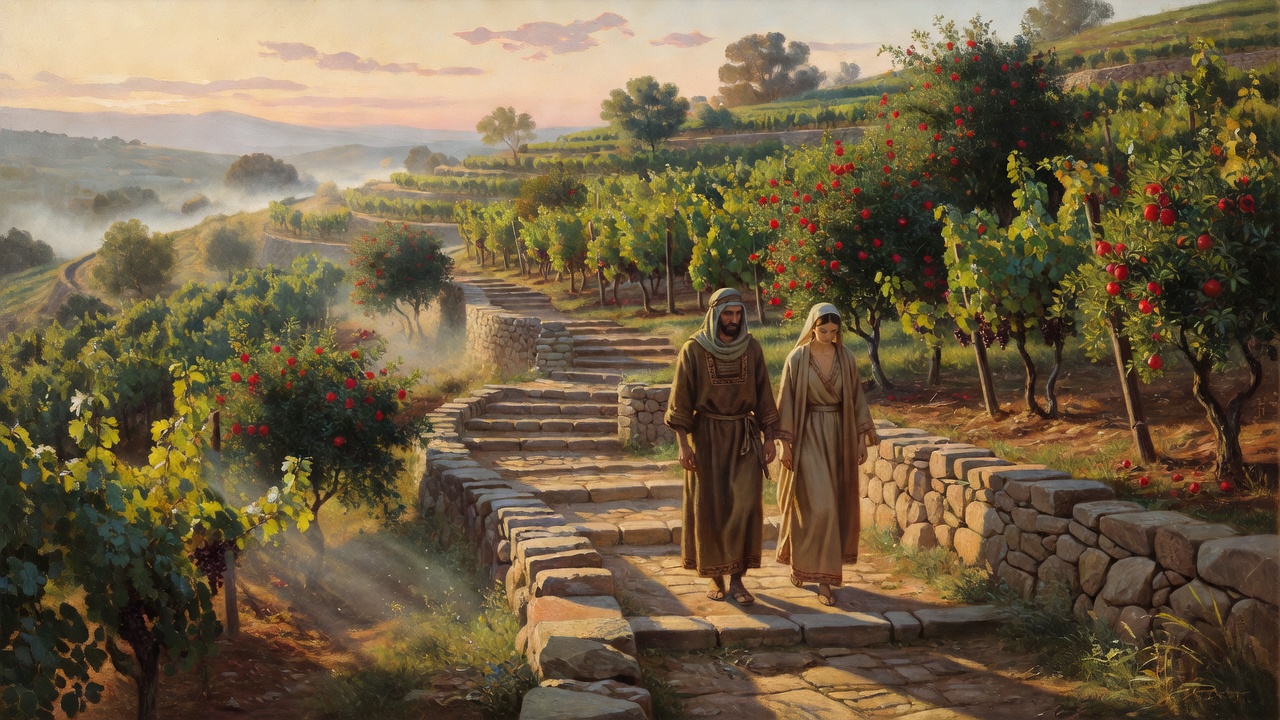
10I am my kinsman's, and his desire is towards me. 11Come, my kinsman, let us go forth into the field; let us lodge in the villages. 12Let us go early into the vineyards; let us see if the vine has flowered, if the blossoms have appeared, if the pomegranates have blossomed; there will I give you my breasts. 13The mandrakes have given a smell, and at our doors are all kinds of choice fruits, new and old. O my kinsman, I have kept them for you.
Você sabia?
Poesia de Amor e Paisagem
- O poema descreve a beleza da mulher usando pontos de referência destacados da região. Seus olhos são comparados aos límpidos reservatórios de Hesbom, junto à porta de Bate-Rabim, a leste do Jordão, enquanto seu perfil é comparado a uma torre imponente nas montanhas do Líbano voltada para Damasco.Fontes: o próprio texto bíblico · Heshbon · Bath-rabbim · Lebanon
- O capítulo se encerra com um convite para o campo durante a renovação da primavera. Os amados vão conferir o brotar das videiras, a floração das romãzeiras e o aroma das mandrágoras, refletindo a íntima ligação na poesia hebraica antiga entre o romance e a vitalidade da natureza.Fontes: o próprio texto bíblico
Notas escritas com auxílio de IA a partir de fontes abertas (Theographic Bible Metadata, CC BY-SA 4.0; Easton’s Bible Dictionary, domínio público) e revisadas antes de publicar.
Lugares deste capítulo
- Bath-rabbim · Hoje: in Tell Hesban · 31.801, 35.809 · versículo 4
- Damascus · 33.511, 36.306 · versículo 4
- Lebanon · 33.540, 35.584 · versículo 4
- Mount Carmel · 32.672, 35.023 · versículo 5
Só aparecem lugares com identificação de alta confiança (90% ou mais segundo as fontes acadêmicas reunidas pelo OpenBible). Mapa da época: DARE (Digital Atlas of the Roman Empire), CC BY 4.0; mapa atual: © colaboradores do OpenStreetMap; lugares: OpenBible.info (CC BY 4.0).
Créditos e licença desta tradução
LXX2012: Septuagint in British/International English 2012
The Septuagint with Apocrypha, translated from Greek to English by Sir Lancelot C. L. Brenton and published in 1885, with some language updates (British/International English)
Public Domain
Language: English
Dialect (if applicable): British
Language in English: English
Translation by: Sir Lancelot Charles Lee Breton
LXX2012: Septuagint in English 2012, British/International English Edition
This is a translation of the Old Testament and Apocrypha/Deuterocanon from Hebrew to Greek to 19th Century British English, with some updates of spelling and word usage to contemporary British/International English. The original English translation was done by Sir Lancelot Charles Lee Brenton and published by Samuel Bagster & Sons, Ltd., in London in 1851. It has entered the Public Domain due to the passage of sufficient time. In the process of scanning and typing the text, the original poetry and prose formatting, as well as peripheral material like introductions and notes, have been omitted.
This edition of the Septuagint has some language updates. Brenton's word order and punctuation has been mostly retained, meaning that quotation marks are not used, and sentences within quotes may not start with capital letters, as was standard usage in 1851. Names transliterated from Greek to those transliterated from Hebrew in the common English Bibles often differ. These language updates are dedicated to the Public Domain by the author of those edits, Michael Paul Johnson. Therefore this edition may be freely copied, published, etc.
Before considering making changes to the text of this work, I recommend that you consult with God, because this is really His Book.
If you find errors in the text, please report them so that we can correct them.
Donations to help with the expenses of operating this web site and thus help others have free access to the Word of God may be made to us, but are not required. Please see http://MLJohnson.org/partner/ for more about that.
Títulos de seção adaptados da Berean Standard Bible (domínio público); não fazem parte do texto bíblico desta tradução.
Fonte: http://ebible.org/eng-uk-lxx2012/ · eBible.org