Cântico dos Cânticos 6
LXX2012: Septuagint in British/International English 2012 · Toque num versículo para ver as referências cruzadas.
Together in the Garden
The Friends
1My kinsman is gone down to his garden, to the beds of spice, to feed his flock in the gardens, and to gather lilies.
The Bride
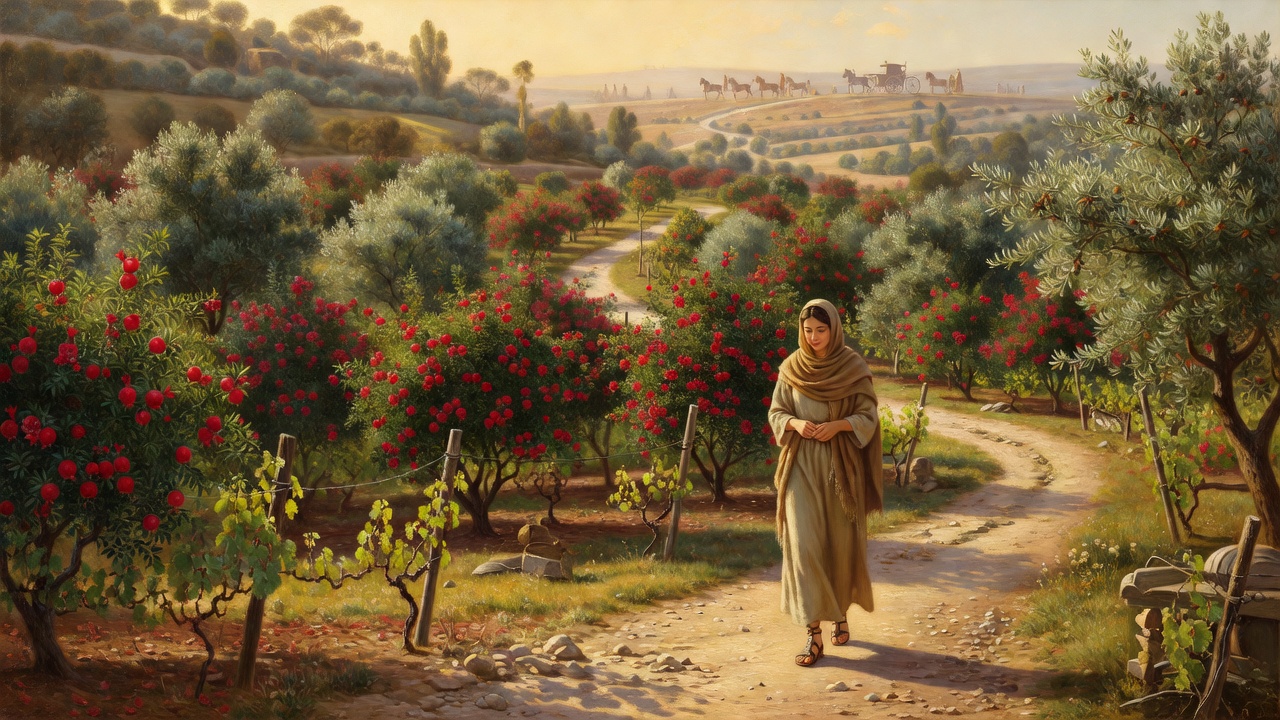
2I am my kinsman's, and my kinsman is mine, who feeds amongst the lilies. 3You are fair, my companion, as Pleasure, beautiful as Jerusalem, terrible as armies set in array.
The Bridegroom
4Turn away your eyes from before me, for they have ravished me: your hair is as flocks of goats which have appeared from Galaad. 5Your teeth are as flocks of shorn sheep, that have gone up from the washing, all of them bearing twins, and there is none barren amongst them: your lips are as a thread of scarlet, and your speech is comely. 6Your cheek is like the rind of a pomegranate, being seen without your veil. 7There are sixty queens, and eighty concubines, and maidens without number. 8My dove, my perfect one is one; she is the only one of her mother; she is the choice of her that bore her. The daughters saw her, and the queens will pronounce her blessed, yes, and the concubines, and they will praise her. 9Who is this that looks forth as the morning, fair as the moon, choice as the sun, terrible as armies set in array?
The Friends
10I went down to the garden of nuts, to look at the fruits of the valley, to see if the vine flowered, if the pomegranates blossomed.
The Bridegroom
11There I will give you my breasts: my soul knew it not: it made me as the chariots of Aminadab. 12Return, return, O Sunamite; return, return, and we will look at you. What will you⌃ see in the Sunamite? She comes as bands of armies.
Você sabia?
Beleza e Esplendor Real
- O poema exalta a beleza da mulher comparando-a a Tirza e a Jerusalém, dois destacados centros reais. Tirza era uma antiga cidade cananeia célebre por seu encanto que mais tarde serviu como uma das primeiras capitais do reino do norte de Israel, enquanto Jerusalém se erguia como a capital montanhosa de Judá.Fontes: Tirzah · Jerusalem · o próprio texto bíblico
- A descrição do cabelo que desce como um rebanho de cabras de Gileade evoca o território montanhoso a leste do rio Jordão, onde rebanhos pastavam ao longo de encostas íngremes.Fontes: Gilead · o próprio texto bíblico
Notas escritas com auxílio de IA a partir de fontes abertas (Theographic Bible Metadata, CC BY-SA 4.0; Easton’s Bible Dictionary, domínio público) e revisadas antes de publicar.
Lugares deste capítulo
Só aparecem lugares com identificação de alta confiança (90% ou mais segundo as fontes acadêmicas reunidas pelo OpenBible). Mapa da época: DARE (Digital Atlas of the Roman Empire), CC BY 4.0; mapa atual: © colaboradores do OpenStreetMap; lugares: OpenBible.info (CC BY 4.0).
Créditos e licença desta tradução
LXX2012: Septuagint in British/International English 2012
The Septuagint with Apocrypha, translated from Greek to English by Sir Lancelot C. L. Brenton and published in 1885, with some language updates (British/International English)
Public Domain
Language: English
Dialect (if applicable): British
Language in English: English
Translation by: Sir Lancelot Charles Lee Breton
LXX2012: Septuagint in English 2012, British/International English Edition
This is a translation of the Old Testament and Apocrypha/Deuterocanon from Hebrew to Greek to 19th Century British English, with some updates of spelling and word usage to contemporary British/International English. The original English translation was done by Sir Lancelot Charles Lee Brenton and published by Samuel Bagster & Sons, Ltd., in London in 1851. It has entered the Public Domain due to the passage of sufficient time. In the process of scanning and typing the text, the original poetry and prose formatting, as well as peripheral material like introductions and notes, have been omitted.
This edition of the Septuagint has some language updates. Brenton's word order and punctuation has been mostly retained, meaning that quotation marks are not used, and sentences within quotes may not start with capital letters, as was standard usage in 1851. Names transliterated from Greek to those transliterated from Hebrew in the common English Bibles often differ. These language updates are dedicated to the Public Domain by the author of those edits, Michael Paul Johnson. Therefore this edition may be freely copied, published, etc.
Before considering making changes to the text of this work, I recommend that you consult with God, because this is really His Book.
If you find errors in the text, please report them so that we can correct them.
Donations to help with the expenses of operating this web site and thus help others have free access to the Word of God may be made to us, but are not required. Please see http://MLJohnson.org/partner/ for more about that.
Títulos de seção adaptados da Berean Standard Bible (domínio público); não fazem parte do texto bíblico desta tradução.
Fonte: http://ebible.org/eng-uk-lxx2012/ · eBible.org