Josué 20
LXX2012: Septuagint in American English 2012 · Toque num versículo para ver as referências cruzadas.
Six Cities of Refuge
1And the Lord spoke to Joshua, saying, 2Speak to the children of Israel, saying, Assign the cities of refuge, of which I spoke to you by Moses. 3Even a refuge to the slayer who has struck a man unintentionally; and the cities shall be to you a refuge, and the slayer shall not be put to death by the avenger of blood, until he have stood before the congregation for judgment. 4And Joshua separated Cades in Galilee in the mount Nephthali, and Sychem in the mount Ephraim, and the city of Arboc; this is Chebron, in the mountain of Juda. 5And beyond Jordan he appointed Bosor in the wilderness in the plain out of the tribe of Ruben, and Aremoth in Galaad out of the tribe of Gad, and Gaulon in the country of Basan out of the tribe of Manasse. 6These were the cities selected for the sons of Israel, and for the stranger dwelling among them, that every one who smites a soul unintentionally should flee there, that he should not die by the hand of the avenger of blood, until he should stand before the congregation for judgment.
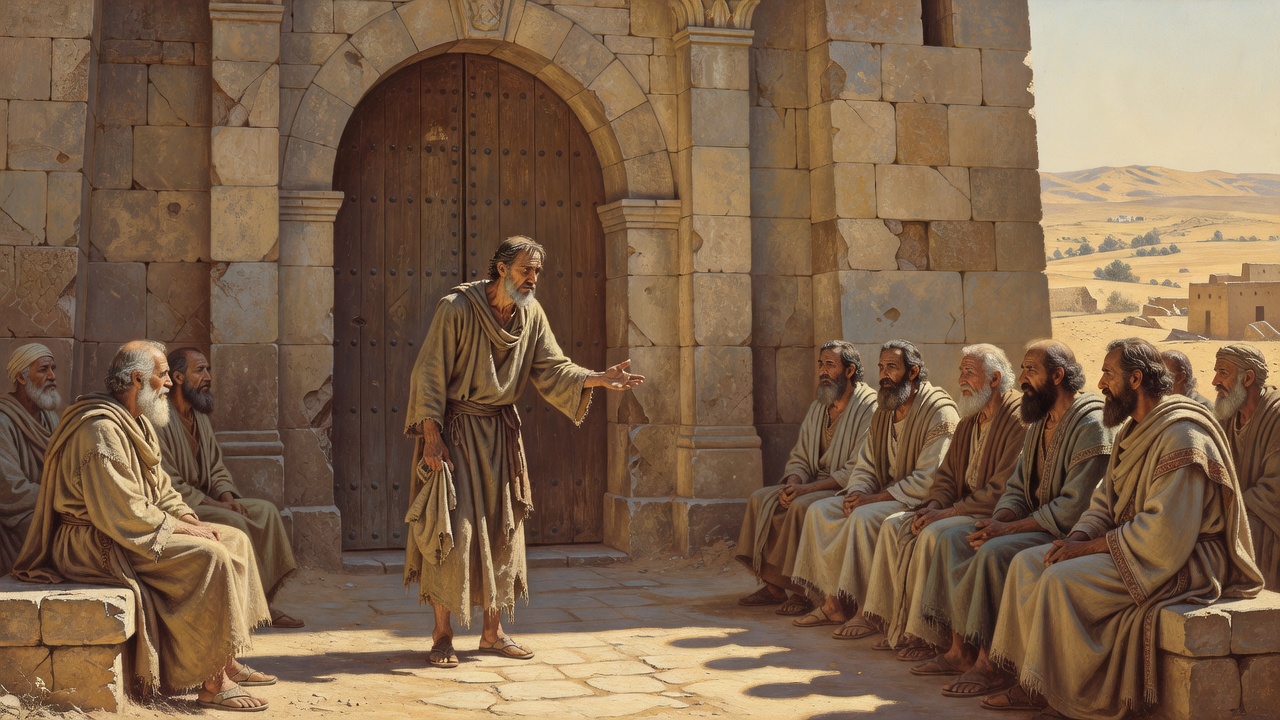
Você sabia?
As cidades de refúgio
- As cidades de refúgio ofereciam abrigo a qualquer pessoa que causasse uma morte acidental, protegendo-a da retaliação do vingador do sangue. O fugitivo devia expor seu caso aos anciãos junto à porta da cidade e podia permanecer em segurança até ser julgado pela assembleia e até a morte do sumo sacerdote em exercício.Fontes: o próprio texto bíblico
- Seis cidades foram designadas por toda a região, divididas igualmente em três de cada lado do rio Jordão. Quedes, Siquém e Hebrom atendiam a região montanhosa a oeste do Jordão, enquanto Bezer, Ramote em Gileade e Golã em Basã serviam às tribos orientais.Fontes: o próprio texto bíblico · Hebron · Shechem · Kedesh
- A proteção jurídica oferecida pelas cidades de refúgio aplicava-se tanto aos israelitas nativos quanto aos estrangeiros que residiam entre eles.Fontes: o próprio texto bíblico
Notas escritas com auxílio de IA a partir de fontes abertas (Theographic Bible Metadata, CC BY-SA 4.0; Easton’s Bible Dictionary, domínio público) e revisadas antes de publicar.
Lugares deste capítulo
- Galilee · 32.760, 35.527 · versículo 7
- Hebron · Hoje: Tel Rumeida · 31.525, 35.102 · versículo 7
- Kedesh · Hoje: Tel Kedesh · 33.112, 35.530 · versículo 7
- Shechem · Hoje: Tell Balatah · 32.214, 35.282 · versículo 7
- Bashan · 32.781, 35.935 · versículo 8
- Gilead · Hoje: Gilead 1 · 32.187, 35.692 · versículo 8
- Jericho · Hoje: Tell es Sultan · 31.872, 35.445 · versículo 8
- Jordan · Hoje: Jordan River · 31.761, 35.558 · versículo 8
- Ramoth · Hoje: Tall er Rumeith · 32.500, 36.015 · versículo 8
Só aparecem lugares com identificação de alta confiança (90% ou mais segundo as fontes acadêmicas reunidas pelo OpenBible). Mapa da época: DARE (Digital Atlas of the Roman Empire), CC BY 4.0; mapa atual: © colaboradores do OpenStreetMap; lugares: OpenBible.info (CC BY 4.0).
Créditos e licença desta tradução
LXX2012: Septuagint in American English 2012
The Septuagint with Apocrypha, translated from Greek to English by Sir Lancelot C. L. Brenton and published in 1885, with some language updates (American English)
Public Domain
Language: English
Dialect (if applicable): American
Language in English: English
Translation by:
Sir Lancelot Charles Lee Brenton
Michael Paul Johnson
LXX2012: Septuagint in English 2012
This is a translation of the Old Testament and Apocrypha/Deuterocanon from Hebrew to Greek to 19th Century British English, with some updates of spelling and word usage to contemporary American English. The original English translation was done by Sir Lancelot Charles Lee Brenton and published by Samuel Bagster & Sons, Ltd., in London in 1851. It has entered the Public Domain due to the passage of sufficient time. In the process of scanning and typing the text, the original poetry and prose formatting, as well as peripheral material like introductions and notes, have been omitted.
This edition of the Septuagint has some language updates. Brenton's word order and punctuation has been mostly retained, meaning that quotation marks are not used, and sentences within quotes may not start with capital letters, as was standard usage in 1851. Names transliterated from Greek to those transliterated from Hebrew in the common English Bibles often differ. These language updates are dedicated to the Public Domain by the author of those edits, Michael Paul Johnson. Therefore this edition may be freely copied, published, etc.
Before considering making changes to the text of this work, I recommend that you consult with God, because this is really His Book.
If you find errors in the text, please report them so that we can correct them.
Donations to help with the expenses of operating this web site and thus help others have free access to the Word of God may be made to us, but are not required. Please see http://MLJohnson.org/partner/ for more about that.
Títulos de seção adaptados da Berean Standard Bible (domínio público); não fazem parte do texto bíblico desta tradução.
Fonte: http://ebible.org/eng-lxx2012/ · eBible.org