Gênesis 50
Brenton Septuagint Translation · Toque num versículo para ver as referências cruzadas.
Mourning and Burial for Jacob
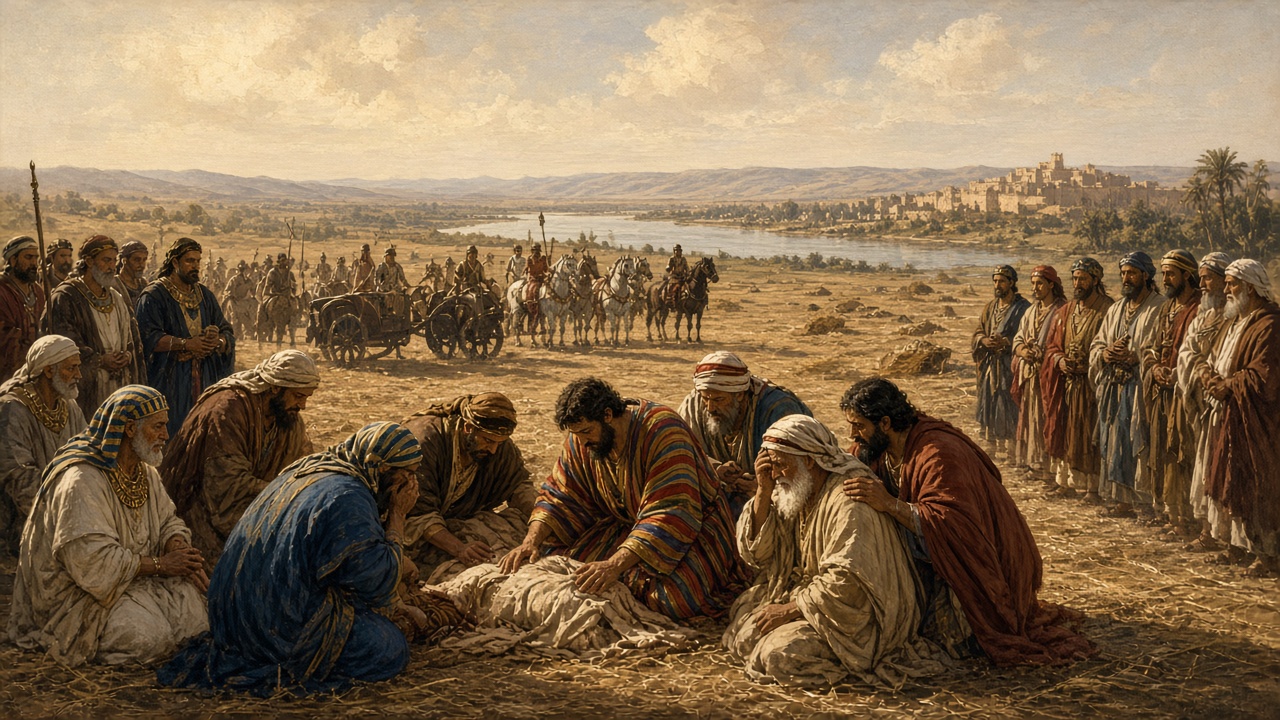
1And Joseph fell upon his father's face, and wept on him, and kissed him. 2And Joseph commanded his servants the embalmers to embalm his father; and the embalmers embalmed Israel. 3And they fulfilled forty days for him, for so are the days of embalming numbered; and Egypt mourned for him seventy days. 4And when the days of mourning were past, Joseph spoke to the princes of Pharao, saying, If I have found favour in your sight, speak concerning me in the ears of Pharao, saying, 5My father adjured me, saying, In the sepulchre which I dug for myself in the land of Chanaan, there thou shalt bury me; now then I will go up and bury my father, and return again. 6And Pharao said to Joseph, Go up, bury thy father, as he constrained thee to swear. 7So Joseph went up to bury his father; and all the servants of Pharao went up with him, and the elders of his house, and all the elders of the land of Egypt. 8And all the household of Joseph, and his brethren, and all the house of his father, and his kindred; and they left behind the sheep and the oxen in the land of Gesem. 9And there went up with him also chariots and horsemen; and there was a very great company. 10And they came to the threshing-floor of Atad, which is beyond Jordan; and they bewailed him with a great and very sore lamentation; and he made a mourning for his father seven days. 11And the inhabitants of the land of Chanaan saw the mourning at the floor of Atad, and said, This is a great mourning to the Egyptians; therefore he called its name, The mourning of Egypt, which is beyond Jordan. 12And thus his sons did to him. 13So his sons carried him up into the land of Chanaan, and buried him in the double cave, which cave Abraam bought for possession of a burying place, of Ephrom the Chettite, before Mambre. 14And Joseph returned to Egypt, he and his brethren, and those that had gone up with him to bury his father.
Joseph Comforts His Brothers
15And when the brethren of Joseph saw that their father was dead, they said, Let us take heed, lest at any time Joseph remember evil against us, and recompense to us all the evils which we have done against him. 16And they came to Joseph, and said, Thy father adjured us before his death, saying, 17Thus say ye to Joseph, Forgive them their injustice and their sin, forasmuch as they have done thee evil; and now pardon the injustice of the servants of the God of thy father. And Joseph wept while they spoke to him. 18And they came to him and said, We, these persons, are thy servants. 19And Joseph said to them, Fear not, for I am God's. 20Ye took counsel against me for evil, but God took counsel for me for good, that the matter might be as it is to-day, and much people might be fed. 21And he said to them, Fear not, I will maintain you, and your families: and he comforted them, and spoke kindly to them.
The Death of Joseph
22And Joseph dwelt in Egypt, he and his brethren, and all the family of his father; and Joseph lived a hundred and ten years. 23And Joseph saw the children of Ephraim to the third generation; and the sons of Machir the son of Manasse were borne on the sides of Joseph. 24And Joseph spoke to his brethren, saying, I die, and God will surely visit you, and will bring you out of this land to the land concerning which God sware to our fathers, Abraam, Isaac, and Jacob. 25And Joseph adjured the sons of Israel, saying, At the visitation with which God shall visit you, then ye shall carry up my bones hence with you. 26And Joseph died, aged an hundred and ten years; and they prepared his corpse, and put him in a coffin in Egypt.
Você sabia?
O sepultamento de Jacó e a morte de José
- A eira de Atade, onde a comitiva pranteou em alta voz durante sete dias do outro lado do Jordão, recebe o nome de uma palavra que significa espinheiro-cerval. Os cananeus que viram o luto chamaram o lugar de Abel-Mizraim, 'prado do Egito' ou 'luto do Egito'. O Dicionário Bíblico de Easton situa Abel-Mizraim a oeste do Jordão e diz que o sítio é desconhecido, ao passo que descreve Atade como provavelmente perto de Hebrom.Fontes: o próprio texto bíblico
- Os filhos de Jacó o sepultaram na caverna de Macpela, no campo perto de Manre, o lugar de sepultura que Abraão tinha comprado de Efrom, o hitita. O Dicionário Bíblico de Easton identifica Efrom como filho de Zoar e registra o preço de quatrocentos siclos de prata.Fontes: o próprio texto bíblico
- José permaneceu no Egito e viveu até os cento e dez anos, o bastante para ver os filhos de Efraim até a terceira geração. Os filhos de Maquir, filho de Manassés, foram criados sobre os joelhos de José — expressão que a Revised Version inglesa traduz por 'nascidos sobre os joelhos de José' e que o Dicionário Bíblico de Easton explica como adoção desde o nascimento. Ele disse a seus irmãos que Deus os faria subir à terra prometida a Abraão, Isaque e Jacó, e fez os filhos de Israel jurarem que levariam os seus ossos do Egito; quando morreu, embalsamaram-no e o colocaram num caixão ali.Fontes: o próprio texto bíblico
Notas escritas com auxílio de IA a partir de fontes abertas (Theographic Bible Metadata, CC BY-SA 4.0; Easton’s Bible Dictionary, domínio público) e revisadas antes de publicar.
Lugares deste capítulo
- Canaan · 32.767, 35.333 · versículos 5, 13
- Egypt · 30.129, 31.308 · versículos 7, 14, 22, 24, 26
- Goshen · Hoje: Goshen 1 · 30.799, 31.834 · versículo 8
- Atad · Hoje: near the mouth of the Jordan River · 31.915, 35.530 · versículos 10, 11
- Jordan · Hoje: Jordan River · 31.761, 35.558 · versículos 10, 11
- Machpelah · Hoje: Cave of the Patriarchs · 31.525, 35.111 · versículo 13
Só aparecem lugares com identificação de alta confiança (90% ou mais segundo as fontes acadêmicas reunidas pelo OpenBible). Mapa da época: DARE (Digital Atlas of the Roman Empire), CC BY 4.0; mapa atual: © colaboradores do OpenStreetMap; lugares: OpenBible.info (CC BY 4.0).
Créditos e licença desta tradução
Translation of the Greek Septuagint into English by Sir Lancelot Charles Lee Brenton
Published in 1851, and now in the Public Domain.
If you find errors in the text, please report them so that we can correct them.
Títulos de seção adaptados da Berean Standard Bible (domínio público); não fazem parte do texto bíblico desta tradução.
Fonte: http://ebible.org/eng-Brenton/ · eBible.org