Êxodo 1
Brenton Septuagint Translation · Toque num versículo para ver as referências cruzadas.
Sobre este livro
Sobre Êxodo
- O Easton's Bible Dictionary (1897) data a saída de Israel do Egito em cerca de 1490 a.C., quatrocentos e oitenta anos antes da construção do templo de Salomão. A duração da permanência é disputada: Êxodo 12:40 fala em quatrocentos e trinta anos, Gênesis 15 em cerca de quatrocentos, e as versões grega e samaritana incluem também os anos em Canaã, de modo que alguns contam apenas duzentos e quinze anos no Egito.Fontes: Easton: Exodus
- O Easton's Bible Dictionary (1897) não nomeia o autor de Êxodo. O verbete sobre Moisés diz que Jacó e seus filhos desceram ao Egito, provavelmente uns trezentos e cinquenta anos antes do nascimento de Moisés, e que um rei hicso, de um povo semita pastoril da Ásia que então dominava o Egito, os estabeleceu em Gósen. Moisés passou depois quarenta anos em Midiã, onde esse povo apascentava rebanhos na península do Sinai, e tornou-se genro de Jetro, sacerdote de Midiã.Fontes: Moses · Easton: Exodus · Midian · Jethro
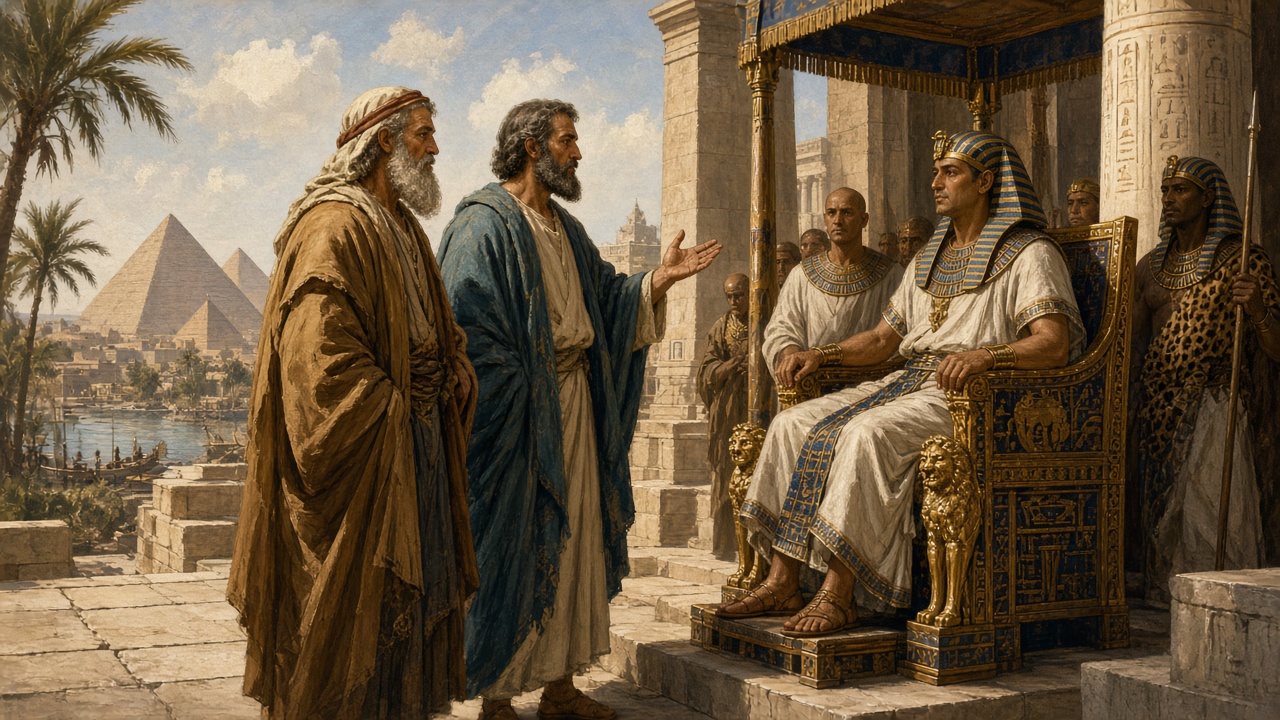
- Também se discute quem era o faraó na época da saída. O Easton's Bible Dictionary (1897) o identifica provavelmente com Menephtah I, o décimo quarto e o mais velho dos filhos sobreviventes de Rameses II, que residia em Zoan e ali se encontrou com Moisés e Arão, mas observa que alguns preferem Seti II, cujo reinado começou em paz e terminou num desastre repentino.Fontes: Pharaoh (of the Exodus)
- As pragas, escreve Easton, afrouxaram o domínio do faraó, e a Páscoa foi instituída como memorial perpétuo, com o sangue do cordeiro aspergido nos umbrais. No terceiro mês o povo chegou ao monte Sinai, também chamado Horebe, a cerca de cento e cinquenta milhas do mar Vermelho, e acampou ali cerca de um ano. Os últimos vinte e dois capítulos de Êxodo registram essa estada, inclusive o tabernáculo, cujo Lugar Santo não tinha abertura para a luz do dia e era iluminado só pelo castiçal de ouro.Fontes: Easton: Exodus · Mount Sinai · Holy Place
- Arão, filho mais velho de Anrão e Joquebede, nasceu no Egito três anos antes de Moisés e foi enviado ao encontro do irmão para que os dois trabalhassem juntos. Em Refidim, Josué, também nascido no Egito, comandou os combatentes de Israel quando os amalequitas, povo pastoril que vivia entre o mar Morto e o mar Vermelho, tentaram barrar-lhes o caminho.Fontes: Aaron · Joshua · Amalek
Notas escritas com auxílio de IA a partir de fontes abertas (Theographic Bible Metadata, CC BY-SA 4.0; Easton’s Bible Dictionary, domínio público) e revisadas antes de publicar.
The Israelites Multiply in Egypt
1These are the names of the sons of Israel that came into Egypt together with Jacob their father; they came in each with their whole family. 2Ruben, Simeon, Levi, Judas, 3Issachar, Zabulon, Benjamin, 4Dan and Nephthalim, Gad and Aser. 5But Joseph was in Egypt. And all the souls born of Jacob were seventy-five. 6And Joseph died, and all his brethren, and all that generation. 7And the children of Israel increased and multiplied, and became numerous and grew exceedingly strong, and the land multiplied them.
Oppression by a New King
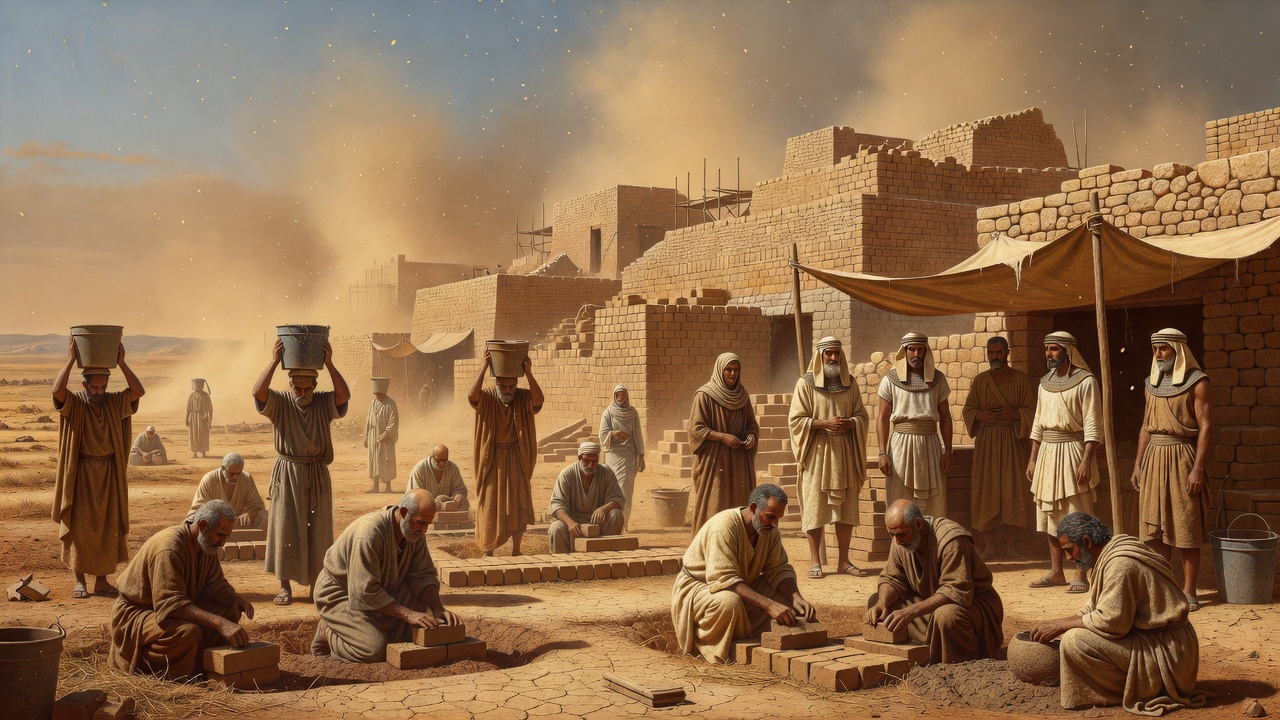
8And there arose up another king over Egypt, who knew not Joseph. 9And he said to his nation, Behold, the race of the children of Israel is a great multitude, and is stronger than we: 10come then, let us deal craftily with them, lest at any time they be increased, and whensoever war shall happen to us, these also shall be added to our enemies, and having prevailed against us in war, they will depart out of the land. 11And he set over them task-masters, who should afflict them in their works; and they built strong cities for Pharao, both Pitho, and Ramesses, and On, which is Heliopolis. 12But as they humbled them, by so much they multiplied, and grew exceedingly strong; and the Egyptians greatly abhorred the children of Israel. 13And the Egyptians tyrannised over the children of Israel by force. 14And they embittered their life by hard labours, in the clay and in brick-making, and all the works in the plains, according to all the works, wherein they caused them to serve with violence.
15And the king of the Egyptians spoke to the midwives of the Hebrews; the name of the one was, Sepphora; and the name of the second, Phua. 16And he said, When ye do the office of midwives to the Hebrew women, and they are about to be delivered, if it be a male, kill it; but if a female, save it. 17But the midwives feared God, and did not as the king of Egypt appointed them; and they saved the male children alive. 18And the king of Egypt called the midwives, and said to them, Why is it that ye have done this thing, and saved the male children alive? 19And the midwives said to Pharao, The Hebrew women are not as the women of Egypt, for they are delivered before the midwives go in to them. So they bore children. 20And God did well to the midwives, and the people multiplied, and grew very strong. 21And as the midwives feared God, they established for themselves families. 22And Pharao charged all his people, saying, Whatever male child shall be born to the Hebrews, cast into the river; and every female, save it alive.
Você sabia?
O crescimento e a opressão de Israel no Egito
- O Dicionário Bíblico de Easton (1897) diz que os hebreus no Egito estiveram sob a proteção de José por cerca de setenta anos e que, após a morte dele, a situação deles mudou apenas aos poucos. O verbete observa que, em geral, se supunha que o novo rei que não conhecia José fosse Aahmes I, a quem Josefo chama de Amosis, embora descobertas daquela época levassem o dicionário a concluir que se tratava de Seti, depois que os hicsos foram expulsos e a dinastia anterior foi restaurada.Fontes: Pharaoh · o próprio texto bíblico
- Sujeitos a trabalhos forçados, os israelitas construíram Pitom e Ramessés como cidades-armazéns para o faraó. O Dicionário Bíblico de Easton (1897) explica Pitom como o egípcio Pa-Tum, 'casa de Tum', o deus-sol, e a chama de cidade-tesouro construída para o faraó Ramessés II; identifica o local com Tell-el-Maskhuta, onde em 1883 foram relatadas ruínas de supostos celeiros.Fontes: Pithom · Raamses · o próprio texto bíblico
- O faraó ordenou então que todo filho nascido dos hebreus fosse lançado ao rio. O Dicionário Bíblico de Easton (1897) observa que o nome Nilo não aparece nas Escrituras; o Antigo Testamento chama esse rio de Sihor, 'a corrente negra', ou simplesmente 'o rio', como em Êxodo 1:22.Fontes: Nile · o próprio texto bíblico
Notas escritas com auxílio de IA a partir de fontes abertas (Theographic Bible Metadata, CC BY-SA 4.0; Easton’s Bible Dictionary, domínio público) e revisadas antes de publicar.
Lugares deste capítulo
- Egypt · 30.129, 31.308 · versículos 1, 5, 8, 15, 17, 18
- Nile · Hoje: Nile River · 31.465, 30.367 · versículo 22
Só aparecem lugares com identificação de alta confiança (90% ou mais segundo as fontes acadêmicas reunidas pelo OpenBible). Mapa da época: DARE (Digital Atlas of the Roman Empire), CC BY 4.0; mapa atual: © colaboradores do OpenStreetMap; lugares: OpenBible.info (CC BY 4.0).
Créditos e licença desta tradução
Translation of the Greek Septuagint into English by Sir Lancelot Charles Lee Brenton
Published in 1851, and now in the Public Domain.
If you find errors in the text, please report them so that we can correct them.
Títulos de seção adaptados da Berean Standard Bible (domínio público); não fazem parte do texto bíblico desta tradução.
Fonte: http://ebible.org/eng-Brenton/ · eBible.org