Mateus 7
I 'utz laj tzij re i dios · Toque num versículo para ver as referências cruzadas.
Ma ʼat tzij chirij jun chic
1Mi ʼat tzij piquiwi iwachiʼil, queje ile, i Dios n-cu ʼat ti tzij ʼuri piwi yix. 2Mi ʼano, man we cʼax u ʼatic tzij qui ʼano, xak cʼax ʼuri u ʼatic tzij coʼon i Dios piwi yix; ire xak jun u ʼonquil coʼono, pacha u ʼonquil xi ʼan yix. 3¿Wuchac cat cʼachiric rumal i ral tzʼil ca takej chupam u baʼwach awachiʼil, y n-ca na taj ʼo jun nim laj ʼet chupam a baʼwach yet? 4¿Wuchac ʼuri ca bij che awachiʼil: “Cha ya a baʼwach chwe, cwesaj i tzʼil ʼo chupam,” cat cha, we ʼo jun ʼet chupam a baʼwach yet? 5Yet, ¡n-katzij ti ca ʼano! Nabe chawesaj ni ʼet pa baʼwach yet, teʼuri cat tzun bien cawesaj ni tzʼil ʼo chupam u baʼwach awachiʼil.
6Mi ya chique i tzʼi wach tak i ʼo u ʼij, man mokxa i tzʼi quiqui cʼak quib chiwij y quix qui raxij. Xak mi ya jun chom laj uwaj chiquiwach i ak, mokxa que oc chu yaʼyaxic.
Dios cu ya ni ʼutz chique i racʼal chi lic qui tzʼonom che
7We ʼo rajwaxic chiwe, chi tzʼonoj che i Dios y Ire cu ya na chiwe; chi tzucuj, y qui rik na; chi cʼojcʼa i porta, y ca jaki na chiwe. 8Queje ile chi ʼana, man we jun lic cu tzʼonoj, ca yaʼ che; we lic cu tzucuj, cu rik na; we lic cu cʼojcʼa i porta, ca jaki na che. 9Yix chi ix kajawxel, we ʼo jun iwacʼal cu tzʼonoj u wa chiwe, ¿xataba qui ya jun abaj che, pu qʼuexel u wa? N-qui ya taj. 10We xak cu tzʼonoj car chiwe, ¿xataba qui ya jun cumatz che, pu qʼuexel? Xak n-qui ya taj. 11Yix, chi toʼ ix winak, tupu n-qui ʼan ti ʼutz, xui-ri, lic qui ya ni ʼutz chique iwacʼal. I Kajaw chicaj, mas ʼutz coʼon na chuwach ile; lic cu ya ni ʼutz chique pachin i que tzʼonow che.
12Chi ʼana chique i winak pacha i quiwaj yix quiqui ʼan na ique chiwe. Are ile are usucʼ i ʼatbal tzij u tzʼibam can i mam Moises, xak are i usucʼ i tzij qui bim can i ajbil u tzij i Dios ujer.
Chix oc che uchija chi xa pichʼ u wach
13Je queb i be re i cʼaslemal: jun, xa pichʼ u wach y jun chic, nim u wach. Chix oc yix che i uchibe chi pichʼ u wach, man i uchibe chi nim u wach, xa pa ʼaʼ ca ʼe wi. Lic je qʼui que bin na che i be-le. 14I uchibe, xak i be, chi coj u cʼam bi che i cʼaslemal sakil, xa pichʼ qui wach; ne te qʼui quiqui riko.
Que iwetamaj na pachin je aj tʼoronel, rumal wach tak quiqui ʼano
15Chi ʼana cwent chique i que upon iwuʼ chi quiqui bij je ajbil u tzij i Dios; pent ne te are. ʼOlic xa je pacha mal laj tak utiw chi qui ʼanom che quib pacha je chij; lic je ʼutz quiwil yix. 16Que iwetamaj na, je bi chi winakil rumal wach tak i quiqui ʼano. Que iwetamaj na pacha retamaxic u wach i qʼuix. Iwetaʼam chi jun qʼuix n-ta úva cu wachij; xak i jun tzum-tzerek n-ti hígo 7.16 cu wachij. 17Quiwil na bi chi winakil, man jun ʼutz laj cheʼ, niʼpa i u wach cu yaʼo ʼis ʼutz; xak jun cheʼ n-ʼus taj, n-ti u wach ʼutz cu yaʼo. 18I jun cheʼ ʼutz, n-cu ya ti u wach chi n-ʼus taj; xak jun cheʼ n-ʼus taj n-ca tiqui ta chu yaʼic u wach ʼutz. 19Niʼpa i cheʼ chi n-ti u wach ʼutz cu yaʼo, ca cʼatzix na, y ca porox na pa ʼaʼ. 20Yix ʼut que iwetamaj na pachin i xa je aj tʼoronel; que iwetamaj na rumal wach quiqui ʼano.
Jun, n-rumal ta wach cu bij ruʼ u chiʼ cu rikbej na re i rocbal chicaj
21Mok ʼo jun cu bij na, “Wajwal, Wajwal,” cu bij chwe, ire n-coc ta chicaj pa cu ʼat wi tzij i Dios we xa rumal ni ile chi cu bij ruʼ u chiʼ. Xui niʼpa i qui ʼanom pacha craj i Ta chicaj, xui ique que oc ruʼ. 22Are cu rik i qʼuisbal ʼij, je qʼui na quiqui bij chwe: “Kajwal, Kajwal, choj a to, man are yoj xoj cuxtaw a bi are xka bij u tzij i Dios chique i winak; are yoj xoj cuxtaw a bi are xe kesaj bi itzel tak tew chique i winak; are yoj xoj cuxtaw a bi are xka ʼan uqʼuial milágro.” (Queje ni ile quiqui bij chwe.) 23Yin quin bij na ʼuri chique: “Lic n-wetaʼam ti wach; ¡chix el chin wach, yix chi ix aj ʼanol mal!” (Queje ile quin bij na chique.)
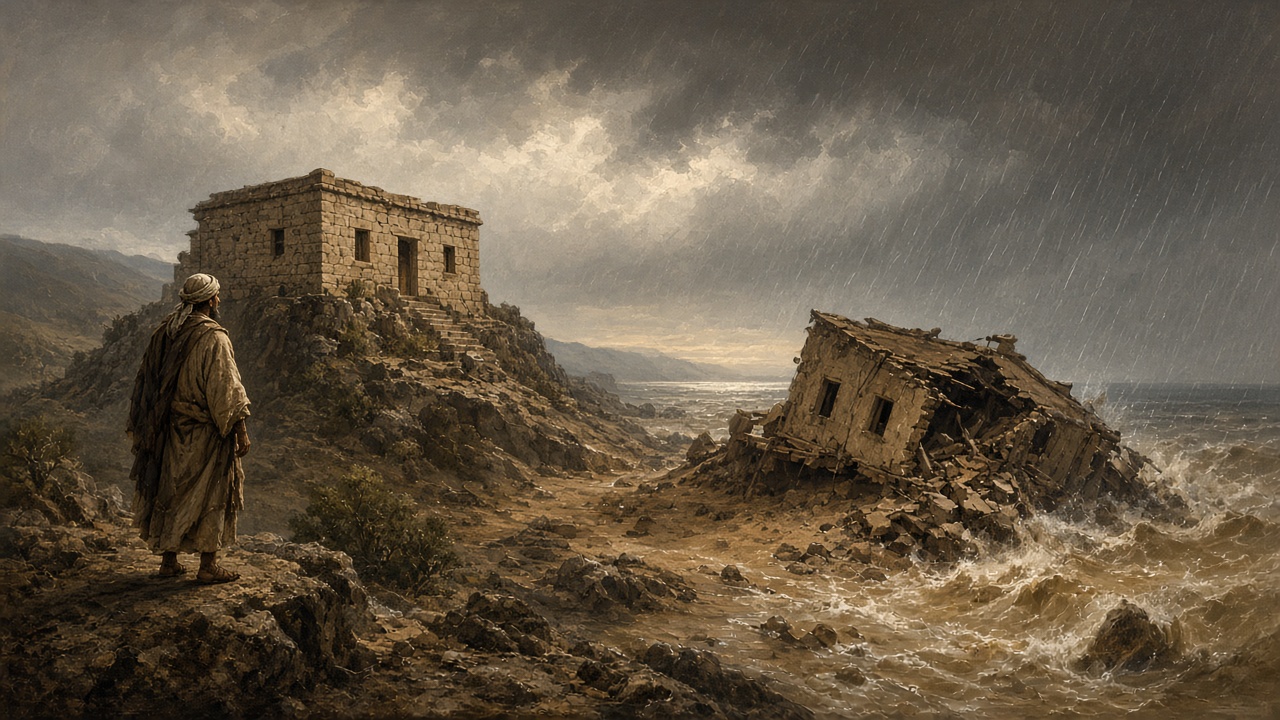
I queb ja: jun cubam puwi abaj y jun cubam puwi seneb
24Je niʼpa i que taw in tzij-i, we que cojon che, ʼo qui noʼoj ʼuri. Queje pacha jun achi, ʼo u noʼoj, xu cuba i rachoch pujaʼ abaj. 25Xoʼon panok, xpe i jab nim, lic xnimar i ya, xak xpe i tew, craj cu tzaksaj i ja pulew péro n-xtzak taj man cul pujaʼ abaj. 26Xui-ri, je niʼpa i que taw in tzij, we n-que cojon ta che, n-ta qui noʼoj ʼuri. Queje pacha jun achi, n-tu noʼoj, xu cuba i rachoch xa puwi i seneb. 27Xoʼon panok, xpe i jab; xnimar i ya; xak xpe i tew chirij i rachoch, y xtzak pulew. ¡Lic xoʼon mal!
28Are xutzin i Jesus chu bixquil chique, i winak lic xqui bisoj wach i cʼutunic xoʼono. 29Are ca chʼaʼat cuʼ, ʼalaj ʼuri chi lic retaʼam usucʼ wach i xu bij; n-are ta pacha quiqui ʼan i toʼ je tijonel re i ʼatbal tzij.
Você sabia?
O juízo, o caminho estreito e um alicerce firme
- O registro do evento data o início do Sermão da Montanha em 28 d.C. e sua duração em um dia. Este capítulo termina com as multidões admiradas com o ensino de Jesus, porque ele ensinava como quem tem autoridade, e não como os escribas deles.Fontes: Sermon on the Mount · o próprio texto bíblico
- Jesus adverte que o juízo que alguém pronuncia, e a medida que essa pessoa usa, voltarão sobre ela. Ele descreve alguém que repara no cisco no olho do irmão, mas não percebe a trave no próprio olho, e diz que a trave precisa ser removida primeiro.Fontes: o próprio texto bíblico
- O capítulo chama de essência da Lei e dos Profetas fazer aos outros o que se gostaria que lhe fizessem. Ele contrasta uma porta larga e um caminho espaçoso que leva à destruição, pelo qual muitos entram, com uma porta pequena e um caminho estreito que leva à vida, que poucos encontram, e compara ouvir essas palavras e praticá-las a uma casa construída sobre a rocha, e não sobre a areia.Fontes: o próprio texto bíblico
Notas escritas com auxílio de IA a partir de fontes abertas (Theographic Bible Metadata, CC BY-SA 4.0; Easton’s Bible Dictionary, domínio público) e revisadas antes de publicar.
Créditos e licença desta tradução
I 'utz laj tzij re i dios
New Testament in Achi (I 'utz laj tzij re i dios)
copyright © 2009 Wycliffe Bible Translators, Inc.
Language: Achi
Dialect: Cubulco
Translation by: Wycliffe Bible Translators, Inc.
Achi, Cubulco
Achi' is a Mayan language very
closely related to K'iche' (Quiché in the older orthography). It is spoken by the
Achi people, primarily in the area of Baja Verapaz in Guatemala. There are two Achi'
dialects. Cubulco Achi' is spoken by approximately 48,000 people in the Cubulco area
west of Rabinal area. Rabinal Achi' is spoken by approximately 37,000 people in the
Rabinal area.
El Nuevo Testamento
en el idioma Achí de Cubulco de
Guatemala
Ediciones anteriores
Segunda edición
©2009, Wycliffe Bible
Translators
Primera edición
Publicado por
©1984, Sociedad Bíblica
Internacional
Copyright Information
© 2009, Wycliffe Inc. All rights reserved.
This translation text is made available to you under the terms of the Creative
Commons License: Attribution-Noncommercial-No Derivative Works. ( http://creativecommons.org/licenses/by-nc-nd/3.0/ ) In addition, you have
permission to port the text to different file formats, as long as you do not change
any of the text or punctuation of the Bible.
You may share, copy, distribute, transmit, and extract portions or quotations from
this work, provided that you include the above copyright information:
You must give Attribution to the work.
You do not sell this work for a profit.
You do not make any derivative works that change any of the actual words or
punctuation of the Scriptures.
Permissions beyond the scope of this license may be available if you contact us
with your request. If you want to revise a translation, use a translation in an
adaptation, or use a translation commercially, we will consider your request.
NT:segunda edición
The New Testament
in Achi
© 2009, Wycliffe Inc. All rights reserved.
This translation is made available to you under the terms of the
Creative Commons Attribution-Noncommercial-No Derivatives license 4.0.
You may share and redistribute this Bible translation or extracts from it in any format, provided that:
You include the above copyright and source information.
You do not sell this work for a profit.
You do not change any of the words or punctuation of the Scriptures.
Pictures included with Scriptures and other documents on this site are licensed just for use with those Scriptures and documents.
For other uses, please contact the respective copyright owners.
2013-01-05
Fonte: http://ebible.org/acr-acc/ · eBible.org