Mateus 3
I 'utz laj tzij re i dios · Toque num versículo para ver as referências cruzadas.
I ma Wan, aj kajsanel ya, coc chi chac
1Xoʼon panok, i ma Wan, aj kajsanel ya, xupon che i chakij jyub tzʼinilic, chila pa jyub Judéa. Are xuponic, xoc chu bixquil u tzij i Dios chique i winak chi xe moltaj ruʼ.
2—Chi jalwachij i nojbal chuwach i Dios —xu bij chique—. Man i ʼatbal tzij chi ca pe chicaj ya ca jekanic —xu bij.
3I ma Wan-le are i jun chi ʼax bital wi chi ca cʼunic. Are i bin-nak can ile are i ujer ajbil u tzij i Dios mam Isaías. Ire u tzʼibam canok:
Ca tataj u chʼawbal jun ca siqʼuin che i jyub tzʼinilic; cu bij:
“¡Ya ca pe i Kajwal! Chi yijba u be chuwach.
Chi sucʼba niʼpa i jul, niʼpa i tanalak pu be i Kajwal.”
(Queje ile tzʼibtal canok.)
4I ma Wan, i u ʼuʼ ire xa are i rismal camey ʼantal u ʼuʼ che; i ximbal u pam xa are chʼakap tzʼum. Wach i xu tijo xa are wach i xu rik pa tak ʼes: xa xu tij u waʼal cab, xak xe u tij i ral tak sacʼ. 5I winak chi xe upon ruʼ chu tayic u tzij, ʼo i je petnak cʼa pa tinimit Jerusalen, xak ʼo i je petnak pa ronojel tak lugar re i jyub Judéa, xak ʼo i je petnak chu nakaj i ya Jordan. 6Ique, are xqui tzʼonoj ni cuybal mac che i Dios, teʼuri i ma Wan xu kajsaj ya piquiwi pa ya Jordan.
7Xui-ri, xril ire je qʼui i aj Fariséo winak, xak i aj Saducéo, chi cacaj ique toʼ ca kajsax ya piquiwi. Are ʼuri xu bij chique:
—¡Yix xa ix racʼal cumatz! ¿Pachin xbin chiwe yix chi quix totaj chuwach i tojpen chi ca tijin nali piwi? 8Chi ʼalijinsaj ʼut ruʼ wach tak i qui ʼano we i jalwachim chic i nojbal chuwach i Dios. 9Mi chʼob yix mok xa n-ca pe tu tojbalil piwi yix xa rumal ix aj Israel winak, xa rumal ix umuk uxiquin can i mam Abraham. Mi chʼob yix chi lic quix totaj na rumal. Quin bij chiwe chi Dios, che i abaj-i, ca tiqui chu ʼonquil uqʼuial aj Israel winak che, we ta craj —xu bij i ma Wan chique. 10Xak xu bij:
—I tojpen ya ca pe piwi, pacha jun icaj yij chic che jun cheʼ, cʼatzbal re i raʼ. Ronojel tak i cheʼ chi n-cu ya tu wach chom, ca cʼatzixic; teʼuri ca porox pa ʼaʼ. 11Yin, katzij, quin kajsaj ya piwi yix, cʼutbal-re we i jalwachim chic i nojbal chuwach i Dios. Xui-ri, i Jun chi ca cʼun chwijil yin cu kajsaj i u Tewal i Dios piquiwi niʼpa i qui jalwachim qui cʼaslemal; xak cu kajsaj li ʼaʼ piquiwi i je mal. Ire lic nim ni u ʼij chinwach yin; n-ca majaw ta chwe we quin ʼan mocom che wib chirij, mi tene cwucʼaj u xajab, rumal ni u ʼij nim. 12Col u ʼata tzij piquiwi i winak, pachin i je ʼutz, xak pachin i ne te ʼutz. Ire yij chic pacha coʼon jun ruʼ u pala are cu pu u wach u trígo. Are i ʼutz quel che u trígo, cu molo y cu ya pu cʼolbal. I rij, chi n-ʼus taj, ca porox pa ʼaʼ chi n-tu chupic —xu bij i ma Wan chique.
U kajsaxic ya puwi i Jesus
13Che tak i ʼij-le, i Jesus xel pa Galiléa, xupon chiya Jordan pa ʼo wi i ma Wan; xupon chu kajsaxic ya puwi rumal ire. 14I ma Wan xu chʼobo chi n-cu maj taj we are ire ca kajsaw ya puwi i Jesus. Xu bij:
—Yet, mas ca majaw chawe chi ca kajsaj ya pinwi yin. N-ca majaw taj we yin quin kajsaw ya pawi yet —xu bij.
15I Jesus xu bij:
—N-ta coʼono. Queje cha ʼana ni ile woʼor, man ca majawic caka ʼan ni ronojel pacha craj i Dios —xu bij.
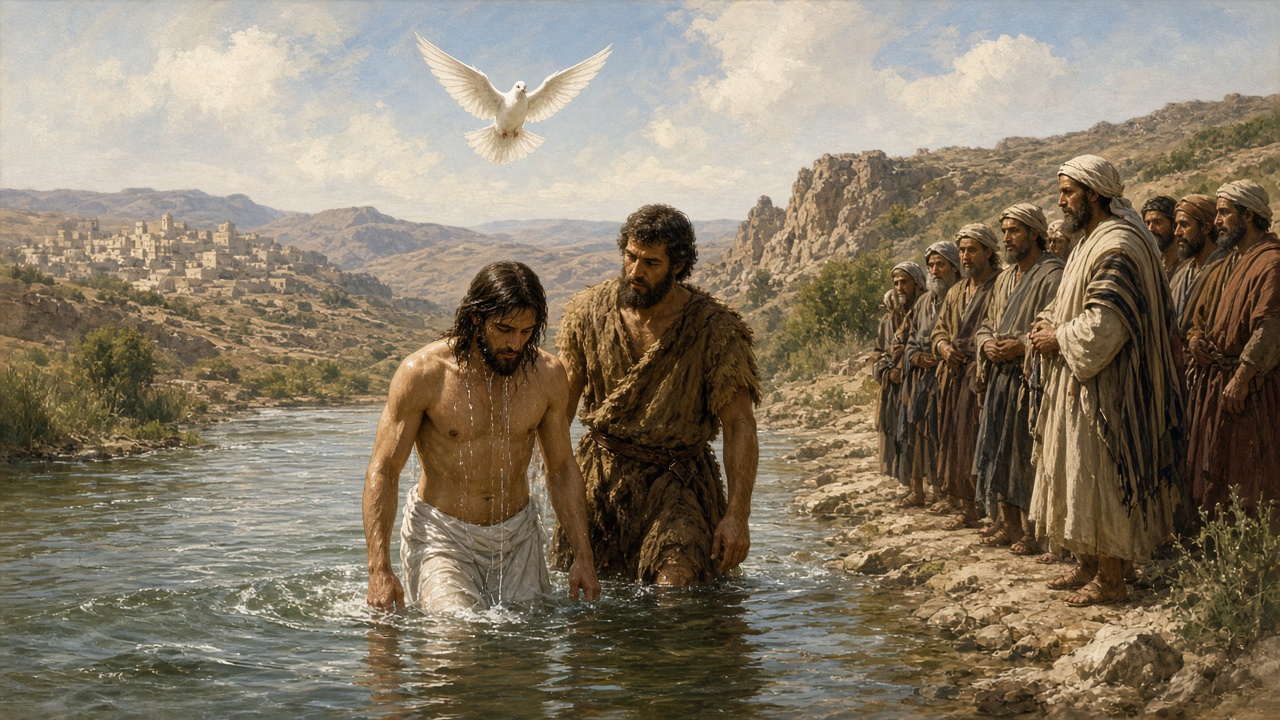
Teʼuri i ma Wan xu ya u wach che, wach i xbix che. 16I Jesus, are xutzin u kajsaxic ya puwi, xel pa ya. Xak teʼet, xjaktaj i caj, xa ʼiltaj i u Tewal i Dios chi xkaj lok pacha jun palomax sucʼulic puwi Jesus, 17y xtataj jun chʼawbal chicaj chi xu bij:
—Iri lic are i wacʼal chi cʼax quin naʼo; lic quin quicot che, wach u ʼanom.
Você sabia?
Arrependimento e batismo no Jordão
- Mateus identifica João Batista como aquele de quem falou o profeta Isaías: uma voz que clama no deserto: “Preparem o caminho do Senhor”. O Dicionário Bíblico de Easton (1897) registra que a missão de João foi objeto de profecia, citando este trecho, Isaías 40:3 e Malaquias 3:1, e que ele era de descendência sacerdotal — o pai, Zacarias, sacerdote da turma de Abias, e a mãe, Isabel, das filhas de Arão. Uma cronologia data tanto o início do ministério de João quanto o batismo de Jesus no ano 26 d.C.Fontes: o próprio texto bíblico · John the Baptist · John the Baptist Begins Ministry · John Baptizes Jesus
- João veio pregando no deserto da Judeia, e pessoas de Jerusalém, de toda a Judeia e de toda a região ao redor do Jordão foram ao seu encontro, confessando os pecados e sendo batizadas no rio Jordão. O Dicionário Bíblico de Easton (1897) observa que, sob os romanos, no tempo de Cristo, Judeia designava a mais meridional das três divisões da Palestina, distinta da Galileia e da Samaria, e incluía os territórios de Judá, Benjamim, Dã, Simeão e parte de Efraim. Jesus veio da Galileia — chamada Galil pelos judeus — ao Jordão para ser batizado por João.Fontes: o próprio texto bíblico · Judea · Galilee
- João advertiu os fariseus e os saduceus a não se fiarem da afirmação “Temos a Abraão por pai”, dizendo que Deus podia suscitar filhos para Abraão a partir das pedras. O Dicionário Bíblico de Easton (1897) explica o nome Abraão como “pai de uma multidão” e o descreve como filho de Terá, nomeado antes dos irmãos mais velhos porque era o herdeiro das promessas.Fontes: o próprio texto bíblico · Abraham
Notas escritas com auxílio de IA a partir de fontes abertas (Theographic Bible Metadata, CC BY-SA 4.0; Easton’s Bible Dictionary, domínio público) e revisadas antes de publicar.
Lugares deste capítulo
- Judea · Hoje: Judea 1 · 31.777, 35.234 · versículos 1, 5
- Jerusalem · 31.777, 35.234 · versículo 5
- Jordan · Hoje: Jordan River · 31.761, 35.558 · versículos 5, 6, 13
- Galilee · 32.760, 35.527 · versículo 13
Só aparecem lugares com identificação de alta confiança (90% ou mais segundo as fontes acadêmicas reunidas pelo OpenBible). Mapa da época: DARE (Digital Atlas of the Roman Empire), CC BY 4.0; mapa atual: © colaboradores do OpenStreetMap; lugares: OpenBible.info (CC BY 4.0).
Créditos e licença desta tradução
I 'utz laj tzij re i dios
New Testament in Achi (I 'utz laj tzij re i dios)
copyright © 2009 Wycliffe Bible Translators, Inc.
Language: Achi
Dialect: Cubulco
Translation by: Wycliffe Bible Translators, Inc.
Achi, Cubulco
Achi' is a Mayan language very
closely related to K'iche' (Quiché in the older orthography). It is spoken by the
Achi people, primarily in the area of Baja Verapaz in Guatemala. There are two Achi'
dialects. Cubulco Achi' is spoken by approximately 48,000 people in the Cubulco area
west of Rabinal area. Rabinal Achi' is spoken by approximately 37,000 people in the
Rabinal area.
El Nuevo Testamento
en el idioma Achí de Cubulco de
Guatemala
Ediciones anteriores
Segunda edición
©2009, Wycliffe Bible
Translators
Primera edición
Publicado por
©1984, Sociedad Bíblica
Internacional
Copyright Information
© 2009, Wycliffe Inc. All rights reserved.
This translation text is made available to you under the terms of the Creative
Commons License: Attribution-Noncommercial-No Derivative Works. ( http://creativecommons.org/licenses/by-nc-nd/3.0/ ) In addition, you have
permission to port the text to different file formats, as long as you do not change
any of the text or punctuation of the Bible.
You may share, copy, distribute, transmit, and extract portions or quotations from
this work, provided that you include the above copyright information:
You must give Attribution to the work.
You do not sell this work for a profit.
You do not make any derivative works that change any of the actual words or
punctuation of the Scriptures.
Permissions beyond the scope of this license may be available if you contact us
with your request. If you want to revise a translation, use a translation in an
adaptation, or use a translation commercially, we will consider your request.
NT:segunda edición
The New Testament
in Achi
© 2009, Wycliffe Inc. All rights reserved.
This translation is made available to you under the terms of the
Creative Commons Attribution-Noncommercial-No Derivatives license 4.0.
You may share and redistribute this Bible translation or extracts from it in any format, provided that:
You include the above copyright and source information.
You do not sell this work for a profit.
You do not change any of the words or punctuation of the Scriptures.
Pictures included with Scriptures and other documents on this site are licensed just for use with those Scriptures and documents.
For other uses, please contact the respective copyright owners.
2013-01-05
Fonte: http://ebible.org/acr-acc/ · eBible.org