Atos 4
I 'utz laj tzij re i dios · Toque num versículo para ver as referências cruzadas.
I ma Pédro, i ma Wan xe yaj cumal i nucʼbal tʼisbal
1I ma Pédro, i ma Wan, cʼa que tijin chi tzij are xe cʼun li juban winak lic que oywaric. I winak-i je are jujun sacerdóte, xak i cajʼatzil i policía re i rachoch i Dios, xak jujun chique i aj Saducéo. 2Ique que oywaric man i ma Pédro i ma Wan que tijin chu cʼutic chique i winak chi i camnak ca cʼun chic sak chiquiwach. Quiqui bij chi ʼetamam ni ile man i Jesus walijnak chic che i camic. 3I policía xe qui chap i ma Pédro i ma Wan y xe qui tzʼapij pa cárcel. Ya xkaj i ʼij, rumal-i cʼa chucab ʼij que ʼelsax-lok, (que yaʼ chuwach i ʼatbal tzij). 4Xui-ri, je qʼui chique i xqui ta i qui tzij i ma Pédro i ma Wan, xqui cuba qui cʼux che i Jesucrísto. Rumal ʼuri xe qʼuiar i creyent, colo je joʼob mil achiab chique. 5Chucab ʼij i cajʼatzil i aj Israel winak xqui mol quib pa tinimit Jerusalen junam cuʼ i nimak tak mamʼib, xak cuʼ i tijonel re i ujer ʼatbal tzij. 6Xak xupon i mam Anas chi ʼatz laj sacerdóte, xak i ma Caifas, i ma Wan, i ma Alejándro, xak conojel i cachalal i cajʼatzil i sacerdóte. 7Xqui tak qui cʼamic i ma Pédro, i ma Wan. Xe qui tacʼba chiquiwach, y xe oc chu tzʼonoxic chique:
—¿Pachin xyaw ile piʼab? ¿Pachin xix takaw chu ʼonquil iri? —xe cha chique.
8I ma Pédro, lic rumal i u Tewal i Dios ʼo ruʼ, queje iri xu bij chique:
—Ix nimak tak kajʼatzil, ix nimak tak mamʼib quin ya rutzil i wach. 9Yix quix tijin chi tacʼalem pa rakan wach u ʼonquil jun utzil chomal ʼantal che jun achi iwab. Qui tzʼonoj chake wach i utziric xu ʼano. 10Woʼor caka ʼalijinsaj chiwe. Cakaj caquetamaj conojel i aj Israel winak chi xa rumal u ʼab i Jesucrísto aj Nazaret xutzir i achi-ri chi ʼo chiwach iwonojel; xa rumal i Jesucrísto, yijinak chic u chʼacul. Are i mísmo Jesucrísto chi xi camsaj yix chuwach cruz, chi xak xcʼastax u wach rumal i Dios, are ire ʼanawnak iri. 11Chupam u wuj i Dios cu bij:
I abaj chi xi xutuj yix ix aj ʼanol ja,
are i abaj-le chi xeʼelok mas nim ni u chac.
(Queje ile tzʼibtal canok. Are i Jesus are i abaj-le chi xutux canok, xui-ri i Dios u ʼanom che chi nim u patan.) 12Xui i Jesus coj ʼelsaw chupam i ka mac; n-ta chic jun chic chuwach i jyub taʼaj. Xui ire-le yatal puʼab rumal i Dios chi coj u to —xu bij i ma Pédro chique.
13I nimak tak mamʼib lic xqui bisoj are xquilo chi ma Pédro i ma Wan lic co qui cʼux. Xquil u be chi ne te tijojtalic, n-ti qui patan, toʼ je winak. Teʼuri xquil u be chi je rachiʼil can i Jesus (rumal-i n-quiqui xij ti quib; ʼis quilom niʼpa i xqui bij). 14N-xui ta la ile, xak i achi chi utzirnak chic, tacʼal chila chiquiwach, rumal-i n-quiqui rik taj wach u laʼic u wach quiqui ʼano. 15Xe qui tak bi i ma Pédro i ma Wan chi sak, teʼuri xe oc chu bixquil chiquiwach wach quiqui ʼano. 16Xqui bij:
—¿Wach caka ʼan chique i achiab-le? Conojel i winak waral pa Jerusalen quetaʼam wach i nim laj ʼanic xqui ʼano; n-ta queʼel wi we cakuwaj u wach. 17¿Wach caka ʼano chi n-ca pax ta rason chiquixol i winak? ʼUtz we que ka xibij; caka bij chique chi miqui lapla chic i Jesus chique i winak. (Queje xqui bij ile chiquiwach.)
18Teʼuri xe qui siqʼuij chic i ma Pédro i ma Wan chiquiwach, y xqui bij chique chi quiqui mayij i u cʼutic u tzij i Jesus, xak miqui lapla chic wach u ʼanom. 19I ma Pédro i ma Wan xqui bij chique:
—Chi bij pe yix pachique i ʼutz chuwach i Dios, ¿we caka ʼan pacha cu bij i Dios, o caka ʼan pacha i qui bij yix? 20Yoj n-caka mayij tu bixquil wach i kilom, wach i ka tom, n-coj tiqui ta che —xqui bij chique.
21Are ʼuri i aj nucʼbal tʼisbal xe qui coj bi ʼil, xui-ri xe coʼtaj bic. N-xqui ʼan ti ʼatbal tzij chique, man xqui xij quib chique i winak. Conojel i winak que tijin chu cojic u ʼij i Dios rumal i milágro u ʼanom, 22man i achi, are xutzirsaxic, ya nim chic, mas che i cuarénta junab ʼo che.
I creyent xqui tzʼonoj u cowil qui cʼux che i Dios; ire xu ya chique
23I ma Pédro i ma Wan, are xe oʼtax bic, xe ʼe cuʼ i cachiʼil y xqui bij chique ronojel wach i xqui bij i cajʼatzil i sacerdóte, xak i nimak tak mamʼib. 24I creyent, are xqui ta ique ile, ʼis xe oc chu tzʼonoxic che i Dios. Xqui bij:
—Kajwal Dios, are yet xat ʼanaw i jyub taʼaj, xat ʼanaw i caj, xak i mar; xak ronojel niʼpa i ʼo chupam, ʼis yet xat ʼanawic. 25Yet xa tak li a Tewal ruʼ i ka mam, mam David ujer, xol u bij a tzij che. Teʼuri i awajchac mam David xu tzʼibaj can i tzij-i:
I ne te aj Israel winak, ¿wuchac que chʼujer rumal i coywal?
I winak, ¿wuchac quiqui tzucuj tzaksabal re i Kajwal?
26I je ʼatol tzij re u wach i jyub taʼaj xqui yijba quib; i cajʼatzil i tinimit xqui mol quib quiqui ʼanbej chʼoʼoj chirij i Kajwal Dios,
xak chirij i Tolke chatal rumal i Dios.
(Queje ile u tzʼibam can i mam David ujer, y queje coj tijin yoj chi rilic woʼor.)
27Katzij i ma Heródes, junam ruʼ i ma Póncio Piláto, xqui mol quib waral pa Jerusalen cuʼ i ne te aj Israel winak, xak cuʼ i je aj Israel. Xqui tzucuj tzaksabal re i loʼlaj Awacʼal Jesus, i Jun chi a yom yet che i loʼlaj u patan. 28Are xqui ʼan ique ile, xeʼelok pacha i a nucʼum yet ujer chi ca ʼani na. 29Woʼor, Kajwal Dios, chawila chi ique coj qui ʼatij, coj qui coj ʼil. Yoj oj a takon, cha ya ʼuri u cowil ka cʼux chu bixquil a tzij chique i winak. 30Caka tzʼonoj chawe coj a to chi cutzirsaxic iwabib, xak chu ʼonquil i milágro, xak chu ʼonquil i nimak tak ʼanic chiquiwach i winak. Choj a to are caka ʼan tak ile chi yatal chake rumal i loʼlaj Awacʼal Jesucrísto. (Queje ile xqui tzʼonoj che i Dios.)
31Are xe utzin chu tzʼonoxic che i Dios, xsilab i ja pa qui molom wi quib. Are ʼuri, xcʼun i u Tewal i Dios piquiwi conojel; lic xoc pa qui cʼux. Teʼuri co qui cʼux xqui jek u bixquil u tzij i Dios.
I creyent ʼis junam qui wach puwi ubitak-que
32I u qʼuial creyent, xak jun qui wach xak jun qui nojbal. Mi jun xoʼon xuy che rib puwi ubitak-re. Niʼpa i ubitak-que, ʼis junam ni qui wach puwi. 33I apostelab n-xqui mayij tu paxsaxic i tzij chique i winak chi katzij i Kajwal Jesus walijnak chic che i camic. I qui tzij mas ʼo u choʼab; i Dios, nim i ʼutz xu ya piquiwi conojel. 34Mi jun chique xu tij uyej, man niʼpa ʼo qui jyub, niʼpa ʼo cachoch, quiqui cʼayij tobal que i creyent je nibaʼib. 35We xcʼaytajic, quiqui cʼam li mer, y quiqui ya na piquiʼab i apostelab. Teʼuri i apostelab quiqui jacho, chirij wach i rajwaxic chique chi qui jujunal. 36Por ejémplo, ʼo jun chique, ma Jose u bi, queje xu ʼan ire ile. Ire aj Chípre, jun jyub setel chuwi mar; ire jun u muk u xiquin can i mam Lewi. I apostelab xqui ya pu bi: ma Bernabe, chi queʼel pa ka chʼawbal: “aj cubsanel re qui cʼux i winak.” 37I achi-le xu cʼayij jun rulew, xu cʼam li mer, y xu ya chique i apostelab.
Você sabia?
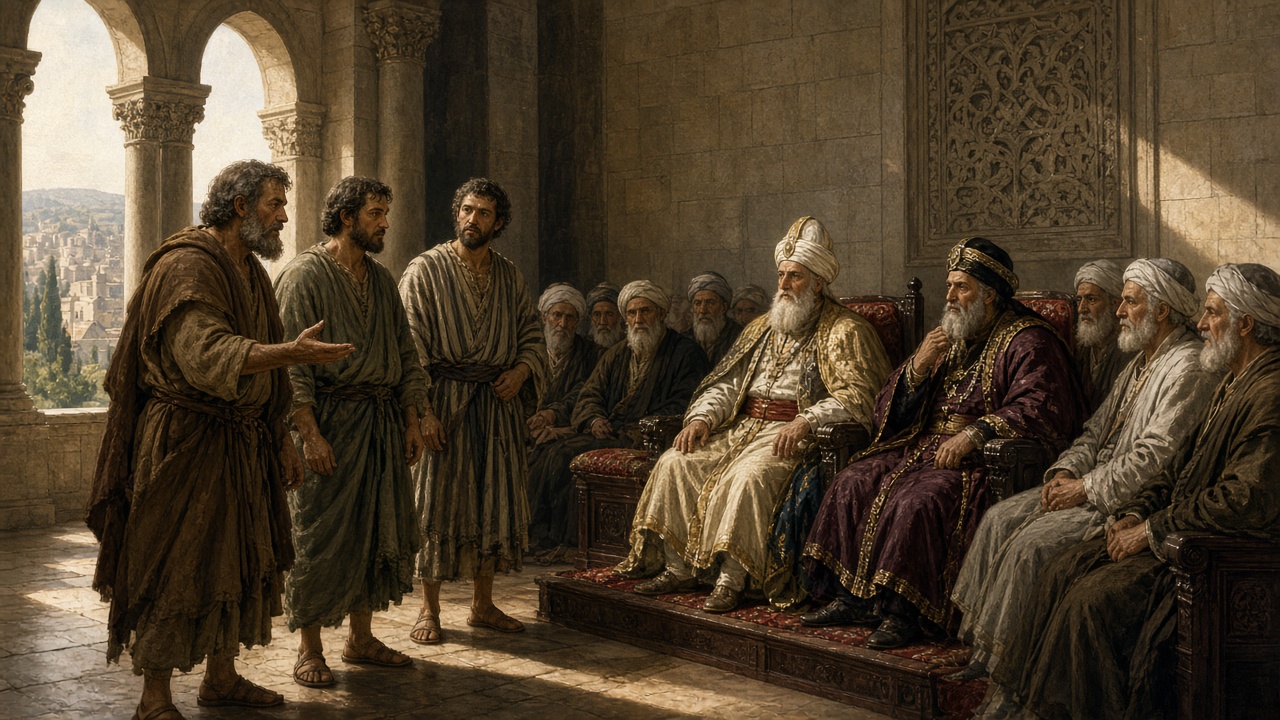
Pedro e João diante do Sinédrio
- Os sacerdotes, o capitão da guarda do templo e os saduceus prenderam Pedro e João porque eles ensinavam o povo e anunciavam em Jesus a ressurreição dos mortos. Caifás, que participou da assembleia no dia seguinte, pertencia aos saduceus.Fontes: o próprio texto bíblico · Caiaphas
- Anás, chamado aqui de sumo sacerdote, ocupou esse cargo de 7 a 14 d.C., até que um procurador romano o depôs. Caifás, que havia se casado com a filha de Anás, foi elevado ao cargo em 25 d.C.; mesmo assim, alguns judeus ainda podiam considerar Anás o sumo sacerdote legal, pois a lei mosaica tratava o ofício como vitalício, e Anás provavelmente era presidente ou auxiliar do Sinédrio. João e Alexandre, parentes do sumo sacerdote e de outro modo desconhecidos, estavam sentados com eles.Fontes: o próprio texto bíblico · Annas · John (Relative of the High Priest) · Alexander (Son of Simon)
- Pedro, pescador de Betsaida, e João, também pescador e filho de Zebedeu, foram levados perante os governantes, os anciãos e os escribas. O conselho admirou-se da ousadia deles ao perceber que eram homens sem instrução e comuns, e notou que haviam estado com Jesus.Fontes: o próprio texto bíblico · Simon Peter · John the Apostle
Notas escritas com auxílio de IA a partir de fontes abertas (Theographic Bible Metadata, CC BY-SA 4.0; Easton’s Bible Dictionary, domínio público) e revisadas antes de publicar.
Lugares deste capítulo
- Jerusalem · 31.777, 35.234 · versículos 5, 16
- Nazareth · 32.702, 35.298 · versículo 10
- Cyprus · 35.000, 33.000 · versículo 36
Só aparecem lugares com identificação de alta confiança (90% ou mais segundo as fontes acadêmicas reunidas pelo OpenBible). Mapa da época: DARE (Digital Atlas of the Roman Empire), CC BY 4.0; mapa atual: © colaboradores do OpenStreetMap; lugares: OpenBible.info (CC BY 4.0).
Créditos e licença desta tradução
I 'utz laj tzij re i dios
New Testament in Achi (I 'utz laj tzij re i dios)
copyright © 2009 Wycliffe Bible Translators, Inc.
Language: Achi
Dialect: Cubulco
Translation by: Wycliffe Bible Translators, Inc.
Achi, Cubulco
Achi' is a Mayan language very
closely related to K'iche' (Quiché in the older orthography). It is spoken by the
Achi people, primarily in the area of Baja Verapaz in Guatemala. There are two Achi'
dialects. Cubulco Achi' is spoken by approximately 48,000 people in the Cubulco area
west of Rabinal area. Rabinal Achi' is spoken by approximately 37,000 people in the
Rabinal area.
El Nuevo Testamento
en el idioma Achí de Cubulco de
Guatemala
Ediciones anteriores
Segunda edición
©2009, Wycliffe Bible
Translators
Primera edición
Publicado por
©1984, Sociedad Bíblica
Internacional
Copyright Information
© 2009, Wycliffe Inc. All rights reserved.
This translation text is made available to you under the terms of the Creative
Commons License: Attribution-Noncommercial-No Derivative Works. ( http://creativecommons.org/licenses/by-nc-nd/3.0/ ) In addition, you have
permission to port the text to different file formats, as long as you do not change
any of the text or punctuation of the Bible.
You may share, copy, distribute, transmit, and extract portions or quotations from
this work, provided that you include the above copyright information:
You must give Attribution to the work.
You do not sell this work for a profit.
You do not make any derivative works that change any of the actual words or
punctuation of the Scriptures.
Permissions beyond the scope of this license may be available if you contact us
with your request. If you want to revise a translation, use a translation in an
adaptation, or use a translation commercially, we will consider your request.
NT:segunda edición
The New Testament
in Achi
© 2009, Wycliffe Inc. All rights reserved.
This translation is made available to you under the terms of the
Creative Commons Attribution-Noncommercial-No Derivatives license 4.0.
You may share and redistribute this Bible translation or extracts from it in any format, provided that:
You include the above copyright and source information.
You do not sell this work for a profit.
You do not change any of the words or punctuation of the Scriptures.
Pictures included with Scriptures and other documents on this site are licensed just for use with those Scriptures and documents.
For other uses, please contact the respective copyright owners.
2013-01-05
Fonte: http://ebible.org/acr-acc/ · eBible.org