Apocalipsis 10
Tupã Je'ẽha · Toca un versículo para ver sus referencias cruzadas.
Paper ra'yr mamã ame'ẽ ke
1A'engi amõ Tupã je'ẽha rahoha rehe ihẽ asak. Ihẽ Juã. Ame'ẽ je'ẽha rahoha riki pyrãtã te hũ ame'ẽ ke a'e. Ywa ngi a'e wyjy uwyr. Ywa takãxĩha juramã rupi ihĩ. Iãkã rehe har riki maju'ã aja saka. Huwa hendy hũ. Warahy aja hendy te hũ. Itymã riki tata pirãha aja hendy. 2Ipo pe paper ra'yr mamã ame'ẽ ke reko. Pirar aja ihĩ. Ipy ijywa katu kotyhar y ramũi pe pyrũ. Ipy ijywa'i kotyhar ywy rehe pyrũ tĩ. 3Pe, a'e pukái. Ame'ẽ riki jangwateran je'ẽha aja tyapuha. Upa pukái rahã, Tupã tyapuha tyapu hũ. Ame'ẽ pe je'ẽha ke mujywyr. Awa po wajar mokõi hetaha tyapu te hũ. Je'ẽha mujywyr. 4Ame'ẽ upa rahã, ihẽ ahendu ame'ẽ ke amupinim ta tipe. Ywa ngi ihẽ pe amõ pandu:
—Anĩ. Tupã tyapuha awa po wajar mokõi hetaha pandu ame'ẽ ke emupinim ym. Emujekwa ym tĩ — aja ihẽ pe.
5A'engi ijywa ke Tupã je'ẽha rahoha ywa koty mupuku. Y ramũi pe pyrũ. Ywy rehe pyrũ tĩ. Ame'ẽ je'ẽha rahoha riki ijywa katu kotyhar ke mupuku. 6A'e pandu:
—Tupã riki ixuwe katute hũ ame'ẽ ke a'e. Uhã te hũ ame'ẽ ke a'e tĩ. Ywa ke a'e mujã. Kome'ẽ ywy keruhũ mujã tĩ. Y ramũi mujã tĩ. Upa katu te ame'ẽ pe ixo ame'ẽ ta ke mujã tĩ. A'e je'ẽha rupi jetehar te ke ihẽ apandu. Harõ ym te ta apo 'y. (Upa ame'ẽ ta ke a'e mukanim ta.) 7Tupã je'ẽha rahoha awa po wajar mokõihar jumi'a ke peju rahã, ma'e ke Tupã ma'e ta. Yman mujekwa ym ngã pe ma'e ke rĩ. Ame'ẽ ke mujekwa ta apo 'y. Yman ima'e je'ẽha ke pandu ame'ẽ ta pe pandu. Ima'e miasu ta ke ame'ẽ ta. Mujekwa ta kỹ — aja Tupã je'ẽha rahoha pandu.
8A'engi ywa ngi ihẽ pe pandu, a'e riki ihẽ pe pandu tĩ:
—Y ramũi pe pyrũ. Ywy rehe pyrũ tĩ. Ame'ẽ Tupã je'ẽha rahoha po pe paper mamã ame'ẽ ke ihĩ. Pirar aja ihĩ. Ame'ẽ ke epyhyk eho — aja ihẽ pe.
9Ame'ẽ Tupã je'ẽha rahoha koty ihẽ aho. Apandu ipe:
—Ihẽ pe paper mamã ame'ẽ ke emuwyr — aja ipe.
—Hã! Epyhyk rahã! E'u tĩ. Nde juru pe eir aja he'ẽ ta. Nde pusu pe ihon rahã, hái ta — aja a'e pandu ihẽ pe.
10Ipo ngi ame'ẽ paper ra'yr mamã ame'ẽ ke ihẽ apyhyk. Pe, ame'ẽ ke ihẽ a'u. Ihẽ juru pe he'ẽ riki. Pe, upa ihẽ a'u rahã, ihẽ pusu pe hái aja uwak oho. (He'ẽ aja rahã, ma'e ke Tupã mujekwa ame'ẽ ke rehe ihẽ rury katu. Hái aja rahã, amõ we pyraraha uhyk ta, aja ihẽ akwa, a'erehe ihẽ apyai.)
11Pe, ihẽ pe pandu:
—Amõ we Tupãma'e myrandu ke nde erepandu ta tĩ. Amõ ywy pe har ta rehe har nde erepandu ta tĩ. Amõ amõ awa ta rehe har aja tĩ. Amõ amõ je'ẽha pandu ame'ẽ ta rehe har aja tĩ. Amõ amõ kapitã keruhũ ta rehe har aja tĩ. Upa ame'ẽ ta rehe har nde erepandu ta tĩ — aja ihẽ pe pandu.
¿Sabías que…?
El ángel, los truenos sellados y el rollo
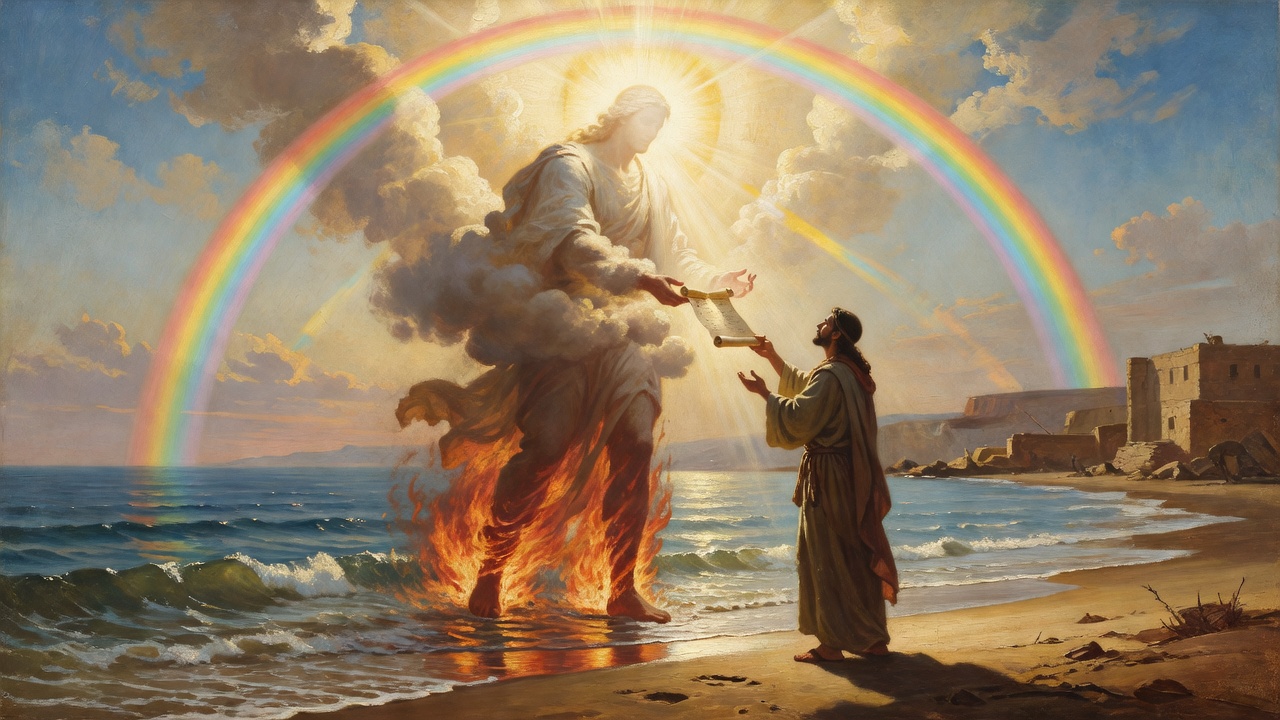
- Un ángel fuerte desciende del cielo, envuelto en una nube, con un arcoíris sobre la cabeza, el rostro como el sol y las piernas como columnas de fuego. Lleva en la mano un pequeño rollo abierto y pone el pie derecho sobre el mar y el pie izquierdo sobre la tierra.Fuentes: el propio texto bíblico
- Cuando el ángel clama como un león que ruge, siete truenos hacen oír su voz. El narrador está a punto de escribir lo que dijeron, pero una voz del cielo ordena que eso quede sellado y no se escriba. De pie sobre el mar y sobre la tierra, el ángel levanta la mano derecha al cielo y jura por quien vive por los siglos de los siglos, que creó el cielo y todo lo que hay en él, la tierra y todo lo que hay en ella, y el mar y todo lo que hay en él, que ya no habrá más demora, pero que en los días en que el séptimo ángel esté a punto de tocar la trompeta el misterio de Dios se cumplirá, tal como él lo anunció a sus siervos los profetas.Fuentes: el propio texto bíblico
- Una voz del cielo manda al narrador tomar de la mano del ángel el pequeño rollo abierto. El ángel dice que lo coma y advierte que será dulce como miel en la boca, pero amargo en el estómago. El narrador lo come y así lo experimenta, y después le dicen que debe profetizar otra vez sobre muchos pueblos, naciones, lenguas y reyes.Fuentes: el propio texto bíblico
Notas escritas con ayuda de IA a partir de fuentes abiertas (Theographic Bible Metadata, CC BY-SA 4.0; Easton’s Bible Dictionary, dominio público) y revisadas antes de publicarse.
Créditos y licencia de esta traducción
Tupã Je'ẽha
New Testament in Kaapor (BR:urb:Kaapor)
copyright © 2012 Wycliffe Bible Translators, Inc.
Language: Kaapor
Translation by: Wycliffe Bible Translators, Inc.
Copyright Information
© 2012, Wycliffe Bible Translators, Inc. All rights reserved.
This translation text is made available to you under the
terms of the Creative Commons License: Attribution-Noncommercial-No Derivative Works.
( http://creativecommons.org/licenses/by-nc-nd/3.0/ )
In addition, you have permission to port the text to different file formats, as long as you
do not change any of the text or punctuation of the Bible.
You may share, copy, distribute, transmit, and extract portions
or quotations from this work, provided that you include the above copyright
information:
You must give Attribution to the work.
You do not sell this work for a profit.
You do not make any derivative works that change any of the actual words or punctuation of the Scriptures.
Permissions beyond the scope of this license may be
available if you contact
us with your request.
The New Testament
in Kaapor
© 2012, Wycliffe Bible Translators, Inc. All rights reserved.
This translation is made available to you under the terms of the
Creative Commons Attribution-Noncommercial-No Derivatives license 4.0.
You may share and redistribute this Bible translation or extracts from it in any format, provided that:
You include the above copyright and source information.
You do not sell this work for a profit.
You do not change any of the words or punctuation of the Scriptures.
Pictures included with Scriptures and other documents on this site are licensed just for use with those Scriptures and documents.
For other uses, please contact the respective copyright owners.
2014-04-27
Fuente: http://ebible.org/urbNT/ · eBible.org