Revelation 10
Tupã Je'ẽha · Tap a verse to see its cross-references.
Paper ra'yr mamã ame'ẽ ke
1A'engi amõ Tupã je'ẽha rahoha rehe ihẽ asak. Ihẽ Juã. Ame'ẽ je'ẽha rahoha riki pyrãtã te hũ ame'ẽ ke a'e. Ywa ngi a'e wyjy uwyr. Ywa takãxĩha juramã rupi ihĩ. Iãkã rehe har riki maju'ã aja saka. Huwa hendy hũ. Warahy aja hendy te hũ. Itymã riki tata pirãha aja hendy. 2Ipo pe paper ra'yr mamã ame'ẽ ke reko. Pirar aja ihĩ. Ipy ijywa katu kotyhar y ramũi pe pyrũ. Ipy ijywa'i kotyhar ywy rehe pyrũ tĩ. 3Pe, a'e pukái. Ame'ẽ riki jangwateran je'ẽha aja tyapuha. Upa pukái rahã, Tupã tyapuha tyapu hũ. Ame'ẽ pe je'ẽha ke mujywyr. Awa po wajar mokõi hetaha tyapu te hũ. Je'ẽha mujywyr. 4Ame'ẽ upa rahã, ihẽ ahendu ame'ẽ ke amupinim ta tipe. Ywa ngi ihẽ pe amõ pandu:
—Anĩ. Tupã tyapuha awa po wajar mokõi hetaha pandu ame'ẽ ke emupinim ym. Emujekwa ym tĩ — aja ihẽ pe.
5A'engi ijywa ke Tupã je'ẽha rahoha ywa koty mupuku. Y ramũi pe pyrũ. Ywy rehe pyrũ tĩ. Ame'ẽ je'ẽha rahoha riki ijywa katu kotyhar ke mupuku. 6A'e pandu:
—Tupã riki ixuwe katute hũ ame'ẽ ke a'e. Uhã te hũ ame'ẽ ke a'e tĩ. Ywa ke a'e mujã. Kome'ẽ ywy keruhũ mujã tĩ. Y ramũi mujã tĩ. Upa katu te ame'ẽ pe ixo ame'ẽ ta ke mujã tĩ. A'e je'ẽha rupi jetehar te ke ihẽ apandu. Harõ ym te ta apo 'y. (Upa ame'ẽ ta ke a'e mukanim ta.) 7Tupã je'ẽha rahoha awa po wajar mokõihar jumi'a ke peju rahã, ma'e ke Tupã ma'e ta. Yman mujekwa ym ngã pe ma'e ke rĩ. Ame'ẽ ke mujekwa ta apo 'y. Yman ima'e je'ẽha ke pandu ame'ẽ ta pe pandu. Ima'e miasu ta ke ame'ẽ ta. Mujekwa ta kỹ — aja Tupã je'ẽha rahoha pandu.
8A'engi ywa ngi ihẽ pe pandu, a'e riki ihẽ pe pandu tĩ:
—Y ramũi pe pyrũ. Ywy rehe pyrũ tĩ. Ame'ẽ Tupã je'ẽha rahoha po pe paper mamã ame'ẽ ke ihĩ. Pirar aja ihĩ. Ame'ẽ ke epyhyk eho — aja ihẽ pe.
9Ame'ẽ Tupã je'ẽha rahoha koty ihẽ aho. Apandu ipe:
—Ihẽ pe paper mamã ame'ẽ ke emuwyr — aja ipe.
—Hã! Epyhyk rahã! E'u tĩ. Nde juru pe eir aja he'ẽ ta. Nde pusu pe ihon rahã, hái ta — aja a'e pandu ihẽ pe.
10Ipo ngi ame'ẽ paper ra'yr mamã ame'ẽ ke ihẽ apyhyk. Pe, ame'ẽ ke ihẽ a'u. Ihẽ juru pe he'ẽ riki. Pe, upa ihẽ a'u rahã, ihẽ pusu pe hái aja uwak oho. (He'ẽ aja rahã, ma'e ke Tupã mujekwa ame'ẽ ke rehe ihẽ rury katu. Hái aja rahã, amõ we pyraraha uhyk ta, aja ihẽ akwa, a'erehe ihẽ apyai.)
11Pe, ihẽ pe pandu:
—Amõ we Tupãma'e myrandu ke nde erepandu ta tĩ. Amõ ywy pe har ta rehe har nde erepandu ta tĩ. Amõ amõ awa ta rehe har aja tĩ. Amõ amõ je'ẽha pandu ame'ẽ ta rehe har aja tĩ. Amõ amõ kapitã keruhũ ta rehe har aja tĩ. Upa ame'ẽ ta rehe har nde erepandu ta tĩ — aja ihẽ pe pandu.
Did you know?
The Angel, the Sealed Thunders, and the Scroll
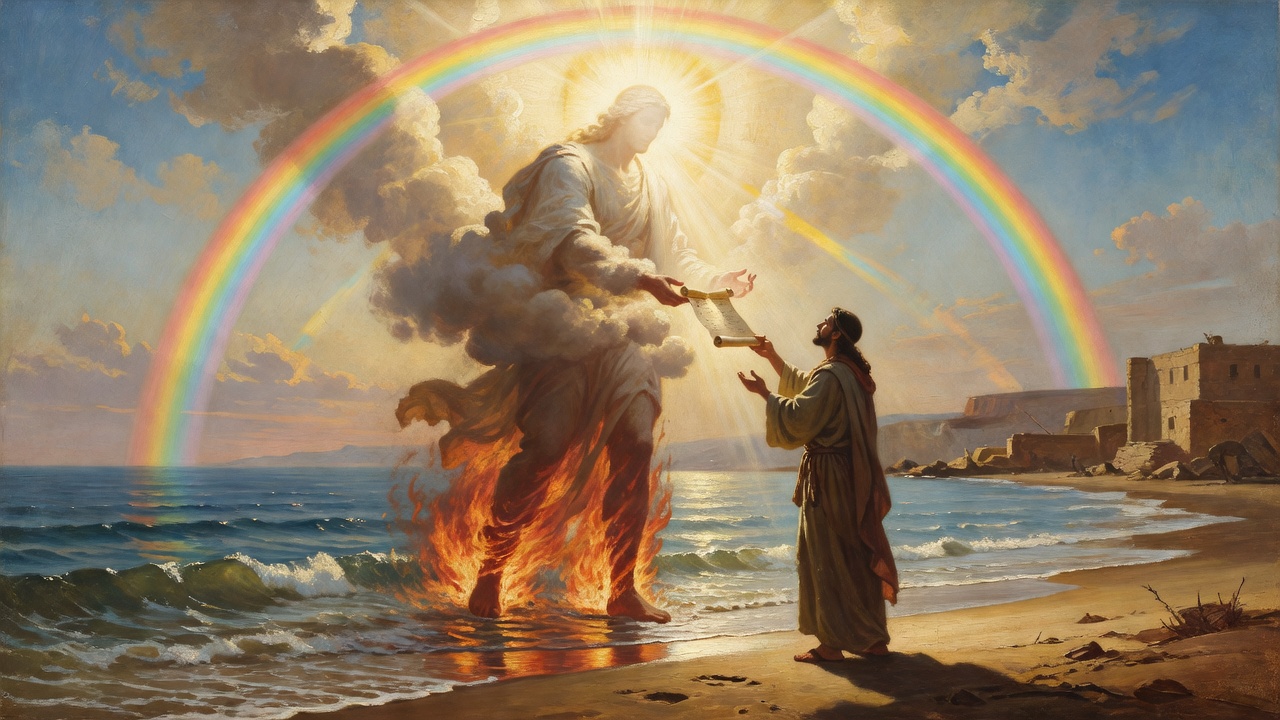
- A mighty angel comes down from heaven, wrapped in a cloud, with a rainbow above his head, a face like the sun, and legs like pillars of fire. He holds a small scroll that lies open, and he places his right foot on the sea and his left foot on the land.Sources: the Bible text itself
- When the angel cries out like a roaring lion, seven thunders speak. The narrator is about to write down what they said, but a voice from heaven commands that it be sealed and not written down. Standing on the sea and on the land, the angel lifts his right hand to heaven and swears by the One who lives forever and ever, who created heaven and everything in it, the earth and everything in it, and the sea and everything in it, that there will be no more delay, yet in the days when the seventh angel is about to sound his trumpet the mystery of God will be fulfilled, just as He proclaimed to His servants the prophets.Sources: the Bible text itself
- A voice from heaven tells the narrator to take the small open scroll from the angel’s hand. The angel says to eat it, warning that it will be sweet as honey in the mouth but bitter in the stomach. The narrator eats it and finds it so, and is then told to prophesy again about many peoples, nations, tongues, and kings.Sources: the Bible text itself
Notes written with AI assistance from open sources (Theographic Bible Metadata, CC BY-SA 4.0; Easton’s Bible Dictionary, public domain) and reviewed before publishing.
Credits and license for this translation
Tupã Je'ẽha
New Testament in Kaapor (BR:urb:Kaapor)
copyright © 2012 Wycliffe Bible Translators, Inc.
Language: Kaapor
Translation by: Wycliffe Bible Translators, Inc.
Copyright Information
© 2012, Wycliffe Bible Translators, Inc. All rights reserved.
This translation text is made available to you under the
terms of the Creative Commons License: Attribution-Noncommercial-No Derivative Works.
( http://creativecommons.org/licenses/by-nc-nd/3.0/ )
In addition, you have permission to port the text to different file formats, as long as you
do not change any of the text or punctuation of the Bible.
You may share, copy, distribute, transmit, and extract portions
or quotations from this work, provided that you include the above copyright
information:
You must give Attribution to the work.
You do not sell this work for a profit.
You do not make any derivative works that change any of the actual words or punctuation of the Scriptures.
Permissions beyond the scope of this license may be
available if you contact
us with your request.
The New Testament
in Kaapor
© 2012, Wycliffe Bible Translators, Inc. All rights reserved.
This translation is made available to you under the terms of the
Creative Commons Attribution-Noncommercial-No Derivatives license 4.0.
You may share and redistribute this Bible translation or extracts from it in any format, provided that:
You include the above copyright and source information.
You do not sell this work for a profit.
You do not change any of the words or punctuation of the Scriptures.
Pictures included with Scriptures and other documents on this site are licensed just for use with those Scriptures and documents.
For other uses, please contact the respective copyright owners.
2014-04-27
Source: http://ebible.org/urbNT/ · eBible.org