Hechos 24
Tupã Je'ẽha · Toca un versículo para ver sus referencias cruzadas.
Páu rehe har jundéu awa ta je'ẽ je'ẽ hũ
1Awa po wajar peteĩhar upa ukwer rahã, Sesaréi ok ta pe Anani oho. Jundéu awa tama'e pa'i keruhũ ke a'e. Amõ tamũi ta namõ a'e oho. Sawa'e ma'e pandu katu te ame'ẽ ke a'eta raho tĩ. Her Ter. Kapitã ruwa koty a'eta pu'am ta. Pe, Páu rehe har a'eta pandu ta. 2Pe, Páu ke sonda ta muhyk rahã, kuja Páu rehe har Ter pandu pandu. Kapitã pe pandu:
—Ser! Katu ame'ẽ ke nde! Nde riki kapitã rahã, yman atu jajumai ym ha aja jaxo katu. Nde erekwa katuha rupi jundéu awa ta pe katu ame'ẽ ke nde erema'ema'e. Upa kome'ẽ ywy rupi katu ame'ẽ ke nde erema'ema'e. 3A'erehe katu aja jakwa katu. Jande rury katu nde rehe tĩ.
4—I'i atu rahã, nde ke ihẽ amupyta ym ta se. A'erehe nde pe ihẽ apandu. Eharõ we rĩ. Ihẽ je'ẽha rehe ehendu katu we rĩ. 5Páu riki ma'e jaxer ame'ẽ ke ma'ema'e. Amõ amõ ta renda rupi oho rahã, jundéu awa ta ke a'e muparahy. Pe, mutyapu hũ ngã ke. Jesu riki Nasare ok ta pe har. Jesu kotyhar tama'e kapitã ke Páu. 6Tupã rehe ngã jumu'eha renda keruhũ a'e mujaxer tar katu. Arahã a'e ke japyhyk. [Jande ramũi ta je'ẽha rupi ehe har jakwa tar katu. 7Anĩ. Jande rehe sonda tama'e kapitã keruhũ uhyk uwyr. Her Risi. Pyrãtãha namõ jande ngi Páu ke a'e pyhyk raho. 8Pe: “Ehe har pandu ame'ẽ ta Ser koty peho” aja jande pe a'e pandu. A'erehe ko jande ja'am.] Apo Páu pe nde erepandu rahã, nde erekwa katu ta tĩ. Upa katu te ehe har japandu ame'ẽ ke jetehar te ke, aja nde erekwa ta tĩ — aja Ser pe Ter pandu.
9Kapitã pe Páu rehe har jundéu awa ta je'ẽ je'ẽ hũ tĩ. Upa katu te Ter je'ẽha riki jetehar te ke, aja a'eta pandu pandu ipe tĩ.
Ser pe Páu pandu pandu
10Pe, Páu pe kapitã ipo pandu: “Ererahã!” aja. Pe, Páu pandu ipe:
—Yman jande anam ta rehe har nde erekwa katu, aja ihẽ akwa katu. (A'erehe jundéu awa ta rehe har nde erekwa katu, aja akwa.) A'erehe nde pe ihẽ juehe har ihẽ apandu rahã, ihẽ rury katu. 11Amukwehe we Jerusarẽ ok ta pe ihẽ aho. Awa py mokõi aker apo. Tupã rehe ihẽ py'a amoĩ moĩ katu aho. Ame'ẽ rehe har nde erekwa tar katu rahã, amõ pe epandurahã! 12Ihẽ ke jundéu awa ta usak rahã, amõ ta namõ ihẽ aje'ẽ hãtã tã ym. Amõ ta ke ihẽ amuparahy ym. Tupã rehe ngã jumu'eha renda keruhũ pe ihẽ axo rahã, aja ym. Jundéu awa tama'e jy'ariha renda pe ihẽ axo rahã, aja ym tĩ. Amõ ta ke ihẽ amuparahy ym tĩ. Ok ta rape rupi ihẽ axo rahã, aja ym tĩ. Amõ ta ke ihẽ amuparahy ym tĩ. 13Ihẽ rehe har katu ym a'eta pandu, ame'ẽ ke jetehar te ke, aja marã ka ym amõ mujekwaha. Jetehar te aja ym.
14—Apo kuja ihẽ apandu nde pe. Jande ramũi ta aja Tupã rehe ihẽ py'a amoĩ moĩ katu tĩ. Amõ kotyhar rehe ihẽ ajurujar katu. Ame'ẽ ke te'e, aja a'eta ukwaha ngã jupe. Upa katu te Moise mupinim ame'ẽ ke rehe ihẽ ahendu katu. Upa katu te Tupã je'ẽha pandu ame'ẽ ta mupinim, ame'ẽ ke rehe ihẽ ahendu katu tĩ. 15Upa katu te manõ ame'ẽ ta ke Tupã mukwera katu ta muhem. Katu ame'ẽ ta ke mukwera katu ta muhem. Katu ym ame'ẽ ta ke mukwera katu ta muhem tĩ. Ame'ẽ ke rehe peme'ẽ sawa'e ta jurujar katu. Peme'ẽ sawa'e ta aja ihẽ ajurujar katu tĩ. 16A'erehe katu ihẽ ama'ema'e tar katu axo. Aja te'eha ihẽ axo. Ame'ẽ ke Tupã ukwa katu. Ngã ukwa katu tĩ.
17—Yman atu, Jerusarẽ ok ta pe ihẽ axo ym rĩ. A'ep ihẽ aho ramõ. Ima'e ym te ame'ẽ ta pe tamatarer ihẽ araho. 18Tupã pe ma'e ke ihẽ ame'ẽ aho tĩ. Aja ihẽ py'a ihẽ amoĩ moĩ axo ehe. Arahã Tupã rehe ngã jumu'eha renda keruhũ pe ihẽ rehe jundéu awa ta usak. Jande ramũi ta je'ẽha aja ihẽ py'a upa juhyk rahã, ihẽ rehe a'eta usak. Ihẽ namõ heta ym ngã ixo. Ngã mutyapu hũ ym tĩ. 19Asia ywy ngi jundéu awa ta uwyr ame'ẽ ta a'ep ixo. Ame'ẽ ta riki se uwyr rahã, katu ta tipe. Pe, nde pe a'eta pandu ta tipe rahã, katu tiki. (Anĩ. Se ame'ẽ ta uwyr ym.) Ihẽ rehe har ma'e pandu tar katu rahã, ame'ẽ ta riki pandu katu ta tipe. 20Anĩ rahã, peme'ẽ sawa'e ta ihẽ rehe har pandu katu. Amukwehe ngã panduha renda pe ihẽ apu'am rahã, ma'e katu ym ihẽ rehe har ame'ẽ ta ukwa my? Ame'ẽ ke a'eta pandu rahã, katu tiki. 21Ame'ẽ ta pyter pe ihẽ apu'am a'am rahã, kuja ihẽ hãtã apandu: “Manõ ame'ẽ ta ke Tupã mukwera katu ta muhem. Ame'ẽ rehe ihẽ ajurujar katu. A'erehe apo ihẽ rehe har pekwa pekwa peĩ” aja ihẽ apandu. Ame'ẽ riki katu ym, aja a'eta ukwa rahã, ame'ẽ jõ ihẽ pe a'eta pandu katu ta — aja Páu pandu.
22Jesu rehe ngã jurujar katu, ame'ẽ rehe har Ser ukwa katu. Pe, a'e pandu:
—A'ewan apo. Sonda tama'e kapitã keruhũ uhyk uwyr rahã, nde rehe har ihẽ akwa ta — aja Páu pe. (Sonda tama'e kapitã keruhũ rer Risi.)
Pe, ngã pe Ser pandu:
—Peho apo — aja.
23Sonda tama'e kapitã pe a'e pandu tĩ:
—Kyndaha pe Páu ke ekynda eraho. Esak katu ehe. A'e wata katu te'e. Ma'e ke ehe katu ame'ẽ ta me'ẽ tar katu ipe rahã, a'eta me'ẽ katu ipe — aja Ser pandu.
Ser namõ Páu pandu pandu. Tusi namõ pandu pandu tĩ.
24Heta ym ukwer rahã, ngã panduha renda pe Ser uhyk tĩ. Hakehar namõ uhyk. Her Tusi. A'e riki jundéu awa ke. Pe, amõ pe Ser pandu:
—Páu ke emuhyk — aja ipe.
Páu ke amõ muhyk rahã, Páu je'ẽha rehe Ser hendu hendu. Myja Jesu Kirisutu rehe amõ jurujar katu, ame'ẽ rehe har Páu pandu pandu ipe. 25Myja katu ame'ẽ ke sawa'e ma'ema'e my, ame'ẽ rehe har Páu pandu pandu ipe tĩ. Katu ym ipy'a pe ma'e ukwa ame'ẽ ke amõ ma'ema'e rahã, katu ym. Ame'ẽ rehe har a'e pandu pandu ipe tĩ. 'Ar ke Tupã manga katu. Arahã upa ngã rehe har a'e ukwa ta. Katu my? Katu ym my? Ame'ẽ ke ukwa ta. Ame'ẽ rehe har a'e pandu pandu ipe tĩ. Ame'ẽ ke Ser hendu rahã, a'e mukahem. Páu pe a'e pandu:
—Eho apo. Amõ wera rahã, nde pe ihẽ apukái ta aho — aja Ser pandu.
26Poiriha rehe tamatarer ke Páu me'ẽ ta ipe my, aja riki Ser putar. A'erehe amõ amõ wera rahã, Páu pe a'e pukái pukái oho. Inamõ a'e pandu pandu.
27Mokõi warahy 'ar aha oho rahã, amõ homa awa tama'e kapitã pu'am. Her Por Set. Ser renda ke pe a'e pu'am. Jundéu awa ta ke Ser muhury tar katu, a'erehe kyndaha pe Páu ke a'e mupyta rĩ.
¿Sabías que…?
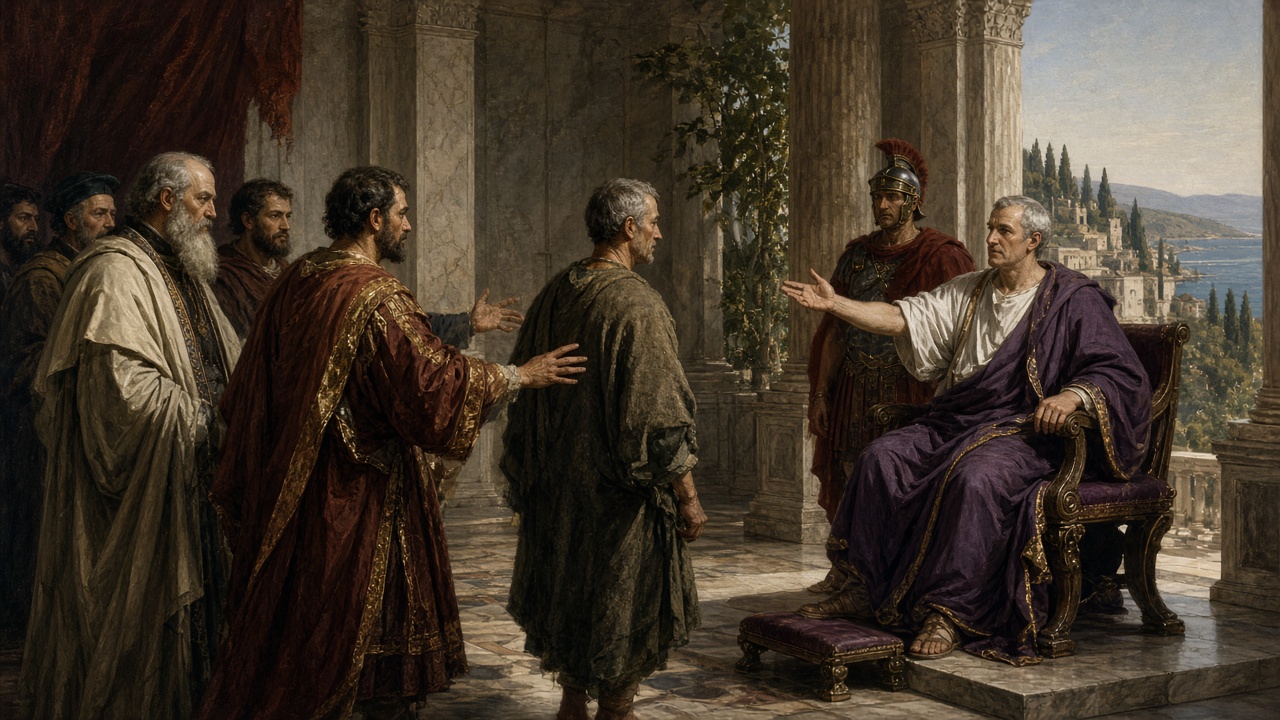
Pablo ante Félix
- El sumo sacerdote Ananías bajó con algunos ancianos y un abogado llamado Tértulo, a quien el Diccionario Bíblico de Easton describe como un abogado romano empleado por los judíos para exponer su causa contra Pablo ante Félix. Tértulo elogió al gobernador y luego dijo que Pablo era una peste que provocaba disensión entre los judíos por todo el mundo, cabecilla de la secta de los nazarenos y un hombre que había intentado profanar el templo. El diccionario relaciona ese elogio inicial con la limpieza que Félix hizo del país, al expulsar a bandidos e impostores.Fuentes: el propio texto bíblico · Tertullus · Felix
- Félix, que estaba bien informado acerca del Camino, aplazó la audiencia y mantuvo a Pablo bajo guarda, aunque le permitió cierta libertad y dejó que sus amigos atendieran sus necesidades. El relato dice que esperaba que Pablo le ofreciera un soborno y por eso lo mandaba llamar con frecuencia; el Diccionario Bíblico de Easton también afirma que al parecer esperaba un soborno y, por ello, tuvo varias entrevistas con él. Después de dos años lo sucedió Porcio Festo —el Diccionario Bíblico de Easton (1897) fecha ese nombramiento en el año 60 d. C.— y, queriendo hacer un favor a los judíos, Félix dejó a Pablo en prisión.Fuentes: el propio texto bíblico · Felix · Portius Festus
- Unos días después, Félix regresó con su esposa Drusila, que era judía, y escuchó a Pablo hablar de la fe en Cristo Jesús y de la justicia, el dominio propio y el juicio venidero; Félix se asustó y lo despidió. El Diccionario Bíblico de Easton (1897) identifica a Drusila como la tercera y la más joven hija de Herodes Agripa I y dice que Félix la indujo a dejar a su esposo, Azizus, rey de Emesa. La misma entrada dice que ella y su hijo perecieron en la erupción del monte Vesubio en el año 79 d. C.Fuentes: el propio texto bíblico · Drusilla
Notas escritas con ayuda de IA a partir de fuentes abiertas (Theographic Bible Metadata, CC BY-SA 4.0; Easton’s Bible Dictionary, dominio público) y revisadas antes de publicarse.
Lugares de este capítulo
- Caesarea · Hoy: Caesarea Maritima · 32.500, 34.892 · versículo 1
- Jerusalem · 31.777, 35.234 · versículos 11, 17
- Asia · 38.400, 28.300 · versículo 18
Solo aparecen lugares identificados con alta confianza (90 % o más según las fuentes académicas reunidas por OpenBible). Mapa de la época: DARE (Digital Atlas of the Roman Empire), CC BY 4.0; mapa actual: © colaboradores de OpenStreetMap; lugares: OpenBible.info (CC BY 4.0).
Créditos y licencia de esta traducción
Tupã Je'ẽha
New Testament in Kaapor (BR:urb:Kaapor)
copyright © 2012 Wycliffe Bible Translators, Inc.
Language: Kaapor
Translation by: Wycliffe Bible Translators, Inc.
Copyright Information
© 2012, Wycliffe Bible Translators, Inc. All rights reserved.
This translation text is made available to you under the
terms of the Creative Commons License: Attribution-Noncommercial-No Derivative Works.
( http://creativecommons.org/licenses/by-nc-nd/3.0/ )
In addition, you have permission to port the text to different file formats, as long as you
do not change any of the text or punctuation of the Bible.
You may share, copy, distribute, transmit, and extract portions
or quotations from this work, provided that you include the above copyright
information:
You must give Attribution to the work.
You do not sell this work for a profit.
You do not make any derivative works that change any of the actual words or punctuation of the Scriptures.
Permissions beyond the scope of this license may be
available if you contact
us with your request.
The New Testament
in Kaapor
© 2012, Wycliffe Bible Translators, Inc. All rights reserved.
This translation is made available to you under the terms of the
Creative Commons Attribution-Noncommercial-No Derivatives license 4.0.
You may share and redistribute this Bible translation or extracts from it in any format, provided that:
You include the above copyright and source information.
You do not sell this work for a profit.
You do not change any of the words or punctuation of the Scriptures.
Pictures included with Scriptures and other documents on this site are licensed just for use with those Scriptures and documents.
For other uses, please contact the respective copyright owners.
2014-04-27
Fuente: http://ebible.org/urbNT/ · eBible.org