Cantares 7
De Heilige Schrift, Petrus Canisiusvertaling, 1939 · Toca un versículo para ver sus referencias cruzadas.
1Hoe sierlijk uw passen In de sandalen, vorstendochter; Uw wiegende heupen als snoeren, Door meesterhanden gemaakt. 2Uw navel een welgerond bekken, Waarin geen wijn mag ontbreken; Uw lijf een tarweschelf, Van lelies omringd. 3Uw beide borsten twee hertenwelpen, Tweelingen van een gazel; 4Uw hals een toren van ivoor, Uw ogen als de vijvers van Chesjbon, Bij de poort der volkrijke stad; Uw neus als de Libanon-spits, Die naar Damascus ziet. 5Het hoofd op u als de Karmel. Uw lokken als purper, In uw vlechten ligt een koning gevangen. 6Wat zijt ge schoon, wat zijt ge bevallig, Een liefste vol bekoorlijkheid! 7Uw slanke leest is als een palm, Uw borsten trossen van druiven. 8Ik dacht: Ik wil de palm beklimmen, Zijn dadels grijpen. Uw borsten mogen voor mij zijn Als druiventrossen uit de wingerd; De geur van uw adem als appels, 9Uw mond als de edelste wijn….Die rechtens naar mijn beminde stroomt, Maar afgeleefde lippen ontvliedt! 10Neen, ik blijf van mijn beminde, En zijn verlangen gaat uit naar mij! … 11Ach kom, mijn beminde, Gaan wij uit naar het veld; Laat ons overnachten in dorpen, Gaan wij vroeg de wijngaarden in. 12Laat ons zien, of de wijnstok al uitbot, Of de bloesems zijn opengegaan, Of de granaten al bloeien: Daar zal ik u mijn liefde schenken! 13De liefdeappelen verspreiden hun geur, Boven onze deur hangen de kostelijkste vruchten, Jonge vruchten en oude: Ik spaarde ze voor u, mijn beminde!
¿Sabías que…?
Poesía de Amor y Paisaje
- El poema describe la belleza de la mujer utilizando destacados puntos geográficos de la región. Sus ojos son comparados con los estanques de Hesbón, cerca de la puerta de Bat-rabim al este del Jordán, mientras que su perfil se asemeja a una torre majestuosa en la cordillera del Líbano que mira hacia Damasco.Fuentes: el propio texto bíblico · Heshbon · Bath-rabbim · Lebanon
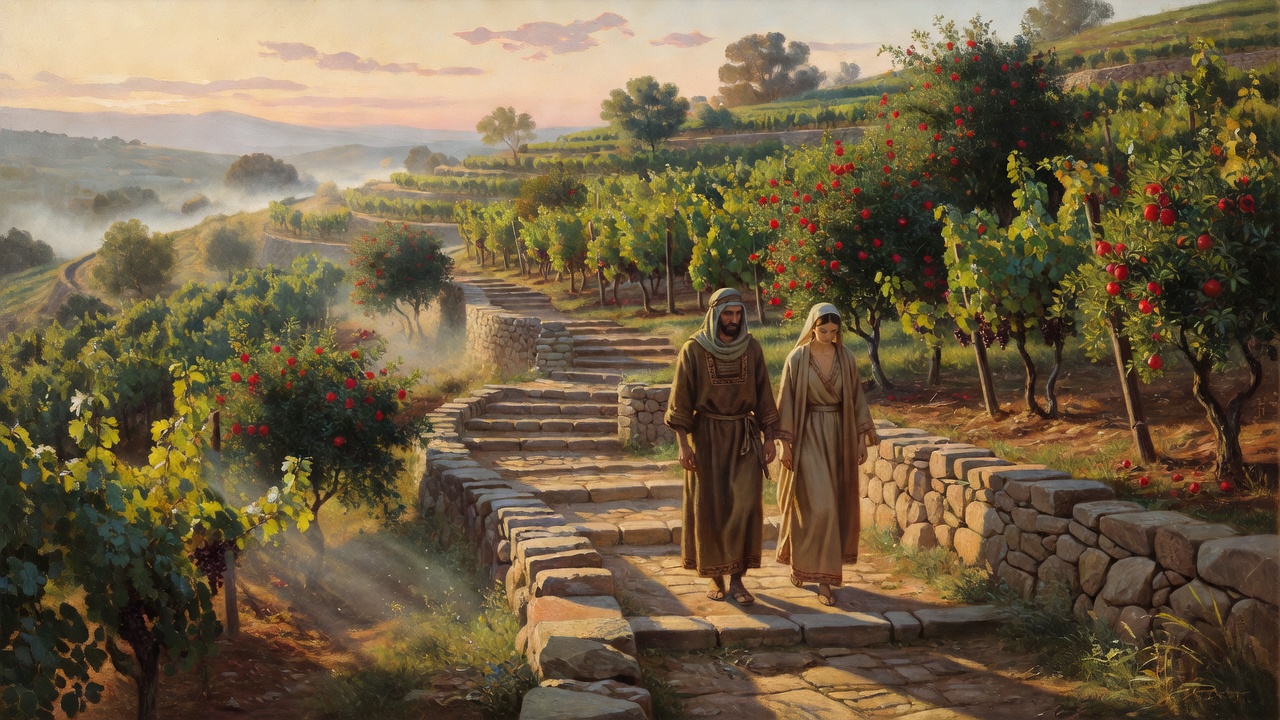
- El capítulo concluye con una invitación al campo durante el despertar de la primavera. Los amantes salen a observar los brotes de las vides, la floración de los granados y el aroma de las mandrágoras, reflejando la estrecha relación en la poesía hebrea antigua entre la intimidad romántica y la naturaleza.Fuentes: el propio texto bíblico
Notas escritas con ayuda de IA a partir de fuentes abiertas (Theographic Bible Metadata, CC BY-SA 4.0; Easton’s Bible Dictionary, dominio público) y revisadas antes de publicarse.
Lugares de este capítulo
- Bath-rabbim · Hoy: in Tell Hesban · 31.801, 35.809 · versículo 4
- Damascus · 33.511, 36.306 · versículo 4
- Lebanon · 33.540, 35.584 · versículo 4
- Mount Carmel · 32.672, 35.023 · versículo 5
Solo aparecen lugares identificados con alta confianza (90 % o más según las fuentes académicas reunidas por OpenBible). Mapa de la época: DARE (Digital Atlas of the Roman Empire), CC BY 4.0; mapa actual: © colaboradores de OpenStreetMap; lugares: OpenBible.info (CC BY 4.0).
Créditos y licencia de esta traducción
De Heilige Schrift, Petrus Canisiusvertaling, 1939
The Holy Bible in Dutch, Petrus Canisius translation, 1939
Public Domain
Language: Nederlandse taal (Dutch)
Eerste uitgave: Het Spectrum, Utrecht, Brussel, 1939
De Petrus Canisiusvertaling is een Nederlandse rooms-katholieke bijbelvertaling, waarvan de eerste complete uitgave verscheen in 1939. De volledige naam luidt: "De Heilige Schrift, vertaling uit de grondtekst met aantekeningen, in opdracht van de Apologetische Vereniging 'Petrus Canisius' ondernomen met goedkeuring van de hoogwaardige bisschoppen van Nederland". De Petrus Canisiusvertaling is de eerste Nederlandse katholieke vertaling die gebaseerd is op de grondteksten in hun oorspronkelijke taal. Andere vertalingen gingen uit van de Vulgaat. Het taalgebruik van de uitgave is naar hedendaagse normen licht archaïsch te noemen, maar nog steeds vlot verstaanbaar.
Verantwoording in verband met de auteursrechten
In verband met de auteursrechten is contact opgenomen met de oorspronkelijke uitgever (1), de Katholieke Vereniging voor Oecume (2) en de Katholieke Bijbelstichting (3) en werden geen bezwaren gevonden tegen deze publicatie. Rekening houdend met de wettelijke termijnen, kan deze uitgave beschouwd worden als vrij van auteursrechten.
First publication: Het Spectrum, Utrecht, Brussel, 1939
The translation "Petrus Canisius" is a dutch roman catholic bible translation, that was first published in 1939. Its full title is "The Holy Scripture, translation of the original texts with annotations, commissioned by the Apologetical Society 'Petrus Canisius' and executed with the approval of the most reverend bishops of the Netherlands". The translation "Petrus Canisius" is the first dutch catholic translation that was based on the scripture texts in their original language. Other translations were based on the Vulgate. The language of this edition is to current standards moderately archaic, but still easily understood.
Accountability in relation to copyright
Concerning the copyright contacts have been made with the original publisher (1), the Katholieke Vereniging voor Oecumene (Catholic Society for Ecumenism) (2) and the Katholieke Bijbelstichting (Catholic Bible Foundation) (3) and no objections have been found against this publication. Taking into account the legal terms, this edition can be considered to be in the public domain.
UITGEVERIJ UNIEBOEK|HET SPECTRUM BV, HOUTEN, THE NETHERLANDS
KATHOLIEKE VERENIGING VOOR OECUMENE, 'S HERTOGENBOSCH, THE NETHERLANDS
KBS, HOEVEN, THE NETHERLANDS
2024-08-06
Fuente: http://ebible.org/nld1939/ · eBible.org