Mateo 8
Parmeswar ke naawa poestak · Toca un versículo para ver sus referencias cruzadas.
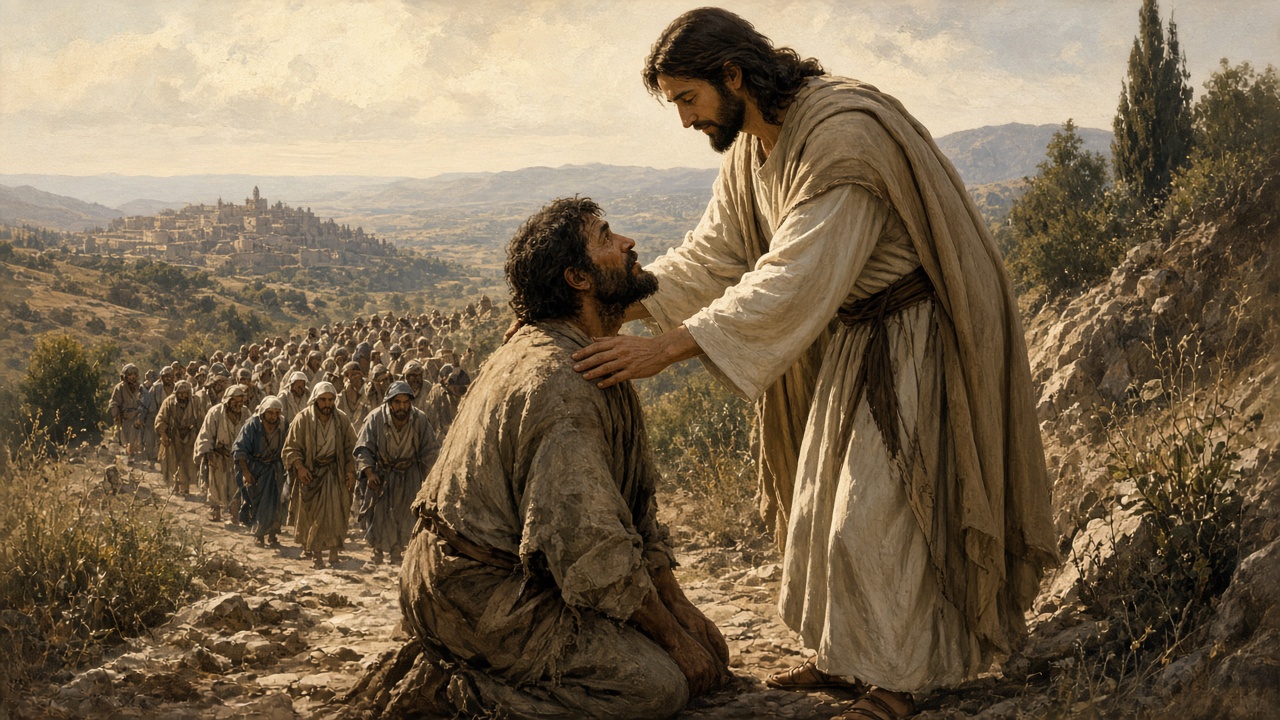
Kaise ek korhia attjha bhail
1Ekare baad Jiesoe pahaar par se oetaral aur djhoend okar pietjhe tjale lagal.
2Tab ek korhia okar paas aaike gaathie par gierke ose bolies: „Prabhoe djie, djab toe maange hai tab toe hamme attjha kar sake hai.” 3Tab Jiesoe aapan haath barhaaike oke tjhoeis aur bolies: „Ham maangiela kie toe attjha hoi dja.” Ohie laage oe manai attjha aur safa hoi gail. 4Oe bhie bolies kie: „Toe koi se koetjh na bataihe. Dja apane ke ekgo agwa ke dekhaaw kie toe attjha hoi gaile hai. Mosas ke hoekoem me to liekhal hai kie djab ekgo korhia phien se attjha hoi gail hai, tab koetjh baliedaan kare ke tjaahie. Ie kaam kar, tab oesab djaan djaaiga kie toe sattje ke attjha hoi gaile hai.”
Jiesoe kaise ek naukar ke attjha karies
5Djab Jiesoe Kaapernaum ke sahar me bhiettar gail, tab okar paas ekgo Roma ke soerdjaatie ke barkwa aail ose koetjh bientie kare aur bolies: 6„Prabhoe djie, hamaar ghare ek naukar loendj hoi gail aur oke bahoet piera hai.” 7Tab Jiesoe poetjhies: „Toe maange hai kie ham aaike oke attjha karie?” Bakie barkwa bolies: 8„Prabhoe djie, ham oe laaik na hai kie aap hamaar ghare aawo. Aap khaalie ek baat bol de, aur hamaar naukar attjha hoi djaaiga. 9Ham aapan barkwa ke nietje hai aur hamaar nietje doesar soerdjaatie hai. Aur djab ham koi ke hoekoem deila: ‘Dja!’ tab oe dja hai. Aur djab ham ek doesar se boliela: ‘Aaw!’ tab oe aawe hai. Aur ek goelaam se boliela: ‘Ie kar!’ tab oe kare hai.”
10Tab Jiesoe ie baat soenke atjambho bhail aur hoewa ke manai log se bolies kie: „Ham satj boliela kie ham Israel me koi ke paas etana barka bieswaas na pailie hai. 11Doenia bhar me se dher doesar djaatie log aaiga aur Israel log ke baap-daada Aabraaham, Iesaak aur Jaakob ke saath swarag ke raadj ke nauta me bhodjan kariega. 12Aur tjaahe Israel ke djaatie log ke pahiela dardja par oe nauta me djaai ke tjaahat, tabbo oelog me se dher log hoewa na djaai paaiga. Oelog bahare andhiaar me khaderal djaaiga. Hoewa par oesab haai-haai karke roi aur daat piesiega.” 13Aur Jiesoe soerdjaatie ke barkwa se bolies kie: „Toe ghare dja. Djaise toe bieswaas kare hai, oisane tor hiettjha poera hoi.” Aur ohie tem par okar naukar attjha hoi gail.
Doesar bemarian
14Djab Jiesoe Petras ke ghare pahoetjal tab dekhies kie okar saas hoewa bokhaar me paral hai. 15Bas oe okar haath pakaries aur bokhaar oke pataai gail. Tab aurat toerant oethke okar sewa kare lagal.
16Oe raat me hoewa ke djanta dher manai log ke Jiesoe ke paas laais djaun ke bhoet pakaries raha. Bas oe ek baat se bhoet-paret ke niekaarke bahaar karies. Aur oe sab bemarian ke bhie attjha kar deis. 17Ie sab kaam ke dwaara Parmeswar ke sanesia Jasaaja ke baat poera bhail. Oe dher dien pahiele bolies raha kie:
„Oe hamlogke bemaarie aapan oeppar lei leis hai,
aur hamlogke doekh kaaties hai.”
Jiesoe ke rasta par tjale ke matlab
18Ek dien Jiesoe djab dekhies kie okar paas ek djhoend manai hai, tab oe aapan tjela log se bolies: „Aaw tjalie samoendar ke oepaar.” 19Tab djaai se pahiele ek dharam ke parhal aadmie okar paas aaike bolies kie: „Maastar djie, tjaahe djaaha toe djaihe, ham tor sanghe tjalab.” 20Tab oe bolies: „Djanaawar log ke biel hai aur tjierai log ke khota, bakie iensaan ke Beta ke ek takia na hai aapan moerie dhare ke.”
21Tab ek tjela ose bienaai karies kie: „Prabhoe djie, hamme djaain deihe djab tak hamaar baap ke mattie na parie.” 22Bakie oe bolies: „Toe hamaar paatjhe tjal. Aur be-bieswaasie logan ke aapan palwaar ke mattie dewan de.”
Aandhie
23Tab Jiesoe ek bot me gail aur okar tjela log okar saathe saath gail. 24Tab etana barka aandhie tjale lagal kie halfa bot me djaai lagal. Aur Jiesoe bot me soetal raha. 25Tab okar tjela log okar paas djaaike oke djagaais aur bolies: „Prabhoe djie! Hamlogke batjaaw! Hamlog doebiela!” 26Tab Jiesoe bolies: „Toelog kaahe ke dera hai? Toelogke bieswaas etana tjhota hai?” Bas oe oethke hauwa aur halfa ke daatke bolies kie: „Roek dja!” Aur paanie ekdam se dhiera hoi gail. 27Tab sab koi atjambho hoike bole lagal kie: „Ie kaisan aadmie hai kie hauwa aur halfa bhie ekar baat maane hai?”
Doei bhoet-paret ke aadmie
28Tab oesabhan samoendar ke habara hoike Gadara des me pahoetjal. Tab hoewa ke kabarsthaan me se doei aadmie oelogke paas aail. Oelogke bhoet pakaries raha aur oelog etana khatarnaak raha kie koi ke hiemmat na raha hoewa paas howe ke. 29Tab oesab tjiellaaike bole lagal kie: „He Parmeswar ke Beta, tose aur hamlogse kaun kaam hai? Toe faisala ke dien se pahiele aile hai hamlogke sataawe ke?”
30Oe tem par koetjh doer me ek barka djhoend soewar tjarat raha. 31Tab bhoet log Jiesoe se bientie kare lagal kie: „Djab toe hamlogke niekariehe tab oe soewar log ke oeppar pathaai deihe.” 32Bas oe bolies: „Dja!” Aur bhoet log oe doeno aadmie ke oeppar se oetarke soewar log ke oeppar tjal gail. Tab oe saara djhoend toerant pahaar par se dhaurke paanie me koed paral aur sab doeb gail.
33Tab soewar ke tjaraawe waalan hoewa se bhaagal. Aur sahar me djaaike sab se bataais soewar log se ka bhail raha aur bhie oe doeno bhoet waala aadmie ke biese me. 34Tab oe sahar bhar ke manai log Jiesoe ke paas gail aur ose bientie karke bolies: „Toe hia se tjal dja.”
¿Sabías que…?
Curaciones, fe y el mar
- Capernaum, la ciudad a la que Jesús entra en este capítulo, era una ciudad de Galilea que no se menciona en el Antiguo Testamento. El Easton's Bible Dictionary (1897) dice que llegó a ser “su propia ciudad” después de que dejó Nazaret, e incluye la súplica del centurión y la curación en la casa de Pedro entre los hechos situados allí.Fuentes: Capernaum · el propio texto bíblico
- Jesús dice que muchos vendrán del oriente y del occidente para compartir el banquete con Abraham, Isaac y Jacob en el reino de los cielos. El Easton's Bible Dictionary (1897) presenta a Abraham como hijo de Taré y heredero de las promesas, a Isaac como el único hijo de Abraham con Sara, y a Jacob —también llamado Israel— como el hijo gemelo menor de Isaac y Rebeca.Fuentes: el propio texto bíblico · Abraham · Isaac · Jacob (Israel)
- Mateo presenta las curaciones de aquella noche como cumplimiento de lo dicho por medio del profeta Isaías: “Él tomó nuestras dolencias y cargó con nuestras enfermedades.” El Easton's Bible Dictionary (1897) identifica a Isaías como hijo de Amoz, que profetizó durante los reinados de Uzías, Jotam, Acaz y Ezequías.Fuentes: el propio texto bíblico · Isaiah
Notas escritas con ayuda de IA a partir de fuentes abiertas (Theographic Bible Metadata, CC BY-SA 4.0; Easton’s Bible Dictionary, dominio público) y revisadas antes de publicarse.
Lugares de este capítulo
- Gadara · Hoy: Umm Qais · 32.656, 35.679 · versículo 28
Solo aparecen lugares identificados con alta confianza (90 % o más según las fuentes académicas reunidas por OpenBible). Mapa de la época: DARE (Digital Atlas of the Roman Empire), CC BY 4.0; mapa actual: © colaboradores de OpenStreetMap; lugares: OpenBible.info (CC BY 4.0).
Créditos y licencia de esta traducción
Parmeswar ke naawa poestak
New Testament in Hindustani, Caribbean (NS:hns:Hindustani, Caribbean)
copyright © 2010 Wycliffe Bible Translators, Inc.
Language: Hindustani, Caribbean
Translation by: Wycliffe Bible Translators, Inc.
Hindustani, Caribbean [hns], Suriname
Copyright Information
© 2010, Wycliffe Bible Translators, Inc. All rights reserved.
This translation text is made available to you under the
terms of the Creative Commons License: Attribution-Noncommercial-No Derivative Works.
( http://creativecommons.org/licenses/by-nc-nd/3.0/ )
In addition, you have permission to port the text to different file formats, as long as you
do not change any of the text or punctuation of the Bible.
You may share, copy, distribute, transmit, and extract portions
or quotations from this work, provided that you include the above copyright
information:
You must give Attribution to the work.
You do not sell this work for a profit.
You do not make any derivative works that change any of the actual words or punctuation of the Scriptures.
Permissions beyond the scope of this license may be
available if you contact
us with your request.
The New Testament
in Hindustani, Caribbean
© 2010, Wycliffe Bible Translators, Inc. All rights reserved.
This translation is made available to you under the terms of the
Creative Commons Attribution-Noncommercial-No Derivatives license 4.0.
You may share and redistribute this Bible translation or extracts from it in any format, provided that:
You include the above copyright and source information.
You do not sell this work for a profit.
You do not change any of the words or punctuation of the Scriptures.
Pictures included with Scriptures and other documents on this site are licensed just for use with those Scriptures and documents.
For other uses, please contact the respective copyright owners.
2014-04-25
Fuente: http://ebible.org/hnsNT/ · eBible.org