Mateo 7
Parmeswar ke naawa poestak · Toca un versículo para ver sus referencias cruzadas.
Doesare ke oeppar faisala na kar
1Doesare ke oeppar faisala na kariehe, tab tor faisala bhie na hoiga. 2Djaise toe doesare ke tauliehe aur napiehe, oisane toe taulal aur naapal djaihe. 3Toe doesare ke aakhie me ke phaitj dekh lewe hai djaun tjhota galtie hai, bakie aapan aakhie me ke laathie ke na dekh paawe hai. 4Djab tor aakhie me ek laathie hai, tab kaise toe aapan bhaai se bol sake hai kie: ‘Laaw ham tor aakhie me ke phaitj niekaar dei’? 5Are, dhokhaabaadj log! Pahiele aapan laathie ke niekaar de, tab toe thiek se dekh paihe okar aakhie ke phaitj ke niekaare ke.
6Pawietr tjiedj koettan ke na deihe, aur aapan nag aur gahana soewar log ke na de, nahie to oesab gor se katjarke aur ghoemke toke tjier-phaar dhaarie.
Parmeswar hamlogke praatna soene hai
7Praatna kar, tab toke mielie. Khodj, tab toe paihe. Aur khoet-khoetaaw, tab tor khaat kholal djaaiga. 8Dje praatna karat rahie, oke mieliega. Dje khodjat rahie, oe paaiga. Aur dje khoet-khoetaawat rahie, okar khaat kholal djaaiga. 9Djab tor larka tose bret maangie tab toe oke thoro ieta deihe? 10Aur djab oe matjharie maangie tab toe oke thoro saap deihe? 11Manai logan kharaab hai aur tabbo aapan larkan ke attjha tjiedj djaane hai dewe. Bakie tor swarag ke Pieta poera hai. Tab djab koi ose koetjh praatna karke maange hai tab oe ketana djaada attjha tjiedj deiga!
12Djaise toe maange hai kie manai log tor sanghe rahe, oisane toe oesabke sanghe rahoe. Ie Mosas ke aur bhie Parmeswar ke doesar sanesia log ke baat tjhota roep me hai.”
Doei rasta
13Jiesoe bolies: „Djaun phaatak dwaara aur rasta ke alang toe barbaad hoi djaihe, oesab tjaura aur tjakala hai. Aur bahoet log opar tjale hai. Bakie djaun phaatak aur rasta se toe sattja djiewan paihe, oesab tjhota aur paatar hai. Aur dher manai log oe rasta na paawe hai. Ohie se paatar phaatak me se Parmeswar ke raadj me bhiettar dja.
Naklie sanesia
15Naklie sanesia log se batjaaike rahiehe. Oesab djaise ek bhola-bhaala bhera dekha hai, bakie sattje me djaise ek bara khatarnaak djanaawar hai. 16Ek per aapan phal se pahietjaanal dja hai, oisane toelog naklie sanesia log ke oesabke tjaal-tjalan se pahietjaan paihe. Toe ek kaata ke per me se thoro aam kie to amroed toer sake hai? 17Aisane ek attjha per attjha phal dewe hai aur ek kharaab per kharaab phal. 18Ekgo barhia per kharaab phal na dei sake hai, aur ek kharaab per barhia phal na dei sake hai. 19Har ek per djaun barhia phal na dewe hai, oe kaatke aagie me djaraai dewal djaaiga. 20Aisane toelog sanesia log ke tjaal-tjalan se pahietjaan djaihe kie oesab Parmeswar ke baat satj bataawe hai kie na.
21Tjaahe dher manai log hamme Prabhoe bolaawe hai, tabbo na sab koi Parmeswar ke raadj me djaaiga. Khaalie dje hamaar swarag ke Pieta ke man waala kare hai, oe Parmeswar ke raadj me bhiettar djaai sake hai. 22Oe dien djab sab koi ke faisala karal djaaiga, tab dher log hamse boliega kie: ‘He Prabhoe, hamlog tor naam se sanesa pathailie. Aur hamlog tor naam se to bhoet log ke niekarlie aur atjambho kaam karlie.’ 23Bakie ham oelogse kholke bol deb kie: ‘Toelog hamaar sanesia na rahiele. Toelog khaalie aapan man waala karle. Hamaar lage se tjal dja!’
Doei rakam ke djiewan
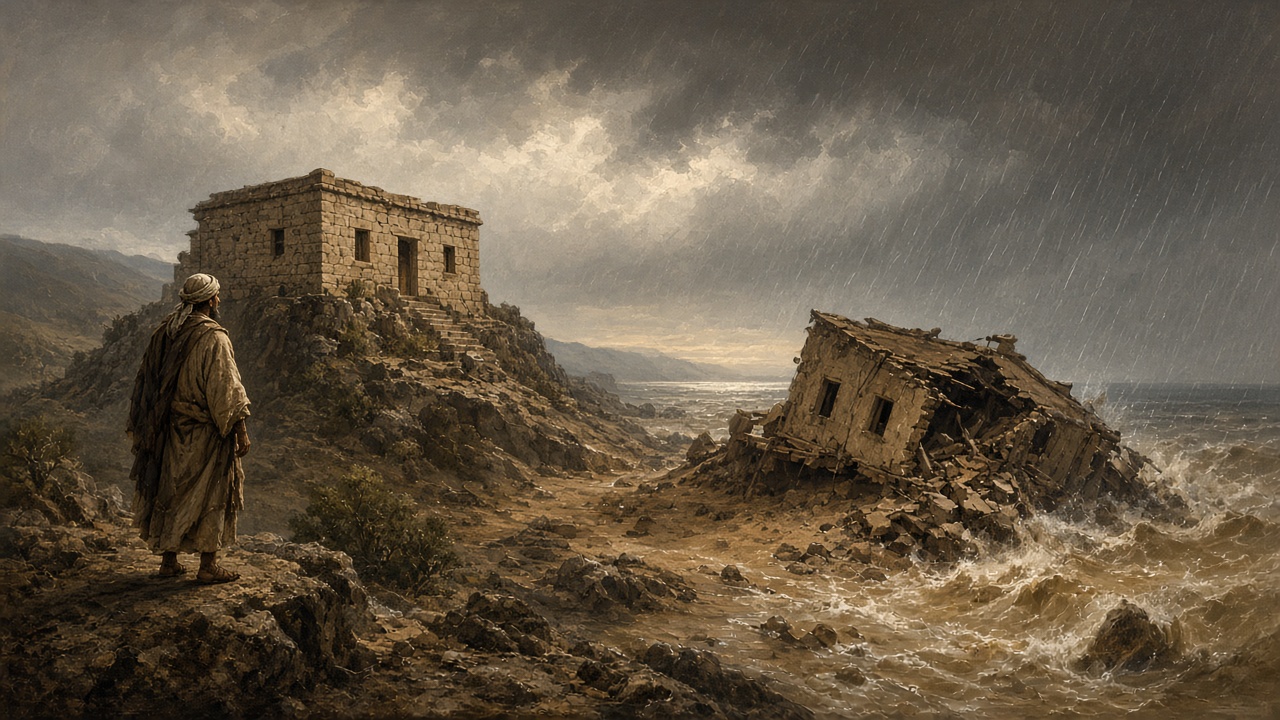
24Har ek djaun hamaar baat soenke kare hai, oe samadjhdaar hai djaise ek manai djaun aapan ghar ek barka patthar par banaais. 25Tab barkha djor se barse lagal aur nadie tjahar gail aur hauwa kaske tjale lagal. Bakie oe ghar to patthar par banaawal raha, ohie se oe na gieral.
26Bakie djab koi hamaar baat khaalie soene hai aur na kare hai, tab oe bhoettjar hai djaise ek manai djaun aapan ghar santie par banaais. 27Tab barkha djor se barsal aur nadie tjahar gail aur hauwa kaske tjale lagal. Aur oe ghar gierke ekdam se naas hoi gail.”
Manai log kaise Jiesoe ke baare me sotje hai
28Djab Jiesoe ie sab baat partjaar kar tjoekal raha tab manai log ie baat soenke bahoet atjambho bhail. 29Oe to na dharam ke parhal waalan ghat siekhaawat raha, bakie Parmeswar ke hoekoem se.
¿Sabías que…?
El juicio, el camino angosto y un fundamento firme
- El registro del acontecimiento fecha el inicio del Sermón del Monte en el año 28 d. C. y su duración en un día. Este capítulo termina con las multitudes asombradas de la enseñanza de Jesús, porque él enseñaba como quien tiene autoridad, y no como sus escribas.Fuentes: Sermon on the Mount · el propio texto bíblico
- Jesús advierte que el juicio que alguien pronuncia, y la medida que esa persona usa, se volverán contra ella. Describe a alguien que nota la paja en el ojo de su hermano, pero no advierte la viga en el propio, y dice que la viga debe quitarse primero.Fuentes: el propio texto bíblico
- El capítulo llama esencia de la Ley y los Profetas hacer a los demás lo que uno querría que le hicieran. Contrasta una puerta ancha y un camino espacioso que lleva a la destrucción, por el que entran muchos, con una puerta pequeña y un camino angosto que lleva a la vida, que pocos hallan, y compara oír estas palabras y ponerlas en práctica con una casa edificada sobre la roca y no sobre la arena.Fuentes: el propio texto bíblico
Notas escritas con ayuda de IA a partir de fuentes abiertas (Theographic Bible Metadata, CC BY-SA 4.0; Easton’s Bible Dictionary, dominio público) y revisadas antes de publicarse.
Créditos y licencia de esta traducción
Parmeswar ke naawa poestak
New Testament in Hindustani, Caribbean (NS:hns:Hindustani, Caribbean)
copyright © 2010 Wycliffe Bible Translators, Inc.
Language: Hindustani, Caribbean
Translation by: Wycliffe Bible Translators, Inc.
Hindustani, Caribbean [hns], Suriname
Copyright Information
© 2010, Wycliffe Bible Translators, Inc. All rights reserved.
This translation text is made available to you under the
terms of the Creative Commons License: Attribution-Noncommercial-No Derivative Works.
( http://creativecommons.org/licenses/by-nc-nd/3.0/ )
In addition, you have permission to port the text to different file formats, as long as you
do not change any of the text or punctuation of the Bible.
You may share, copy, distribute, transmit, and extract portions
or quotations from this work, provided that you include the above copyright
information:
You must give Attribution to the work.
You do not sell this work for a profit.
You do not make any derivative works that change any of the actual words or punctuation of the Scriptures.
Permissions beyond the scope of this license may be
available if you contact
us with your request.
The New Testament
in Hindustani, Caribbean
© 2010, Wycliffe Bible Translators, Inc. All rights reserved.
This translation is made available to you under the terms of the
Creative Commons Attribution-Noncommercial-No Derivatives license 4.0.
You may share and redistribute this Bible translation or extracts from it in any format, provided that:
You include the above copyright and source information.
You do not sell this work for a profit.
You do not change any of the words or punctuation of the Scriptures.
Pictures included with Scriptures and other documents on this site are licensed just for use with those Scriptures and documents.
For other uses, please contact the respective copyright owners.
2014-04-25
Fuente: http://ebible.org/hnsNT/ · eBible.org